A new paper shows that earlier studies of the peppered moth are “completely correct” — the moths evolved darker coloration via natural selection to better camouflage themselves during the height of the Industrial Revolution, then evolved back to their natural, mottled black-and-white color as air quality improved.
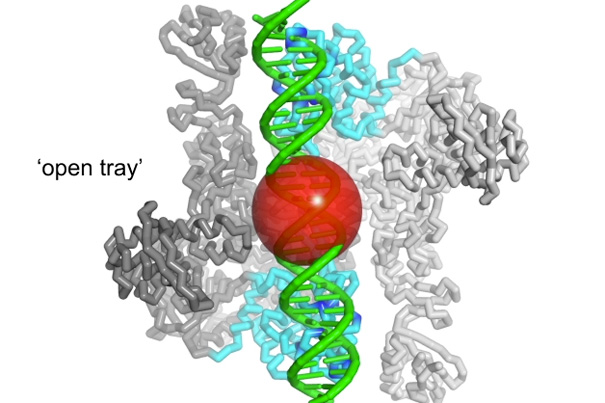
As reported in the online version of Nature Structural & Molecular Biology on Feb. 5, researchers have produced 3-D images of the protein system that works to repair DNA. The images reveal that the proteins can actually alter their shape in what amounts to a genetic “pat-down,” or a way for the mechanism to identify areas of the genetic code that need repair.
A team of researchers, led Harvard Professor David I. Laibson and Christopher F. Chabris of Union College, has found that virtually all claims that intelligence is associated with specific genes are wrong.
Children in the U.S. whose activity choices, interests, and pretend play before age 11 fall outside those typically expressed by their biological sex face increased risk of being physically, psychologically, and sexually abused, and of suffering from post-traumatic stress disorder (PTSD) by early adulthood, according to a new study led by researchers at Harvard School of Public Health.
In a preview of what is likely now playing out in a closed-door meeting of the World Health Organization, a cadre of experts on infectious disease gathered Feb. 15 at the Harvard School of Public Health (HSPH) to debate whether efforts to combat a deadly form of flu have actually increased the risk to public health.
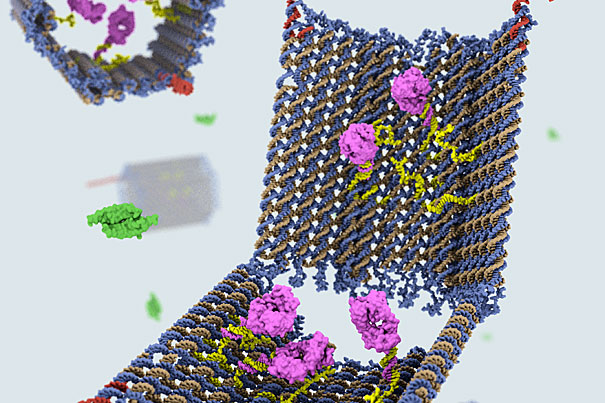
Researchers at the Wyss Institute for Biologically Inspired Engineering at Harvard University have developed a robotic device made from DNA that could potentially seek out specific cell targets within a complex mixture of cell types and deliver important molecular instructions, such as telling cancer cells to self-destruct or programming immune responses.
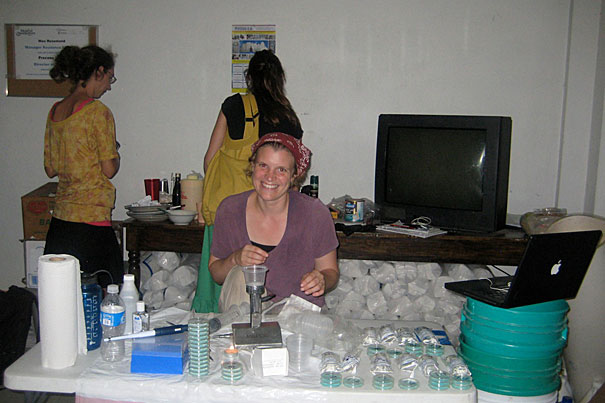
Kennedy School Fellow Daniele Lantagne is using her engineering background to expand on a program, partially developed by Professor Michael Kremer, to provide clean water to communities in rural areas. The soluti
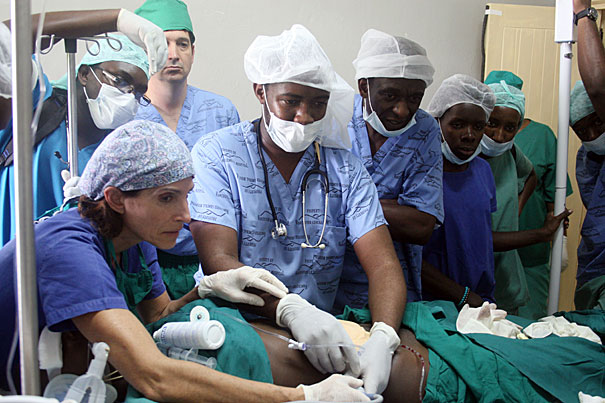
A collaboration between anesthesiologists at Massachusetts General Hospital and overworked doctors at an African hospital provides training in a technique that can soothe patients during surgical recoveries.
Scientists at Dana-Farber Cancer Institute have identified a subtype of ovarian cancer able to build its own blood vessels, suggesting that such tumors might be especially susceptible to “anti-angiogenic” drugs that block blood vessel formation
For roughly 2,000 years, Chinese herbalists have treated malaria using a root extract, commonly known as chang shan, from a type of hydrangea that grows in Tibet and Nepal. More recent studies suggest that halofuginone, a compound derived from this extract’s bioactive ingredient, could be used to treat many autoimmune disorders as well. Now, researchers from the Harvard School of Dental Medicine have discovered the molecular secrets behind this herbal extract’s power.
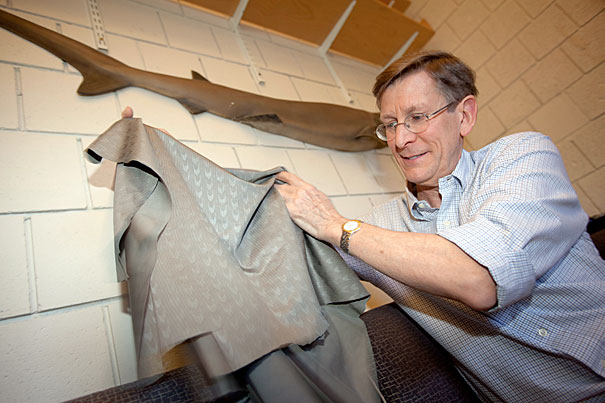
Experiments conducted in a Harvard lab reveal that, while sharks’ sandpaperlike skin does allow the animals to swim faster and more efficiently, the structure of some high-tech swimsuits has no effect when it comes to reducing drag as swimmers move through the water.
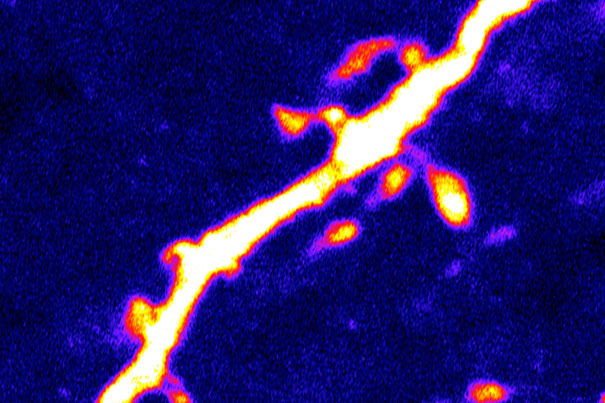
Synaptic plasticity — the ability of the synaptic connections between the brain’s neurons to change and modify over time — has been shown to be a key to memory formation and the acquisition of new learning behaviors. Now research reveals that the neural circuits controlling hunger and eating behaviors are also controlled by plasticity.
Researchers in a Harvard lab have developed a device, dubbed LADY GAGA, that allows them for the first time to precisely control airborne scents. They have used the device in their work unraveling how animals make navigational decisions based on their environment.
A study by Harvard-affiliated Dana-Farber Cancer Institute finds that most terminally ill cancer patients discuss end-of-life care with physicians but that such discussions often occur late in their illness.
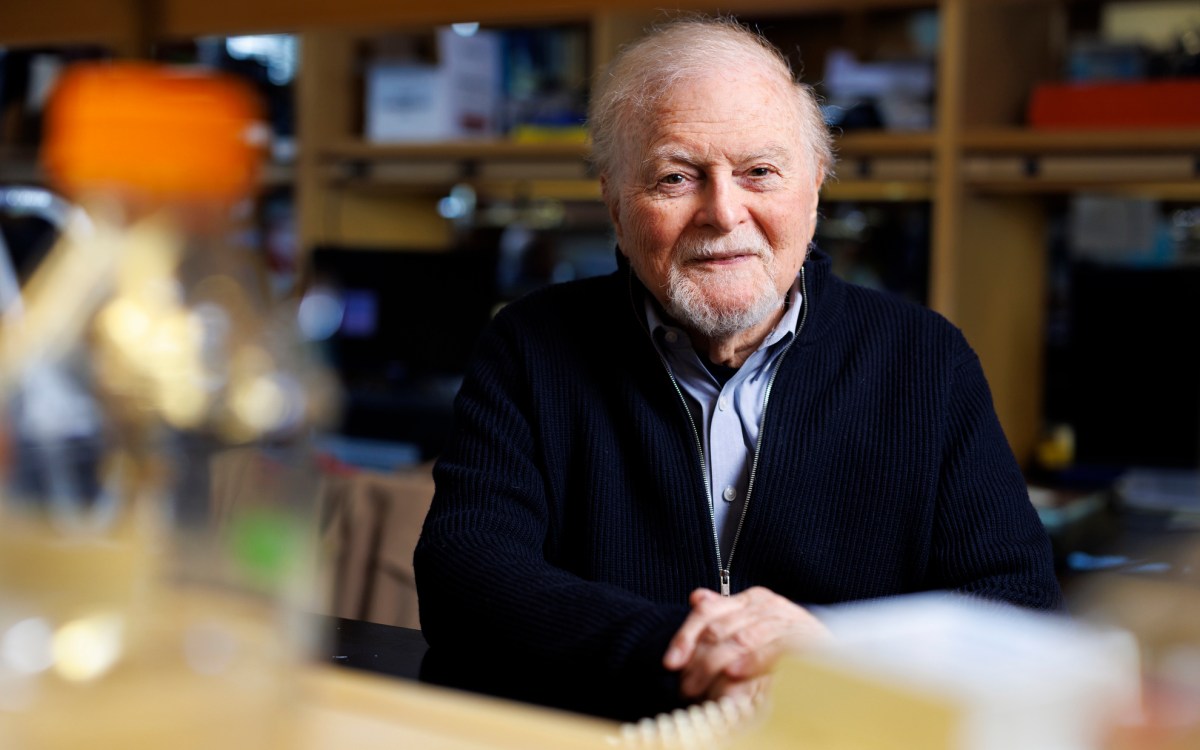
As science wrestles with the problem of how life arose on Earth, hindsight shows that seemingly intractable obstacles can have simple, even elegant solutions, said Nobel laureate Jack Szostak.
Biophysicist Aravinthan Samuel has developed new techniques to monitor and influence the behavior of roundworms to learn how their basic nervous systems work, a first step to understanding the circuitry in more complex creatures, like humans.
Harvard researchers have been at the forefront of many battles against devastating diseases, leading pivotal breakthroughs against scourges from 1800 to the present.
Now 74 years young, the Harvard Study of Adult Development continues to yield a treasure trove of data about how people behave, and change — including predictions of strong indicators to a happy life.
The Eli and Edythe L. Broad Institute of Harvard and MIT today announced that it has received a $32.5 million grant from the Boston-based Klarman Family Foundation to support a new collaborative effort focused on deciphering how human cells are wired.
Perfluorinated compounds (PFCs), widely used in manufactured products such as non-stick cookware, waterproof clothing, and fast-food packaging, were associated with lowered immune response to vaccinations in children in research led by Philippe Grandjean of the Harvard School of Public Health.
Dozens of Harvard undergraduates started the year with a new emphasis on wellness, thanks to the Optimal Health program. With presentations from a lifestyle medicine consultant, a nutritionist, a personal trainer, a sleep specialist, and a stress manager, Optimal Health emphasized prevention and fitness.
Color-coded food labeling and adjusting the way food items are positioned in display cases encouraged healthy choices in a large hospital cafeteria in a study by MGH researchers.
Harvard scientists have developed the fullest picture yet of how neurons in the brain interact to reinforce behaviors that range from learning to drug use, a finding that could open the door to new treatments for addiction.
A new study from Harvard-affiliated Beth Israel Deaconess Medical Center finds that a group of little-explored cells in the tumor microenvironment likely serves as an important gatekeeper against cancer progression and metastasis.
Nutrition experts at HSPH and chefs and dietitians at the Culinary Institute of America have developed five muffin recipes that incorporate healthy fats and whole grains, and use a lighter hand on the salt and sugar.
Research collaboration between the Wyss Institute for Biologically Inspired Engineering at Harvard University and Children’s Hospital Boston has developed “smart” injectable nanotherapeutics that can be programmed to selectively deliver drugs to the cells of the pancreas.
A team led by researchers at Harvard-affiliated Dana-Farber Cancer Institute has isolated a natural hormone from muscle cells that triggers some of the key health benefits of exercise.
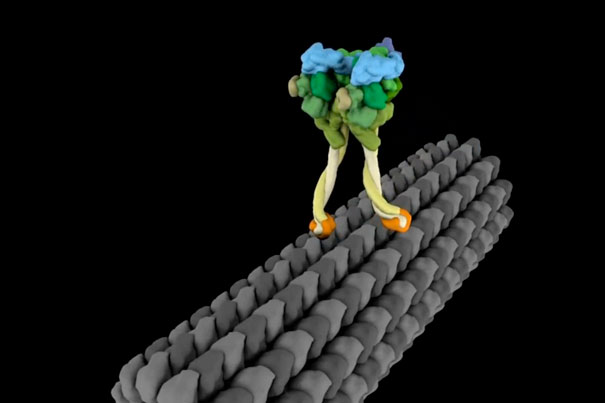
Harvard researchers have found that a tiny motor inside of us called dynein, one tasked with shuttling vital payloads throughout the cell’s intricate highway infrastructure, staggers, which is quite contrary to the regular, efficient poise of its fellow motors.

 Featured series