
 Featured series

Tag: Iraq
-
Nation & World
Power of photography
Pulitzer Prize-winning photojournalist gave the Houghton Library’s Philip and Frances Hofer Lecture on the Art of the Book.
-
Nation & World
Dangers lurk in wake of U.S. pullout in Afghanistan
The shrinking U.S. Mideast presence and a growing Chinese influence are a bad mix, scholars say at a Harvard panel.
-
Nation & World
Animal encounters on the battlefield
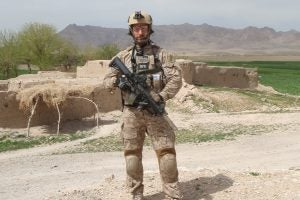
At Radcliffe, Navy veteran Mackin is at work on his next series, “Animals,” featuring a selection of stories left out of his first collection, many inspired by the animals he came across while on duty with a SEAL team in Afghanistan and Iraq.
-
Nation & World
Flight from reason
In his new book, “How America Lost Its Mind: The Assault on Reason That’s Crippling Our Democracy,” Thomas Patterson looks at the rejection of logic and reason in American political life and how it threatens Democracy.

-
Nation & World
Nadia Murad: The making of an activist
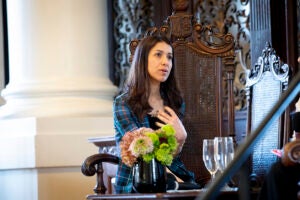
Nadia Murad came to Harvard as a survivor of genocide under ISIS, an advocate for victims of sexual violence, and the first Iraqi citizen to win the Nobel Peace Prize. Her talk focused on her personal journey and how her ordeal turned her into an activist.
-
Nation & World
Carter: Islamic State will be defeated
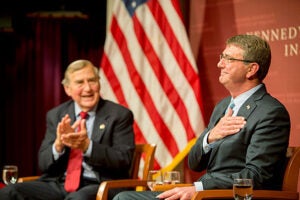
U.S. Secretary of Defense Ashton Carter spoke about the ongoing war with Islamic State and touted the many public service opportunities in the military for students, even if they don’t envision a career on the battlefield.
-
Nation & World
An inside view from Powell, complete with regrets
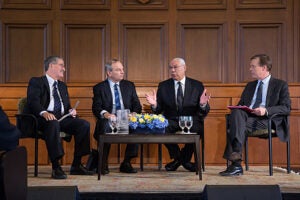
Retired four-star general and former Secretary of State Colin L. Powell expanded on the “intensely human experience” of high-level negotiations in a conversation at HLS.
-
Nation & World
Breaking down the Middle East
Harvard experts assess the rolling waves of violence and political upheaval across much of the Middle East and North Africa.
-
Nation & World
A price too high
The Atlantic’s Jeffrey Goldberg talks about how the Islamic State has fundamentally changed the nature of Middle East war coverage.
-
Nation & World
The rise of ISIS
A question-and-answer session with political scientist Harith Hasan al-Qarawee on the rise of the Sunni extremist group the Islamic State in Iraq and Syria (ISIS).
-
Nation & World
The human toll of war
Members of human rights organizations gathered at Harvard Law School to reflect on the lasting impact of the wars in Iraq and Afghanistan.
-
Nation & World
How to build a nation
While the structures of state can be created by outsiders, national identities can only be created from within, and they commonly arise through shared language, culture, history, and ideals, political theorist Francis Fukuyama says.
-
Nation & World
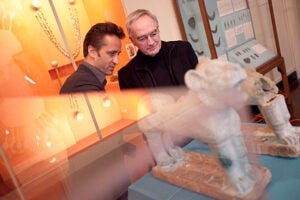
An ancient statue, re-created
Harvard’s Semitic Museum is employing a high-tech response to the destruction of 3,300-year-old figures, using 3-D scanning to repair a ceramic lion that was damaged by the Assyrians.
-
Nation & World
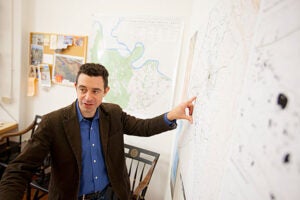
Ancient Iraq revealed
Jason Ur, the John L. Loeb Associate Professor of the Social Sciences, earlier this year launched a five-year archaeological project — the first such Harvard-led endeavor in the war-torn nation since the early 1930s — to scour a 3,200-square-kilometer region around Irbil, the capital of the Kurdish region in northern Iraq, for the signs of…
-
Nation & World
Signs of progress against PTSD
A decade after the start of the wars in Afghanistan and Iraq, studies have shown that the incidence of post-traumatic stress disorder (PTSD) among troops is surprisingly low, and a Harvard researcher credits the drop, in part, to new efforts by the Army to prevent PTSD, and to ensure that those who develop the disorder…
-
Nation & World
From Iraq and back, via 9/11 and Harvard
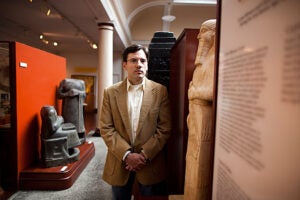
A Harvard authority on ancient Iraq spent several years studying clay tablets looted from that nation, which had been stored in a World Trade Center building that was destroyed on 9/11. The tablets eventually were retrieved, restored, translated, and returned.
-
Nation & World
‘Why do they hate us?’
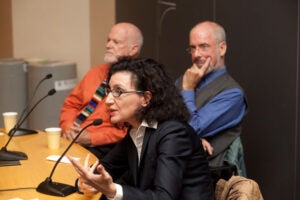
The 9/11 terrorist attacks caused Americans to awaken to the disdain for the nation held by some overseas. It also brought harsh attention to U.S. Muslims and mobilized the nation toward actions it may one day rue, experts said at a panel discussion.
-
Nation & World
History shines through the glass
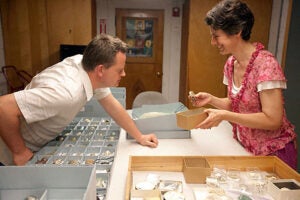
Researchers are examining the Harvard Semitic Museum’s collection of ancient glass for clues about the people who made it and their interactions with other societies through trade.
-
Nation & World
The humanities and war
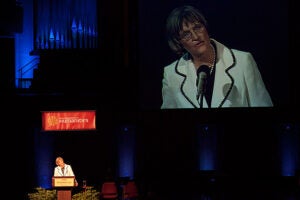
Harvard President Drew Faust delivered the 2011 Jefferson Lecture in the Humanities, citing similarities between the Civil War and current conflicts.
-
Nation & World
Celebrating the humanities
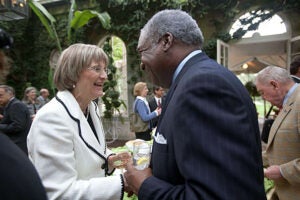
If scholars were celebrities, life might look a little bit like it does on the day of the annual Jefferson Lecture (May 2), with interviews and toasts in anticipation not of a concert or play but a speech on the humanities.
-
Nation & World
Harvard honors veterans
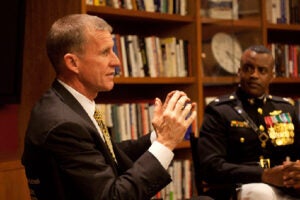
In what is believed to be the largest gathering of uniformed students at the University since Winston Churchill spoke on campus in 1943, more than 170 Harvard veterans from all the service branches gathered at Cambridge’s Sheraton Commander Hotel April 25 for a dinner honoring students who have served in Afghanistan and Iraq.
-
Nation & World
Warrior spirit
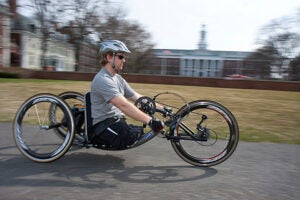
Five years ago, Andrew Kinard lost his legs in Iraq. After 75 surgeries, he’s tackling other big goals, from a Harvard education to the Boston Marathon.
-
Nation & World
Cutting the military’s energy tether
Fueling America’s war effort is an expensive proposition, costing not only money but lives, since supply convoys are routinely attacked. The constraints imposed by an energy-hungry military prompted the Defense Department to investigate conservation techniques.
-
Nation & World
Not so different after all
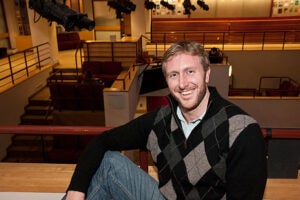
Marines in Iraq, students at Harvard are alike in wondering: Where do their lives go next?
-
Nation & World
Back from Afghanistan
A veteran, now a midcareer student at the Harvard Kennedy School, reflects on the values that his military peers bring to campus. Still, when a sharp noise splits the air, he ducks.

-
Nation & World
The hard way
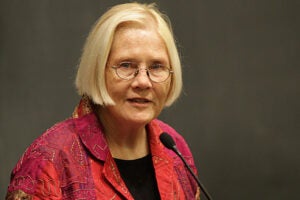
Four people who risked their careers and even their lives to stand on principle shared their stories in an event sponsored by the Carr Center for Human Rights.
-
Nation & World
A friend in the Middle East
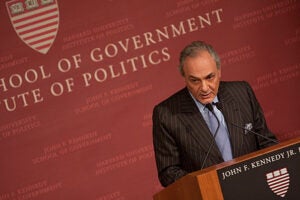
If American leaders want help disentangling — and possibly even solving — complex problems in the Middle East, they should look to Saudi Arabia for leadership, said Prince Turki Al Faisal, former ambassador to the United States, in a talk at the Harvard Kennedy School’s Institute of Politics on Friday (Nov. 19).
-
Nation & World
Unseen victims of war
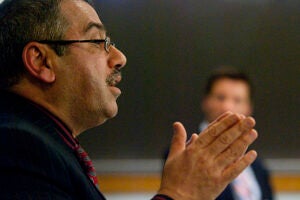
Mental health ailments are widespread among Iraqi children and teenagers, a problem compounded by a lack of mental health treatment facilities and inattention to the problem, an Iraqi psychiatrist says.
-
Nation & World
Getting a bird’s-eye view of the past
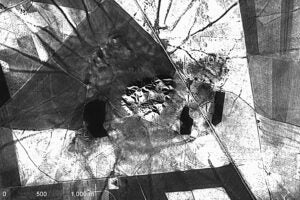
The archaeological work of Harvard students, using satellite photos to locate ancient structures, is on display at the Peabody Museum of Archaeology and Ethnology.
-
Nation & World
Business Schools Tap Veterans
Five years ago, Augusto Giacoman was commanding about 30 soldiers and leading raids in Iraq. Now he spends his days in classrooms alongside former bankers, engineers and other civilians earning a master’s in business administration.