Max Bazerman, a leadership and applied behavioral psychology expert at HKS and HBS, writes that successful leaders must seek out what they don’t know to overcome the human tendency to turn a blind eye to unethical behavior.
A question-and-answer session with political scientist Harith Hasan al-Qarawee on the rise of the Sunni extremist group the Islamic State in Iraq and Syria (ISIS).
Economist Lawrence Summers and foreign policy expert Graham Allison talk about lessons learned from a Chinese research team’s comparison of the conditions around the Great Depression and the recession of 2008.
A new analysis of four blended-format courses taught last fall offers practical guidance for faculty members interested in fresh pedagogical approaches. The pilot study led by the Bok Center for Teaching and Learning placed a premium on person-to-person interaction, and found redundancies between in-class and online instruction.
Harvard Business School’s John A. Davis, who chairs the Families in Business program, talks about the struggles that companies like New England grocery chain Market Basket face when family members are at the helm.
Urban demographic patterns in the United States often defy logic, but a new research paper co-authored by Harvard Kennedy School Professor Edward Glaeser is shedding light on why many Americans continue to move to cities that are on the downturn.
Following the July 9 airstrikes, Stephen M. Walt, the Robert and Renee Belfer Professor of International Affairs at the Harvard Kennedy School, discusses the factors behind this latest outbreak of violence between Israel and Palestine and what the international community can do about it.
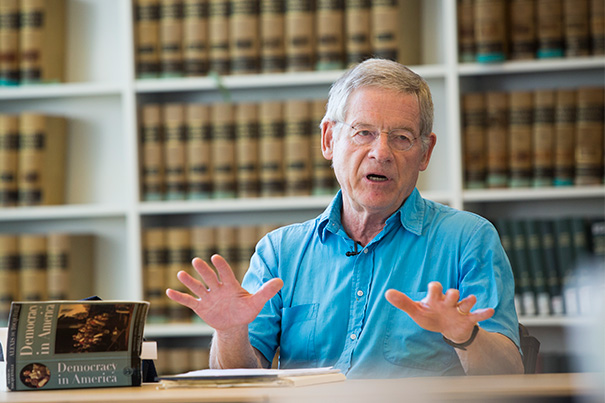
Harvard President Drew Faust welcomed to campus the Warrior-Scholar Project, an academic boot camp for veterans thinking of applying to college, while Professor Harvey C. Mansfield Jr. introduced the students to the two works he considers seminal to understanding American politics.
Edward Glaeser, an economics, government, and public policy expert at Harvard Kennedy School, and Jerold Kayden, an urban planning and design professor at the Graduate School of Design, discuss findings from a new Brookings Institution study on the rise of innovation districts across the nation.
In this edition of the EdCast, Harvard Graduate School of Education senior lecturer Richard Weissbourd discusses the findings in the recent report, “The Children We Mean to Raise.” What messages are adults sending children without even knowing it?
For the past several years, Mary Brinton, Radcliffe fellow and chair of Harvard’s sociology department, and a team of collaborators have been exploring declining fertility rates in postindustrial societies.
A question-and-answer session probes the U.S. Supreme Court’s ruling that for-profit companies can object to the Affordable Care Act’s contraception mandate on religious grounds.
In a question-and-answer session, Harvard Divinity School’s Francis X. Clooney discusses how Christian advocates and opponents of the death penalty turn to Scripture for support of their positions.
Collaboration and inclusion, even of political opponents, is critical to forging successful health policy, former Massachusetts Gov. Michael Dukakis told a group of health ministers from around the world gathered at Harvard.
In a question-and-answer session, Linda Bilmes, the Daniel Patrick Moynihan Senior Lecturer in Public Policy at Harvard Kennedy School, discusses how to fix serious shortcomings in the management of Veterans Affairs.
Harvard Business School’s disruptive innovation guru Clayton Christensen uses crowdsourcing to accelerate the evolution of his latest theory on corporate investment decisions.
The President’s Innovation Fund for International Experiences is supporting development by faculty members of courses in Sweden, Mexico, Turkey, Shanghai, and other locations abroad to enhance the international experiences offered to Harvard students.
Ronald S. Sullivan Jr., a clinical law professor and director of the Criminal Justice Institute at Harvard Law School, talks about U.S. crime and incarceration policies that have led to an unprecedented rate of mass imprisonment. He also discusses the reforms that might reverse that upward trend.
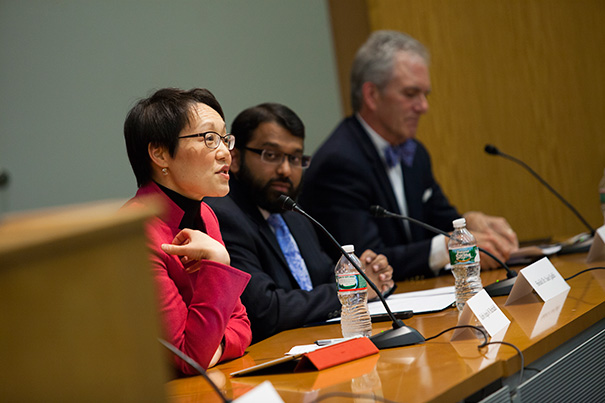
Rabbi Angela W. Buchdahl, senior rabbi-designate at New York City’s Central Synagogue; Sheik Yasir Qadhi, dean of academic affairs at the Al-Maghrib Institute; and the Rev. J. Brent Walker, executive director of the Baptist Joint Committee for Religious Liberty, gathered for a discussion on the role of religion in public life.

 Featured series


 Podcast