Featured series

Tag: Psychology
-
Health
3 ways to strengthen a child’s mental resilience
New study suggests practical strategies to help children through a pandemic.

-
Work & Economy
A key inflation index leaps. Getting worried?
Economist Kenneth Rogoff discusses how consumers’ perceptions about inflation are an important factor that influences inflationary cycles.

-
Campus & Community
The evolution of bigotry
James H. Sidanius devoted much of his career to social justice and racial equality.
-
Campus & Community
An instrumental scientist
Jerome Kagan taught at Harvard for 36 years. He died May 10.
-
Campus & Community
5 faculty members named Harvard College Professors
Five faculty members join the ranks of Harvard College Professors.

-
Health
How spanking may affect brain development in children
Spanking may affect a child’s brain development in ways similar to more severe forms of violence, according to a new study led by Harvard researchers.
-
Science & Tech
What prompted Capitol rioters to violence?
The Jan. 6 attack on the U.S. Capitol over Donald Trump’s election loss stunned the country and forced many to ask what prompts people to political violence.

-
Nation & World
Lessons for the season of giving
Harvard psychologists who study charitable giving launched a new donation platform to examine what motivates people to give more effectively.

-
Science & Tech
Frère Jacques, are you sleeping?
Researchers at Harvard’s Music Lab have determined that American infants relaxed when played lullabies that were unfamiliar and in a foreign language.

-
Health
Childhood trauma can speed biological aging
Childhood violence and trauma has a direct effect on a person’s mental and physical health as they grow, with certain kinds of trauma also affecting the pace of aging.
-
Health
3 takes on dealing with uncertainty
In these volatile times, three Harvard professors share insights from their fields on how to handle uncertainty.

-
Campus & Community
The way we live now
One Harvard student describes what life is like on a deserted campus while another shares his experience going home and the adjustments the followed.
-
Campus & Community
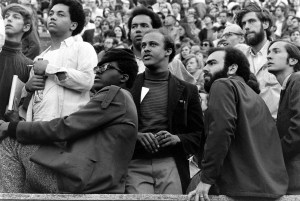
African and African American Studies at 50
Influential, groundbreaking African and African American Studies Department at Harvard turns 50.
-
Nation & World
Unlearning racial bias
Miao Qian, a postdoctoral research fellow with the Inequality in America Initiative, studies the development of implicit racial biases in children to understand better how and when unconscious prejudices and stereotypes form in the brain.

-
Arts & Culture
Music everywhere
Scientists at Harvard published a study on music as a cultural product, which examines what features of song tend to be shared across societies.

-
Nation & World
Targeting incest and promoting individualism
Harvard Professor Joseph Henrich and a team of collaborators researched how a Roman Catholic Church ban in the Middle Ages loosened extended family ties and changed values and psychology of individuals in the West.
-
Science & Tech
Playing our song
Samuel Mehr has long been interested in questions of what music is, how music works, and why music exists. To help find the answers, he’s created the Music Lab, an online, citizen-science project aimed at understanding not just how the human mind interprets music, but why music is a virtually ubiquitous feature of human societies.
-
Campus & Community
One thing to change: Anecdotes aren’t data
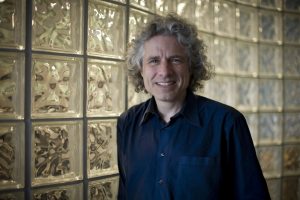
Steven Pinker, the Johnstone Family Professor of Psychology, points to a number of instances where the use of anecdotes over data creates a false narrative.
-
Nation & World
Pros at the con
Psychologist Maria Konnikova ’05, who studies the workings of con artists, talks about what underlies some recent pop culture scams and why we’re so fascinated by stories about them.

-
Science & Tech
Radcliffe scholar tracks squirrels in search of memory gains
Radcliffe Fellow Lucia Jacobs hopes to gain insights on human memory from her work with squirrels.

-
Health
Ellen Langer’s state of mindfulness
Professor Ellen Langer once apologized when she bumped into a mannequin, the kind of automatic, mindless response she says robs us of the benefits of being mindfully engaged in day-to-day…

-
Science & Tech
How to defend against your own mind
Harvard psychology chair Mahzarin Banaji is working with a research fellow to launch a new project called “Outsmarting Human Minds.”
-
Science & Tech
Research may provide the tools to create better schools
Harvard and MIT study reveals that cognitive science field experiments are critical to understanding human learning and education.
-
Campus & Community
Lessons of self-care, while caring for others
Cheryl A. Giles, the Francis Greenwood Peabody Senior Lecturer on Pastoral Care and Counseling, has been counseling and educating young people for more than 30 years.
-
Health
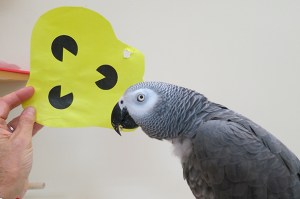
The parrot knows shapes
Despite a visual system vastly different from that of humans, tests showed the bird could successfully identify both Kanizsa figures and occluded shapes. The findings suggest that birds may process visual information in a way that is similar to humans.
-
Health
Against suicide, a century of little progress
Matthew Nock, a psychology professor, talked to the Gazette about a recent federal report showing a sharp rise in suicide in the United States.

-
Science & Tech
For groups in conflict, genes matter
Visiting professor Sasha Kimel examined whether information about genetic links can influence groups in conflict.
-
Campus & Community
Ellen Langer joins group of geniuses
Ellen Langer, professor of psychology, is among the 2016 recipients of the Liberty Science Center Genius Awards.

-
Science & Tech
Study that undercut psych research got it wrong
A study last year claiming that more than half of all psychology studies cannot be replicated turns out to be wrong. Harvard researchers have discovered that the study contains several statistical and methodological mistakes, and that when these are corrected, the study actually shows that the replication rate in psychology is quite high.
-
Nation & World
Bent toward violence
Harvard psychiatrist Ronald Schouten answers questions on the San Bernardino attack and the psychology behind both terrorism and the fear it spreads.