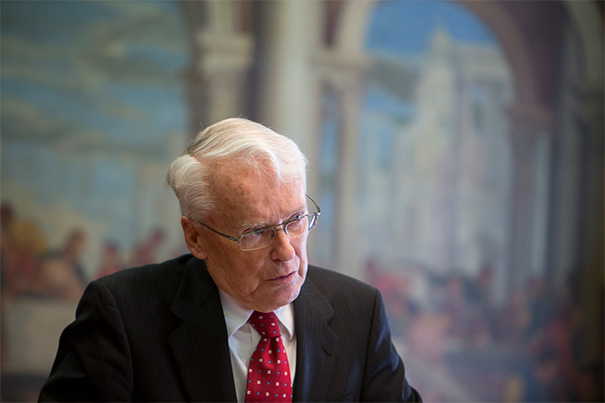
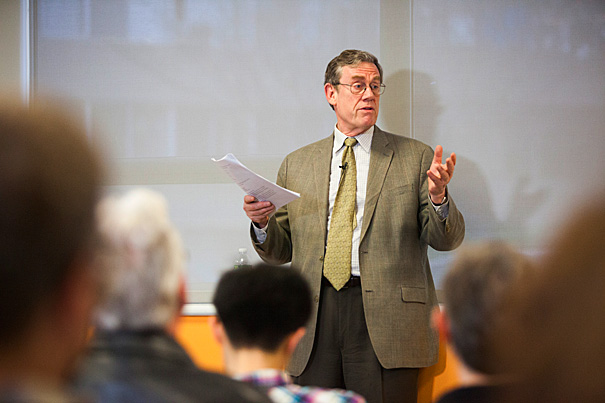
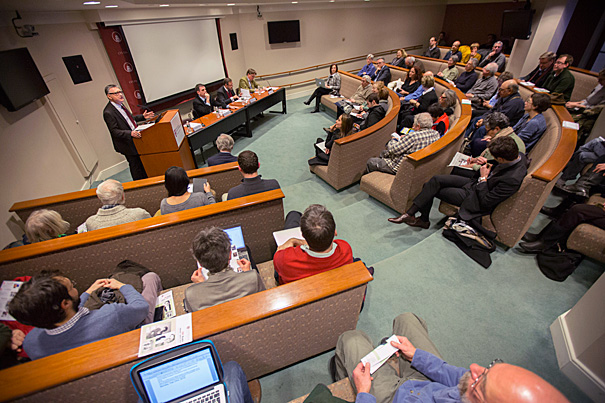
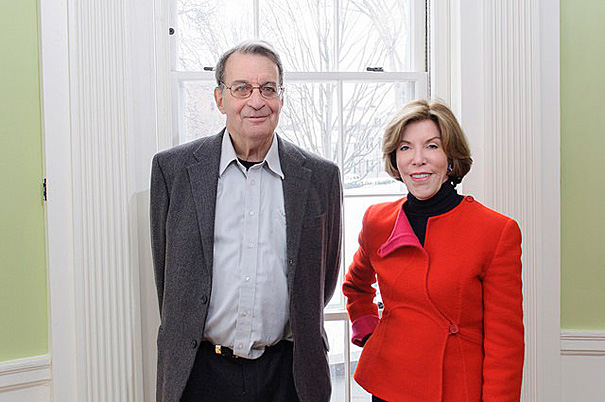
The Rev. Clark Olsen, S.T.B. ’59, who witnessed the 1965 Selma, Ala., murder that accelerated passage of the Voting Rights Act, launched a two-day Harvard look back at the Civil Rights era.
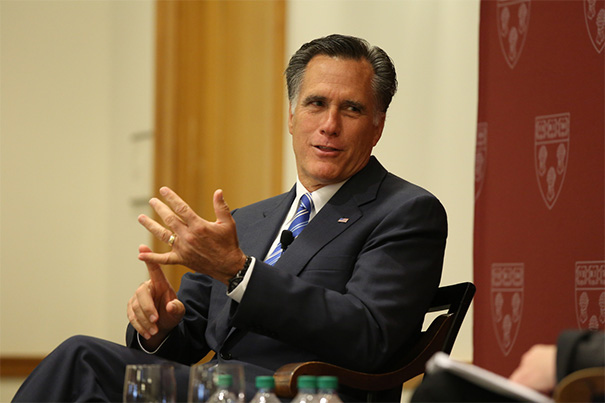
Mitt Romney, the former Massachusetts governor and Republican presidential nominee, visited Harvard Law School on April 10 for a Q&A session hosted by Dean Martha Minow. He encouraged a renewed civility in politics and society, emphasizing the difference one person can make through serving others.
Inaugural winner Chelsea Clinton was on hand as the Harvard T.H. Chan School of Public Health recognized Blake Mycoskie of TOMS Shoes with this year’s Next Generation Award.
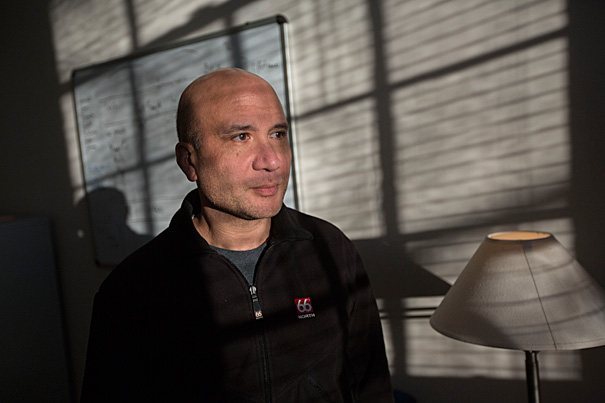
Starting in May 2013, in two of Syria’s war-torn cities, specially trained operatives moved from door to door with a singular purpose: to ask questions. Vera Mironova, a graduate research fellow at Harvard’s Program on Negotiation, was one of the lead authors of the “Voices of Syria” project. She will discuss it today at noon at Wasserstein B015, Harvard Law School.
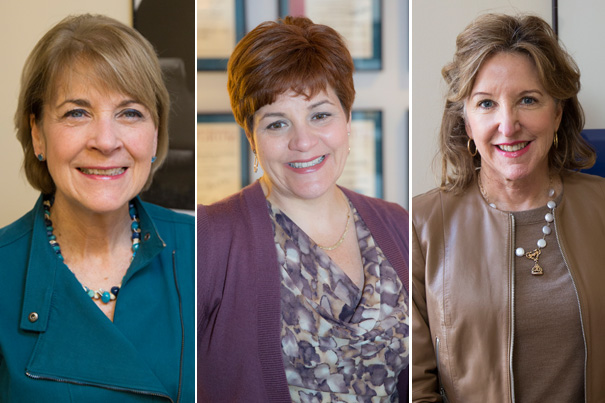
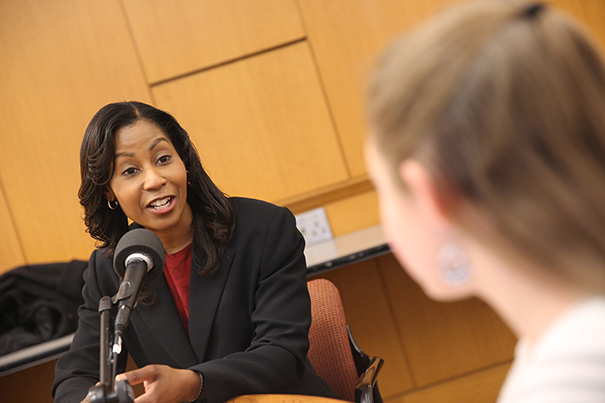
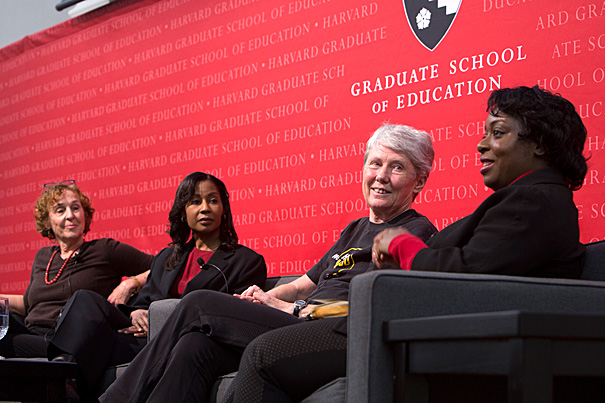
IOP Fellows Martha Coakley, Kay Hagan, and Christine Quinn talk candidly about their battle-scarred campaign days and advise students on what it really takes to make it in politics.
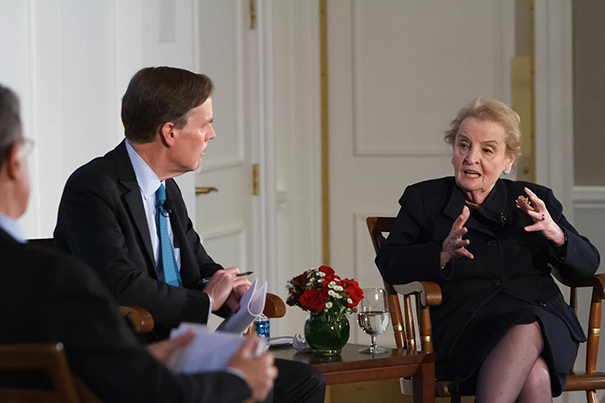
The value of a clear understanding of your country’s objectives and the power of personal relationships were among the insights former U.S. Secretary of State Madeleine Albright shared with a Harvard audience.
As negotiators worked beyond a deadline, experts at Harvard Kennedy School considered the possible outcomes of a deal, or no deal, with Iran over nuclear materials.
A Harvard and MIT study’s findings suggest that teachers often constitute a significant portion of the participants in MOOCs; that learner intentions matter; and that those with financial stakes have higher completion rates.
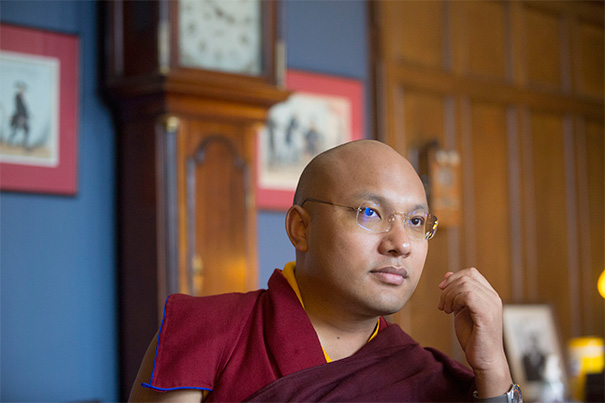
His Holiness the 17th Gyalwang Karmapa, Ogyen Trinley Dorje, spoke about love, environmental issues, and apathy to a capacity crowd at Harvard’s Memorial Church.
Higher education in the digital age is radically remaking the models by which it delivers its content, the leader of a higher education technology association said.
During a historic visit to Beijing, Harvard President Drew Faust delivered the Tsinghua Global Vision Lecture, “Universities and the Challenge of Global Climate Change,” to faculty and students at Tsinghua…
A growing number of monks are coming to Harvard Divinity School through the Ho Family Foundation Scholars program, which covers all tuition and living expenses for a year. They share their experiences and diverse backgrounds.
Professor Jessica E. Stern, a leading terrorism expert, talks about the growing number of young, middle-class Westerners leaving home to join the Islamic State.
Acclaimed French economist Thomas Piketty discusses his landmark text, “Capital in the Twenty-First Century,” one year after its publication in English.
Harvard T.H. Chan School of Public Health Professor John McDonough looks at the latest Supreme Court challenge to Obama’s signature health care reform law, being argued in court this week.
Dutch sociologist Abram de Swaan spoke with the Gazette about his new book, “The Killing Compartments,” ahead of a lecture at the Center for European Studies.
Jose Gomez-Ibanez, a transportation and infrastructure policy expert at Harvard Kennedy School and the Harvard Graduate School of Design, talks about the political and financial hurdles to smoothly running public transit systems.
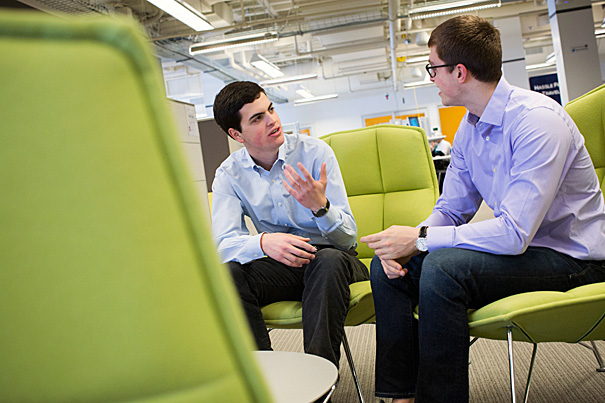
A pair of Harvard seniors, aided by Harvard’s innovation environment, have launched a company that helps people make sense of Congress by gathering in one place diverse information on representatives, districts, bills, and legislative proceedings.
With talk of austerity and bailout terms as the backdrop, experts gathered at the Center for European Studies to discuss the Greek debt crisis in depth. They were not optimistic that a solution is near.
Harvard sociologist and Radcliffe fellow Bruce Western recently completed a study tracking 122 incarcerated men and women in the Boston area who were released back into society. Western’s research helps shed light on how poverty, along with unaddressed problems, helped shape his subjects’ lives.
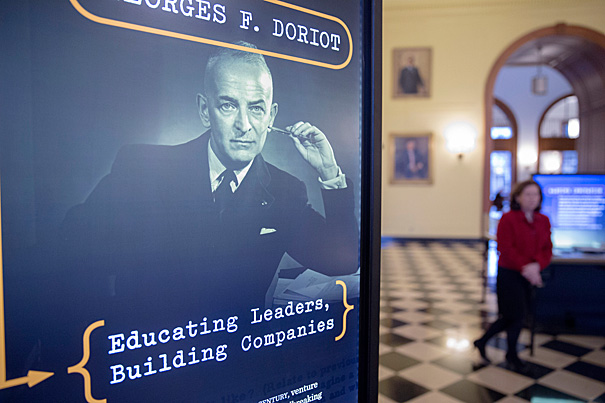
Exhibition at Harvard Business School’s Baker Library celebrates the rich career of one of the School’s most influential faculty members, Georges Doriot.
In a recent EdCast, NASA astronaut Stephanie Wilson shares her thoughts on women and STEM education, her personal journey as a student, and her time in space.
In a question-and-answer session, the leaders of a Radcliffe Institute seminar on America’s long “war on drugs” shared why they are looking back at history and ahead for fresh answers.

 Featured series