Featured series

Science & Tech
-
What it takes to solve math’s toughest problems
Logic skills, yes, but also two seemingly incompatible traits: Confidence and humility
-

When the sea steals homes and jobs
Along West Africa’s Gulf of Guinea, Salata Institute research is helping communities weigh excruciating choices
-

Will Meta settlement reduce physical, mental health risks for young users?
Experts say many of its terms may help limit use, negative social comparisons, but regulation may still be necessary
-
The why behind sex
Research details answer to a question that’s more complex than it seems
-
Does vitriol make you feel special?
Beyond the algorithm, online negativity takes on a life of its own. Here’s why.

-
Do you have a guilty AI secret?
Media, legal experts discuss angst of individuals over appropriate use of powerful technology as institutions, culture scramble to set boundaries
-
Shape-shifting sheets automatically fold into multiple shapes
“More than meets the eye” may soon become more than just for the Transformer line of popular robotic toys. Researchers at Harvard and MIT have reshaped the landscape of programmable…
-
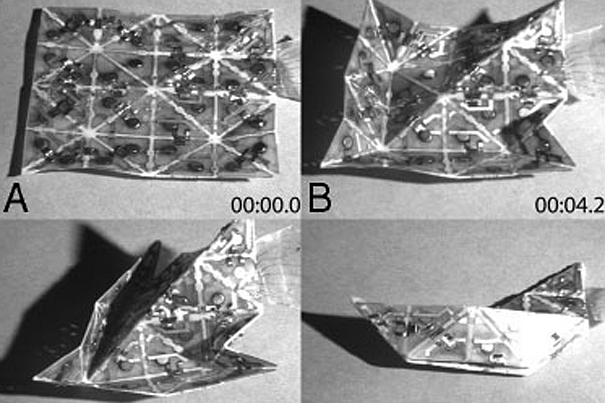
A marriage of origami and robotics
A Harvard and MIT research team demonstrates how a single thin sheet composed of interconnected triangular sections can transform itself into another shape, without the help of skilled fingers, in a kind of origami robotics.
-
Living, breathing human lung-on-a-chip
Researchers at Harvard’s Wyss Institute for Biologically Inspired Engineering have created a device that mimics a living, breathing human lung on a microchip. The device, about the size of a rubber eraser, acts much like a lung in a human body and is made using human lung and blood vessel cells.
-
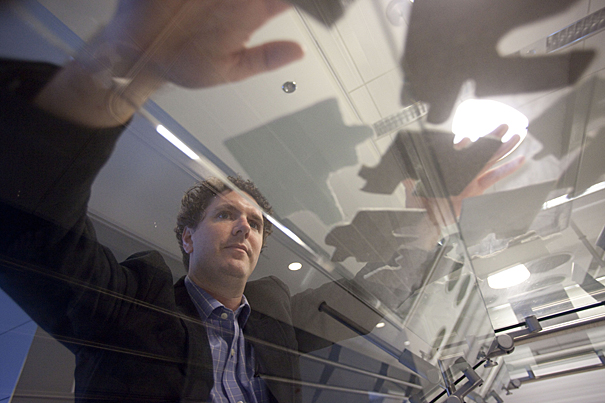
How touch can influence judgments
Researchers find ways in which tactile sensations appear to influence social judgments and decisions in everyday life.
-
Insights on quantum mechanics
Physicists create an artificial material to gain up-close insights into quantum materials and how they interact.

-
Replicating nature’s design principles
In nature, cells and tissues assemble and organize themselves within a matrix of protein fibers that ultimately determines their structure and function, such as the elasticity of skin and the contractility of heart tissue. These natural design principles have now been successfully replicated in the lab by bioengineers at Harvard’s Wyss Institute for Biologically Inspired Engineering and School of Engineering and Applied Sciences.
-
Applied physicists create building blocks for a new class of optical circuits
Imagine creating novel devices with amazing and exotic optical properties not found in nature — by simply evaporating a droplet of particles on a surface. By chemically building clusters of…
-
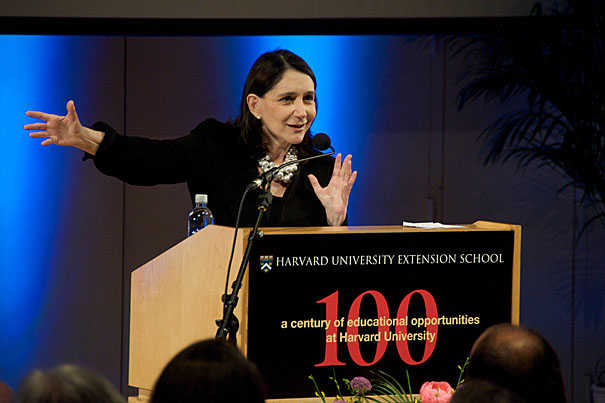
Turkle talks technology, intimacy
“Technology proposes itself an architect of our intimacies,” explained Massachusetts Institute of Technology Professor Sherry Turkle to an engrossed audience May 14 at the Harvard University Extension School.
-
The Postdocs – II
Miriah Meyer isn’t a biologist, but she helps biologists better understand their work. A postdoctoral research fellow in computer science in Harvard’s School of Engineering and Applied Sciences (SEAS), Meyer…
-
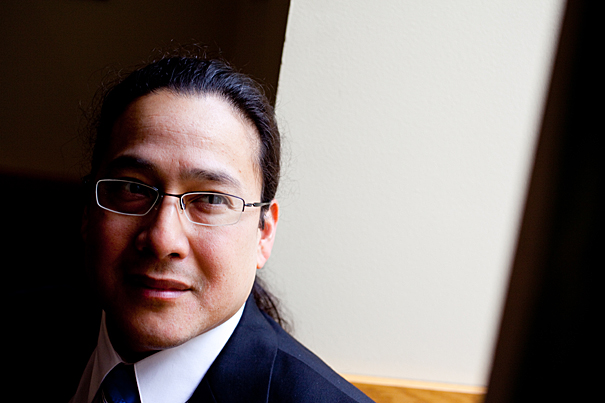
Daily battle to improve health
Harvard School of Public Health student Lyle Ignace hopes to use his experience as an American Indian physician and his new understanding of public health systems to make a difference in the Native American community.
-
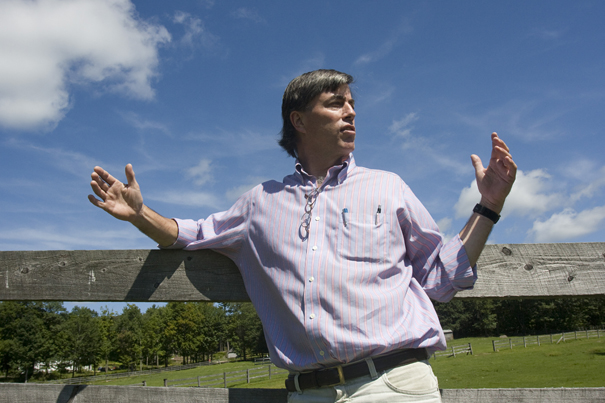
Rolling back the forest canopy
A new report led by researchers at the Harvard Forest says New England woodlands have reached a tipping point, declining in all six states for the first time in 150 years. The report calls for conservation of 70 percent of the forestland.
-
Most Americans who skipped H1N1 vaccines weren’t concerned about the illness
A comprehensive review of 20 national opinion polls, including 8 by Harvard School of Public Health (HSPH) researchers, taken during the 2009 H1N1 pandemic finds two key reasons for the…
-
Majority of young victims of unintentional shootings
Over three-quarters of youths under age 15 who die in firearm accidents are shot by another person, usually another youth, according to new research from the Harvard School of Public Health (HSPH). It is the first multi-state, in-depth study of who fires the shot in unintentional firearm fatalities.
-
Faust calls global health one of her main priorities
Declaring the University’s efforts to improve the state of global health knowledge, education, and capacity building to be one of her “very highest priorities” as president of Harvard, Drew Faust today (May 18) announced the appointment of Sue J. Goldie, Roger Irving Lee Professor of Public Health and director of the Center for Health Decision Science at the Harvard School of Public Health, as the director of the Harvard Institute for Global Health (HIGH).
-
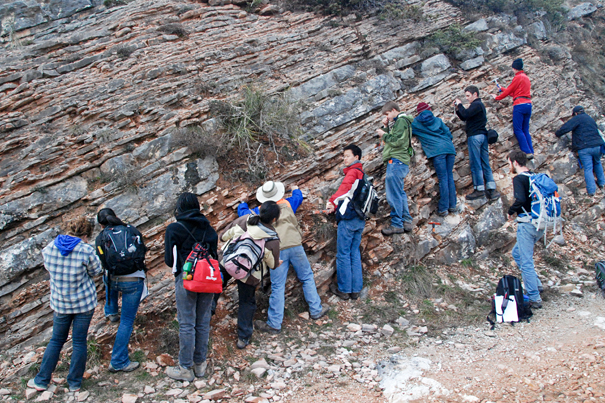
The record in the rocks
Students travel to Italy to study how geologic records show how life on Earth shifted after a cataclysmic event.
-
‘The art of seeing things invisible’
“This is a wonderful story of collaboration and imagination,” said Harvard President Drew Faust, moments before cutting a ribbon yesterday afternoon to open the new Harvard Center for Biological Imaging (CBI). The facility,…
-
Neanderthal genome tells a human story
A preliminary draft of the genome of the Neanderthal, our closest evolutionary relative, reveals in exquisite detail how this long-extinct member of the Homo genus relates to modern humans.
-
Rising seas, raising hopes
Harvard design students, capping a two-year project, encourage the Dutch to look beyond engineering to cope with rising sea levels.

-
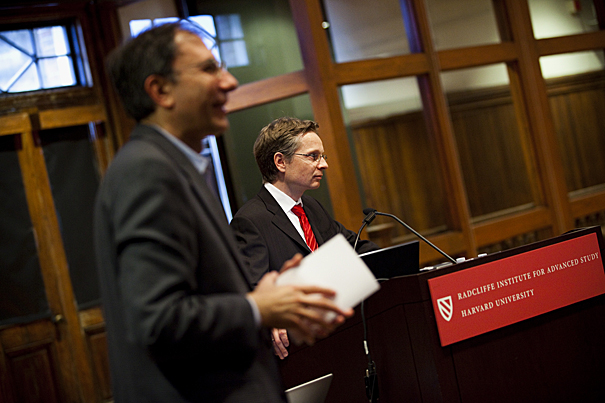
From the cosmos to the cell
A conference at the Radcliffe Institute for Advanced Study examined the prevalence of patterns in the natural world, from enormous ones that order the cosmos to cellular and molecular patterns in living things.
-
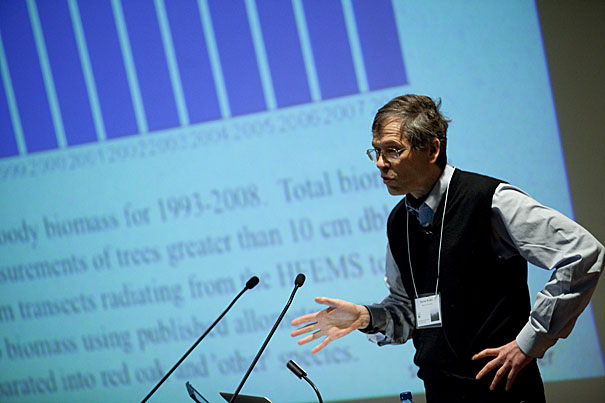
Trees tell of shifting world
Trees from the Harvard Forest to the Amazon rainforest are experiencing changing climactic conditions, with rising temperatures potentially making tropical trees a significant source of carbon dioxide.
-
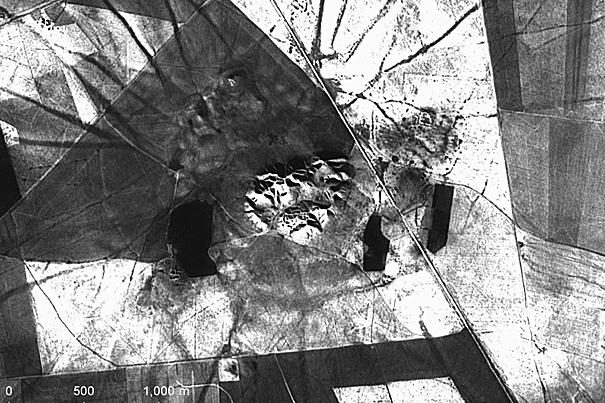
Getting a bird’s-eye view of the past
The archaeological work of Harvard students, using satellite photos to locate ancient structures, is on display at the Peabody Museum of Archaeology and Ethnology.
-
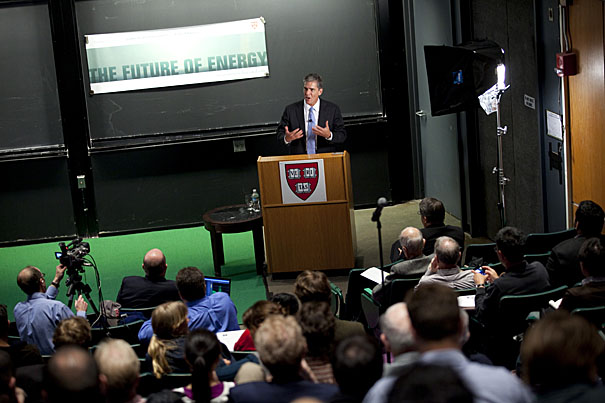
The future energy mix
Shell Oil President Marvin Odum said he expects global energy demand to double by mid-century, with renewables making up 30 percent of the total and fossil fuels remaining an important part of the mix.
-
Panel examines New England’s contributions, role in global health
A new report on global health policy calls for the United States to maintain its commitment to fight HIV, malaria, and tuberculosis and to double the funds committed to maternal and child…
-
Bill Gates on green technology
Bill Gates speaks about how someone following in his footsteps might contribute toward the efforts made in the area of green technology.
-
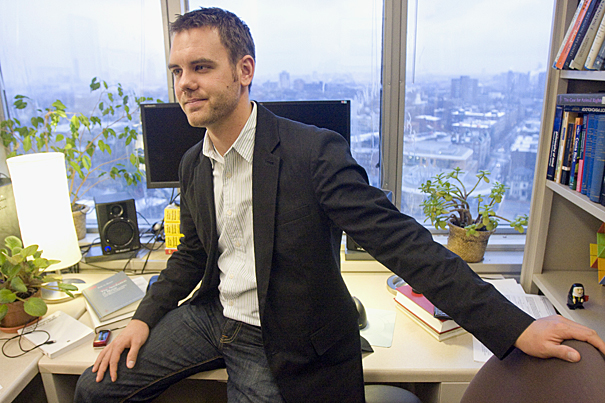
Strength in naughty or nice
Research suggests that when people are convinced they’re engaging in a moral act, either for good or ill, they become stronger in performing physical tasks.
-
The Postdocs
Some physicists spend their lives obsessed with questions about the possibility of parallel universes, or of travel at the speed of light. Amy Rowat is obsessed with the mechanical properties of the tiny…
-
Circling Saturn:
Carolyn Porco is on a mission. As she explained to an audience of several hundred gathered at the Radcliffe Gymnasium earlier this month, in a lecture titled “At Saturn: Tripping the Light Fantastic,”…
-
Mathematician Sophie Morel:
Sophie Morel turned 30 on December 16 of last year, the day after she was appointed a professor of mathematics in Harvard’s Faculty of Arts and Sciences and a Radcliffe Alumnae Professor…
-
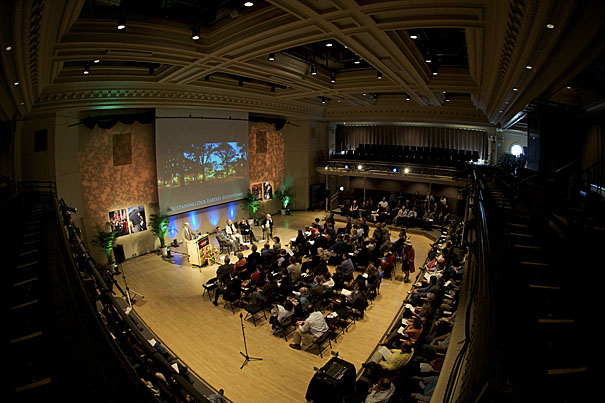
Ecosystems under siege
Environmental panel discusses the problems facing the Earth, and what it would take to reverse the damaging trends.
-
Battling climate change on all fronts
Harvard’s research spans the gamut from the sciences to the humanities, examining key questions about this critical challenge facing humanity.