Featured series
Nation & World
Hot off the presses: The Declaration of Independence
A flawed first copy — dashed off in all-nighter — endures as template for democracy in action
Part of a series of occasional features marking the 250th anniversary of the Declaration of Independence.
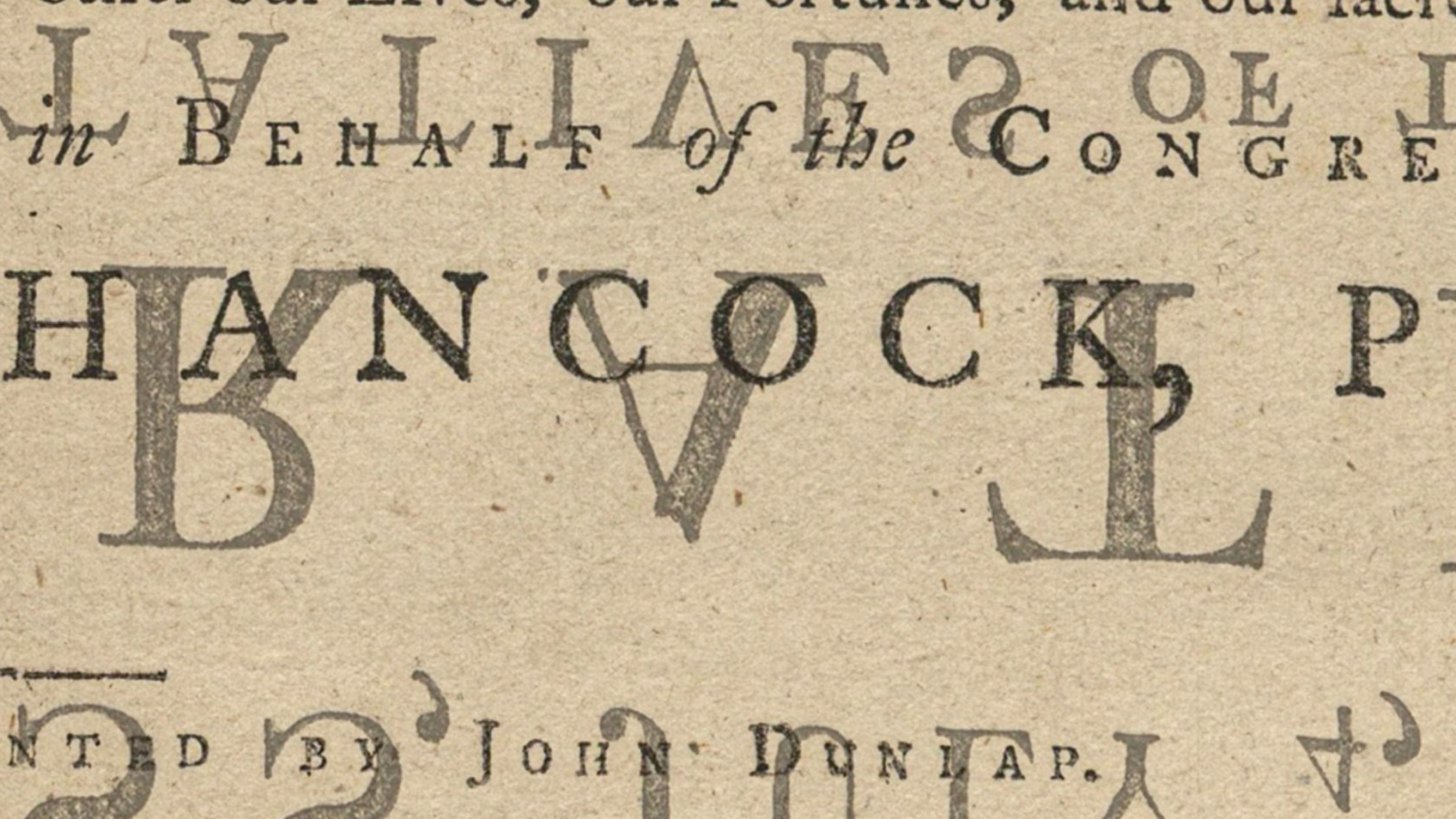
It has been almost 250 years since John Dunlap’s Philadelphia print shop pulled an all-nighter. The July 4-5 job was a rush contract from the Continental Congress: Dunlap was to print the first copies of the Declaration of Independence.
Of the roughly 200 copies Dunlap ran off, only 26 are known to exist today, by the latest count of the Library of Congress; Harvard’s is on display inside the Houghton Library this semiquincentennial summer.
That low survival rate is itself evidence of what the Declaration meant in its moment, and what it was meant to do.
It was a working document, designed to acknowledge, justify, and shape a chain of events rapidly unfolding. It was intended not for library vaults, but for travel, by express mail, to Continental army camps, restive cities and, eventually, to the courts of potential allies in the war of independence already underway.
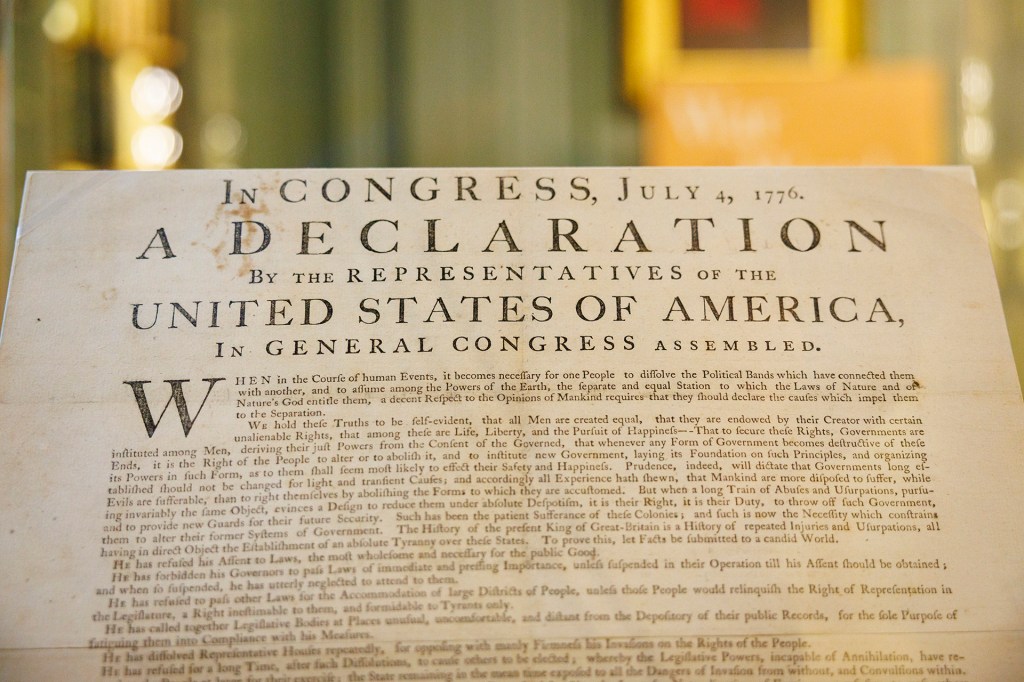
Harvard’s copy of the Declaration is now on view at Houghton Library as part of the “War of Words” exhibit.
File photo by Niles Singer/Harvard Staff Photographer
Once it had done that job, the Declaration itself “kind of sinks out of sight,” noted historian David Armitage.
By the first Independence Day (July 4, 1777), Armitage said, “people were thinking much more about what happens next: on the battlefields, but also in the new state constitutions, for the future of the American cause.”
That helps explain how so many Dunlap broadsides were lost in what Armitage calls the “shipwreck of history,” despite the importance we assign to them now.
“The evidence we have from the past is necessarily fragmentary: So much gets destroyed, burned, thrown away,” said Armitage, the Lloyd C. Blankfein Professor of History.
As he teaches his first-year seminar on the Declaration, he called it an “incredible privilege” to grant today’s students firsthand access to one of the exceptions — the document itself has so much to say.
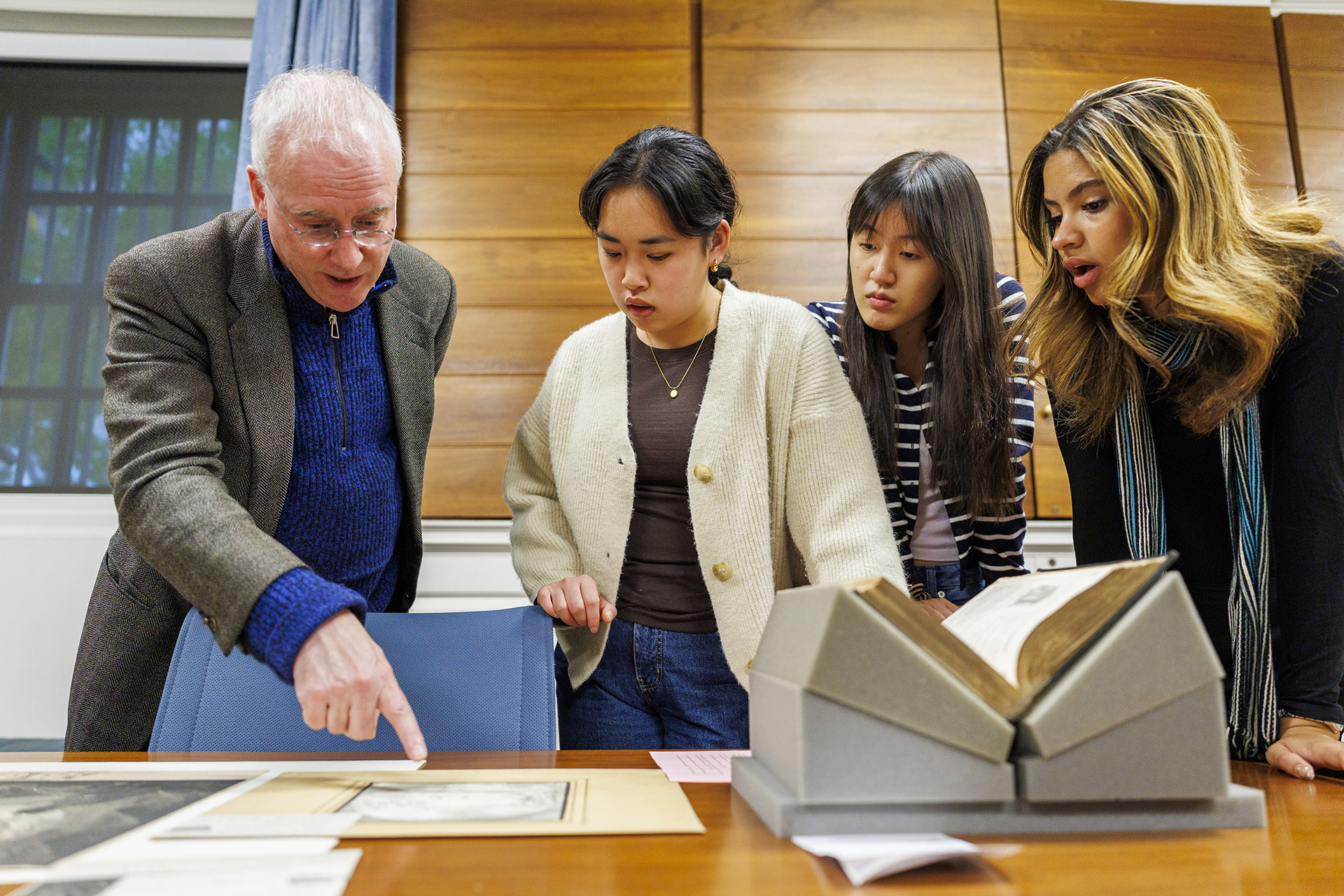
David Armitage digs into Harvard’s archive with students from his first-year seminar on the Declaration of Independence.
File photo by Stephanie Mitchell/Harvard Staff Photographer
The Dunlap broadside sits at the entrance of Houghton’s “War of Words” exhibit (on show through Aug. 7), which aims, among other things, to demystify the run-up to the American Revolution, according to its curator, John Overholt.
“I want people to see the history as being made by actual human beings — and not Mount Rushmore heads,” said Overholt, also Houghton’s early-books curator.
Even before July 4, the drafters of the Declaration had risked getting their all-too-human heads placed in the noose.
The shooting war had begun 14 months earlier in Massachusetts. The Royal Navy had flattened the town of Falmouth, on the present-day site of Portland, Maine, the previous fall. The exhibit also contains a 1775 appeal to American colonists from King George III, warning them against being “misled by dangerous and ill-designing men, and forgetting the allegiance which they owe …”
Independence may have become a majority position amid British reprisals, but it was not unanimous. As late as May 31, 1776, George Washington — on a whirlwind visit to Philadelphia — was troubled to find “many Members of Congress … still feeding themselves upon the dainty food of reconciliation.”
That summer, an uneasy coalition of radicals — Thomas Paine and John Adams were not natural allies — united, despite setbacks and delays, to push independence into reality.
The Dunlap broadside itself attests to its status as a rush order. A 1976 analysis found that 11 of 21 copies studied showed signs of “offsetting” — inverted ink stains from being folded while still wet. Others are torn along the fold. The Harvard copy shows signs of both.
Another takeaway from “War of Words” is that the Declaration came about in a trans-Atlantic society already awash in print. The exhibit’s resulting look, Overholt joked, is “very beige” — pamphlets and counter-pamphlets, personal letters and editorial cartoons, aged to a uniform yellow.
The growth of a relatively literate, curious public meant that printing became a profitable business — a development upon which Benjamin Franklin famously capitalized after his move to Philadelphia in 1723.
“The population was pretty small yet, but it really exploded,” said Joyce Chaplin, a Franklin biographer and the James Duncan Phillips Professor of Early American History.
Franklin played a major role in watching Philadelphia become “for the time, [a] big and sophisticated consumer market,” Chaplin said. “Print shops started expanding and offering different media for different kinds of information: so, yes, newspapers for news, pamphlets for politics, but also almanacs for purely scientific things.”
But the explosion of print had deeper consequences. Harvard-affiliated historians like the late Bernard Bailyn and Gordon Wood have argued that the flood of reading material — progressive parenting manuals, translations, tracts, and treatises — ended up washing away the traditional supports of British authority.
Printing in Philadelphia was a competitive but also a close-knit world: Dunlap, born in Ireland, was a relative of Franklin’s through his uncle’s marriage. And Chaplin notes that Dunlap worked bilingually: Under an alias, “Johann Dunlap,” he served the Protestant Bible-reading Germans of the city.
As the colonial situation worsened, politics became best-selling: Thomas Paine’s “Common Sense” appealed to the more radical-minded patriots, selling, by one estimate, half a million copies over the course of 1776.
It’s no surprise that the Declaration’s path into history involved a leading Philadelphia press, said Armitage.
“It was essential to use the most up-to-date media technology to get out the word” of independence, he said, as a new nation, seeking to establish itself today, might use YouTube. (That’s what South Sudan did in 2011, he added.)
Surprisingly little is known about how Dunlap and the Congress worked out the layout and drafts that night. A member of the drafting Committee of Five was meant to “superintend and correct the Press,” but it isn’t known who did: perhaps John Adams or Franklin himself; Thomas Jefferson, the first author, was apparently out buying ladies’ gloves.
But it is assumed that multiple assistants were working quickly — and, perhaps uncharacteristically, overlooking flaws in the product.
The 1976 study of Dunlap broadsides suggest Harvard’s copy came early in the run, and that Dunlap’s team kept on working despite evident damage to several pieces of type.
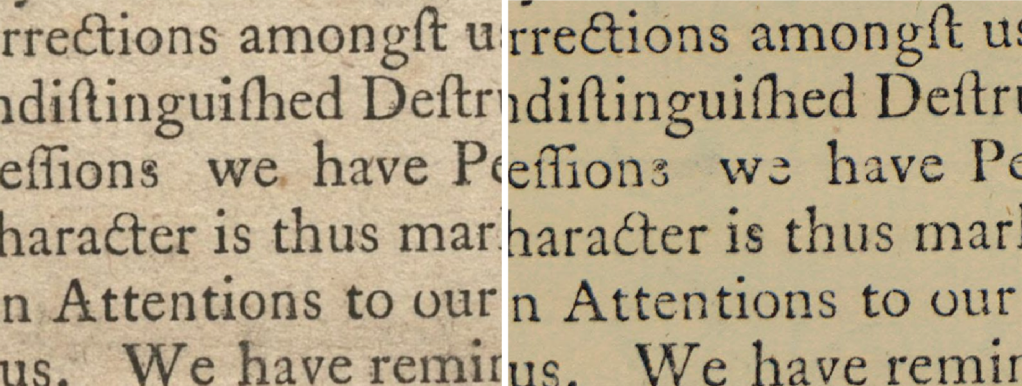
The Continental Congress — and especially that Committee of Five — knew that they needed enough copies to saturate the media environment and to be concise.
“It was going to be pinned up on doors, perhaps on trees, on walls, so it had to be short enough to fit on one single sheet of paper,” Armitage said.
Within “War of Words,” the Dunlap broadside is paired with a dashed-off July 6 letter from Boston merchant John Hancock, the Continental Congress’s president, to Continental Army Gen. Artemas Ward.
“I have only Time to add, that the Importance of it, will naturally suggest the Propriety of proclaiming it in such a Manner, that the whole Army may be fully apprised of it,” Hancock noted.
And the news did spread quickly. By mid-August, the Declaration had been promulgated up and down the eastern seaboard.
In that way, the Declaration was, suddenly, “news,” as the title of historian Emily Sneff’s compelling recent book has it. (It’s worth noting, as Sneff does, that Adams sent one Dunlap broadside to a family friend in Greater Boston.)
Across her years of study of the Declaration, that has been one thing that moved Danielle Allen most of all: “the pattern of ripples” reaching out from that Philadelphia printing house to empower ordinary citizens in a state of profound uncertainty, sometimes fear.
In 2015, Allen — the James Bryant Conant University Professor — established the Declaration Resources Project. She has gone on to develop K-12 curricula that centers close reading of the Declaration and documents like it as a hallmark of what she calls “democratic writing.” As Allen today leads a lab for “democracy renovation,” she says they also are helpful in our own time.
“There are two building blocks of operating a democracy: principles of joint action, and procedures of joint action,” Allen said.
Undoubtedly, the Declaration has suffered by today’s sense of hypocrisy at its heart: that in it, wealthy white men espoused universal equality — even as many went on owning slaves and barring women and the unpropertied from the polls.
(That sense is not even exclusively modern: In 1775, the eminent British commentator Samuel Johnson responded to calls for independence by asking, “How is it that we hear the loudest yelps for liberty among the drivers of negroes?”)
Allen is not convinced. In a talk at the Jack Miller Center this spring, she argued that the founders’ creedal commitment to equality was not a slip-up; despite the contradictions, Jefferson and his editors meant it.
She notes that — just six months after Dunlap’s all-nighter — Prince Hall, a free Black man living in Boston, drew on Jefferson’s opening lines in a petition to ban slavery in Massachusetts. While that petition was unsuccessful, his cause prevailed in the state’s courts in 1783.
“Your Petitioners apprehend that they have, in common with all other Men, a natural & inalienable right to that freedom, which the great Parent of the Universe hath bestowed equally on all Mankind,” Hall wrote.
The Declaration, especially that opening creed, has proven amenable to almost 250 years of American repurposing: Lincoln reconsecrated it at Gettysburg in 1863, and Martin Luther King Jr. invoked it as a “promissory note to which every American was to fall heir” a century later.
And its usefulness was not limited to the U.S.
Time and again, Armitage has found, in the wave of liberations that nominally decolonized the world since 1776, new nations have profited from the Declaration’s structure — a statement of rights, a “charge sheet” against the colonizer, and a formal declaration.
They did so whether or not the modern American government supported their decision. (From Haiti and the Philippines to Vietnam, Armitage sighed, “the ironies just continue.”)
That makes sense to Allen: The Declaration — not as a museum piece, but as a democratic gesture, hot off the press — is a powerful model.
“It’s a story of human agency,” she said. “People survey their circumstances, find them wanting, and decide to do something about it. They articulate their principles, link arms, and get going.”
Harvard’s copy of the Dunlap broadside is on display as part of Houghton Library’s “War of Words” exhibition. The exhibition is open to members of the public as part of a special event on July 4, from noon to 3 p.m., or weekdays through Aug. 7.
More like this
-
Helping to give birth to nation — and Harvard Med
School founder John Warren numbered among alumni who were part of revolutionary generation
-
How did Ben Franklin’s barber keep up with news on war for independence?
Houghton exhibit showcases newspapers, pamphlets, other media, offering on-the-ground view of what regular citizens knew, and when they knew it
-
One of first to receive University honorary degree? George Washington.
Archivist says it’s an early example of ‘long tradition of honoring national leaders’
-

Did the British unleash biological warfare against Washington’s troops?
Historians trace role of physicians, medicine, disease during war in articles marking 250th anniversary of Declaration of Independence
-
Moved by what’s missing in Homer’s ‘Harrow’
Curator launches series steeped in U.S. history
-
Walking in Harvard’s ‘Revolutionary footsteps’
Exhibit traces University’s role in America’s birth — from campus barracks to Founding Father alumni
-
High-tech for the 1700s
Exhibit showcases tools that powered Revolutionary America