Featured series

Nation & World
You’re getting a divorce. What happens to the frozen embryo?
Panelists dig into fraught legal, ethical questions at heart of fertility cases
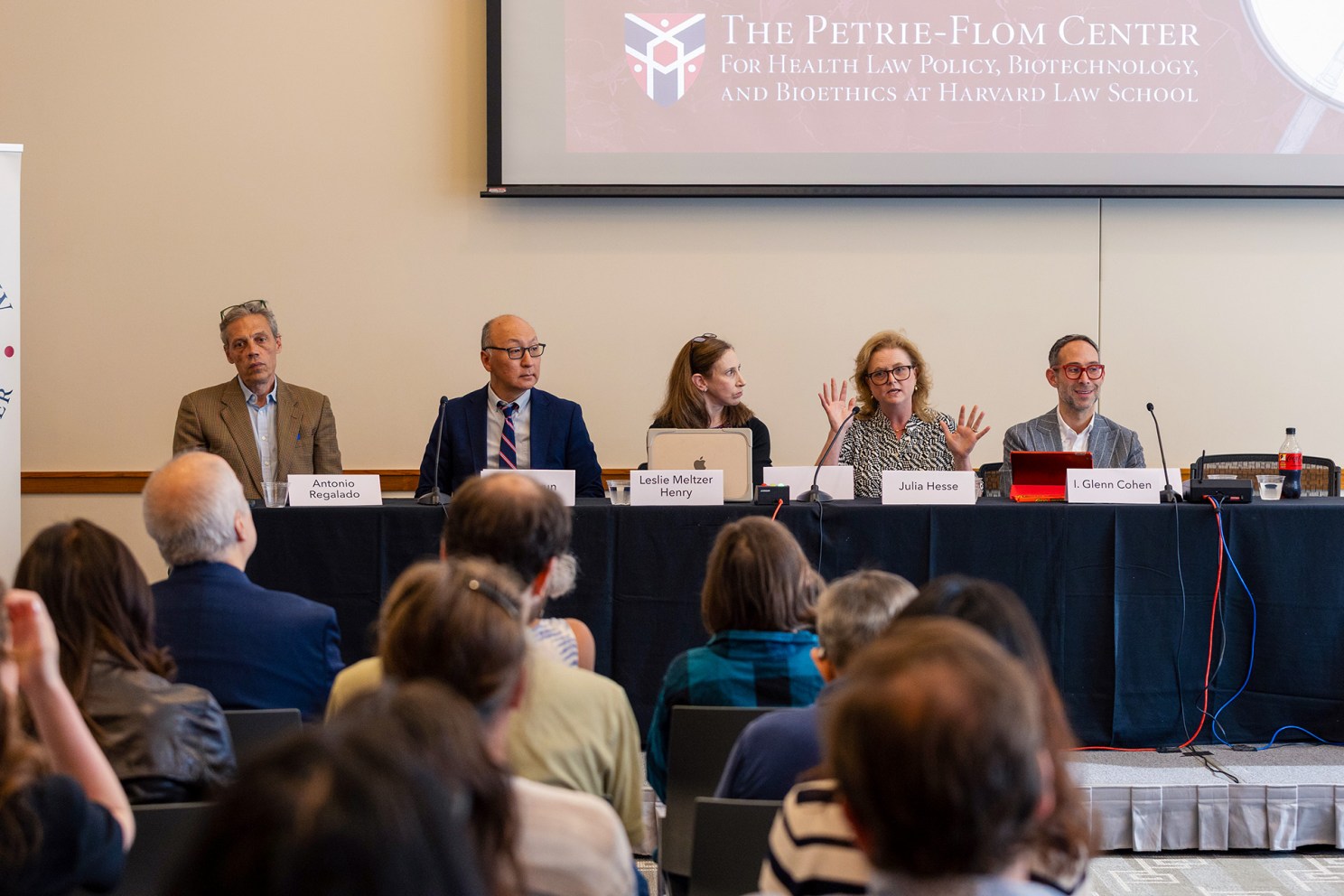
Guest speakers Antonio Regalado (from left), Insoo Hyun, Leslie Meltzer Henry, Julia Hesse, and moderator I. Glenn Cohen.
Photo courtesy of Harvard Law School
There are more than a million frozen embryos in the U.S. — and it seems just about as many ethical and legal questions behind their regulation.
A panel of experts attempted to untangle some of the thorniest issues at play during a recent Petrie-Flom Center for Health Law, Biotechnology, and Bioethics event titled “Hot Topics in Embryo Law and Ethics.”
Since 1980, more than 500 legal cases involving frozen embryos have been filed in state courts, according to Leslie Meltzer Henry, a professor of law at the University of Maryland Francis King Carey School of Law and faculty at the Johns Hopkins Berman Institute of Bioethics.
The cases, she said, often involve disputes between intended parents following a divorce, separation, or another change in plans. Although the highest courts of nine states have addressed such disputes, no consistent standard has emerged.
This fragmented legal landscape, she said, “contributes to the costly emotional litigation that has left both intended parents and fertility providers without clear guidance.”
Julia Hesse, a partner at the law firm Holland & Knight who often represents fertility clinics, agreed. She said a lack of clear laws and insufficient coverage from insurance companies have made running fertility clinics burdensome.
For typical medical malpractice claims in other fields, she said, tort reform has protected doctors from paying out huge sums of money that could lead to closure of their businesses. The same protection is not afforded to the fertility industry, potentially making the accidental destruction of embryos financially catastrophic.
“You can’t operate a business where the liability is unlimited but the amount that they’re charging for long-term storage is $500 or $1,000 a year,” Hesse said. “There’s a big mismatch.”
She advocated for laws, similar to some passed in Europe, that establish a maximum duration for tissue storage. A 10-year limit, she said, would help solve the problem clinics face when clients lose contact or stop paying instead of deciding whether to continue storing their embryos.
“You can’t operate a business where the liability is unlimited but the amount that they’re charging for long-term storage is $500 or $1,000 a year.”
Julia Hesse
While American Society of Reproductive Medicine guidelines allow clinics to dispose of embryos after long periods of lost contact, no clinic wants to seem excessively harsh, fearing both reputational and legal consequences.
Other panelists, like MIT Technology Review senior editor Antonio Regalado, spoke about the philosophical debates over using embryos for scientific purposes. Regalado cited the work of Jacob Hanna, a researcher he profiled whose lab creates synthetic embryo models — and who Regalado said intends to grow these models to harvest useful human tissues. The research is now intersecting with longevity science and members of the ultra-rich who intend to live forever.
“They’re darn serious about not dying,” Regalado said, “and having a clone of yourself is their top fix.”
Insoo Hyun, director of the Center for Life Sciences and Public Learning at the Museum of Science and a fellow at the Hastings Center for Bioethics, said that when it comes to ethical issues around stem-cell use, “What’s old is new again.” He recalled graduating with his Ph.D. in philosophy in 1998, the same year James Thomson derived the first human embryonic stem cell line. Recently, he said, people have been asking him about the same reproductive cloning debate that began decades ago.
Hyun stressed that while the threat of human cloning with embryo models still exists, the technology behind it has not yet reached a point where a lab-grown embryo model could develop into a human being.
Regardless of whether that threat is already scientifically possible, legislation and judicial rulings continue to shape the field. Judith Daar, a law professor at the Northern Kentucky University Chase College of Law, suggested that while courts used to favor the person who wanted to avoid procreation in embryo disputes, the Supreme Court’s Dobbs decision eliminating the constitutional right to abortion has shifted that dynamic.
Taking the idea further, one audience member asked how a state’s decision to define embryos as people could affect parents’ decisions to freeze their embryos.
Hesse worried about the potential for these laws to create an obligation to carry every embryo to term. If every embryo needed to be placed for pregnancy, she said, “I think it would really limit people’s desire to begin a fertility journey.”
Henry shared similar concerns, raising the possibility that adults could be legally compelled to carry a pregnancy. Regalado encouraged the audience to ponder a future in which people made thousands of embryos to select the perfect baby — a fantasy he said is harbored in certain corners of Silicon Valley.