Featured series

Science & Tech
-
What it takes to solve math’s toughest problems
Logic skills, yes, but also two seemingly incompatible traits: Confidence and humility
-

When the sea steals homes and jobs
Along West Africa’s Gulf of Guinea, Salata Institute research is helping communities weigh excruciating choices
-

Will Meta settlement reduce physical, mental health risks for young users?
Experts say many of its terms may help limit use, negative social comparisons, but regulation may still be necessary
-
The why behind sex
Research details answer to a question that’s more complex than it seems
-
Does vitriol make you feel special?
Beyond the algorithm, online negativity takes on a life of its own. Here’s why.

-

Do you have a guilty AI secret?
Media, legal experts discuss angst of individuals over appropriate use of powerful technology as institutions, culture scramble to set boundaries
-
Sustaining the cities
An interdisciplinary Harvard working group on sustainable cities is in search of some organizational details, but is already certain of its urgent mission.

-
‘Breathtakingly awful’
With 8 million orphans living in institutions worldwide, an ongoing Harvard study highlights the devastating effect institutionalization has on children, providing support for a switch to foster care.
-
Simple beauties of math (yes, math)
Mathematics Professor Shing-Tung Yau tells how he discovered the Calabi-Yau manifold, a mysterious but important mathematical concept important in string theory.
-
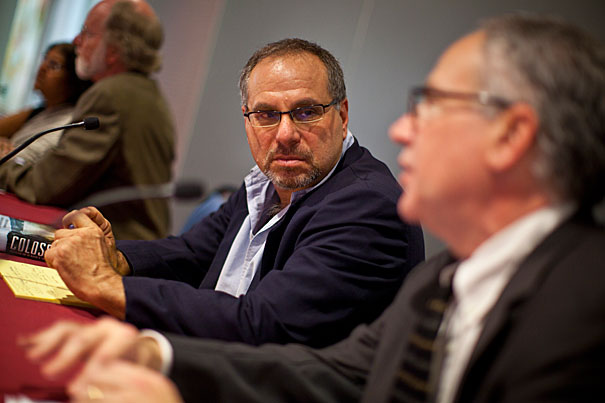
Doubting Thomas nation
Why aren’t you listening? Scientists discuss the difficulty of transferring scientific consensus to the public.
-
Graphene may help speed up DNA sequencing
Researchers from Harvard University and MIT have demonstrated that graphene, a surprisingly robust planar sheet of carbon just one-atom thick, can act as an artificial membrane separating two liquid reservoirs.
-
Sustainability at Harvard: We are a living lab
A video tour through five case studies of sustainability at Harvard, including: * Student Peer-to-Peer Programs Educate and Inspire * Innovative Solutions that Serve as Models for Other * Greener, Healthier, More Efficient Buildings * Rethinking Campus Operations * Building a Culture of Sustainability
-
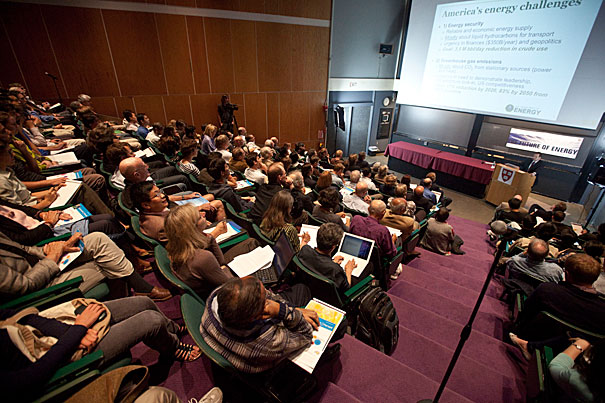
Pondering energy’s future
Reducing dependence on foreign oil and reducing greenhouse gases are the two major challenges facing U.S. energy systems, a visiting federal energy official told a Harvard audience.
-
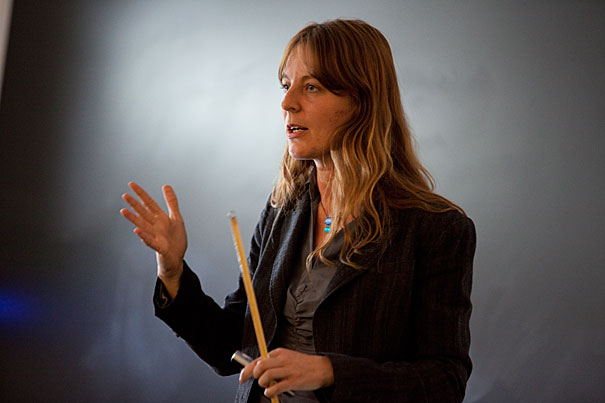
‘It is within our grasp’
Answers to questions about life in the universe is “within our grasp,” astronomer Lisa Kaltenegger said at an Origins of Life Initiative forum.
-
A clean break
Engineers’ finding could provide crucial clues about cloud formation, differences between natural and polluted environments, and climate change.

-
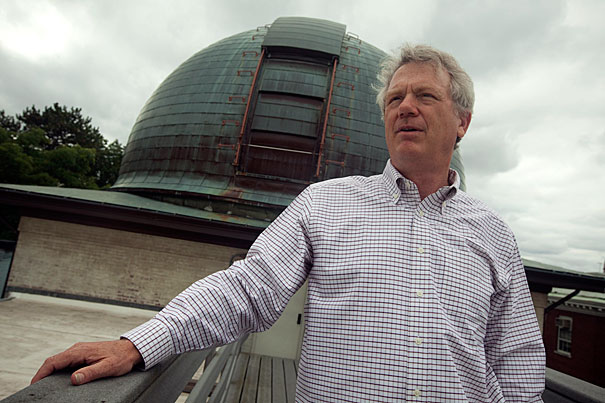
Harvard probes the final frontier
Since Harvard received its first telescope in the 1670s, its astronomers have pushed back the frontiers of knowledge about the ever-expanding, planet-rich place that is the universe.
-
NIH resumes funding stem cell research – for now
The National Institutes of Health (NIH) today announced that it is resuming funding embryonic stem cell research. “We are pleased with the…interim ruling” yesterday by a three-judge panel of the…
-
President Faust issues statement supporting federal funding of stem cell research
A temporary restraining order last month that blocked federal funding for certain kinds of stem cell research was viewed by many as a blow to cutting-edge science that already is…
-
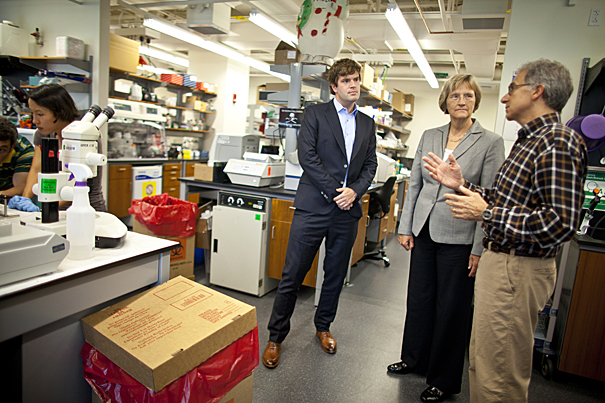
Importance of stem cell research
A temporary restraining order that blocked federal funding for certain kinds of stem cell research was viewed by many as a blow to cutting-edge science. In response, President Drew Faust said, “We hope that the temporary injunction will soon be lifted and that Congress will take the steps necessary to ensure that stem cell scientists can carry on their work vigorously and responsibly, in the interests of the millions of people who may someday enjoy its benefits. …”
-
Cracking flight’s mysteries
Harvard engineers have created a millionth-scale automobile differential to guide tiny aerial robots.
-
Forward, into the past
Harvard undergraduate Derek Robins recounts his summer spent doing astronomy research on campus.
-
The speedup of climate change
Scientist discusses growing effects of global climate change with members of Harvard’s Class of 2014.

-
Major moral decisions use general-purpose brain circuits to manage uncertainty
Harvard researchers have found that humans can make difficult moral decisions using the same brain circuits as those used in more mundane choices related to money and food. These circuits,…
-
Social ill
A new study finds link between lack of close ties and heart disease risk, adding to evidence that a person’s social environment can play a big role in health.

-
Delicate touch
Chemists and engineers at Harvard University have fashioned nanowires into a new type of V-shaped transistor small enough to be used for sensitive probing of the interior of cells.

-
Competing for a mate can shorten lifespan
“Love stinks!” the J. Geils band told the world in 1980, and while you can certainly argue whether or not this tender and ineffable spirit of affection has a downside,…
-
Researchers demonstrate highly directional terahertz laser rays
A collaborative team of scientists at Harvard and the University of Leeds have demonstrated a new terahertz (THz) semiconductor laser that emits beams with a much smaller divergence than conventional…
-
Quantum networks advance with entanglement of photons, solid-state qubits
A team of Harvard physicists led by Mikhail D. Lukin has achieved the first-ever quantum entanglement of photons and solid-state materials. The work marks a key advance toward practical quantum networks, as…
-
Quantum connections
Harvard physicists demonstrate the first quantum entanglement of photons and solid-state materials, in work that marks a key advance toward practical quantum networks that can communicate over long distances.
-
Inklings of suicide
Two new computerized tests, developed at Harvard, show promise in predicting patients’ risk of attempting suicide.

-
Hyperfast star was booted from Milky Way
A hundred million years ago, a triple-star system was traveling through the bustling center of our Milky Way galaxy when it made a life-changing misstep. The trio wandered too close to the galaxy’s giant black hole, which captured one of the stars and hurled the other two out of the Milky Way.
-
University adopts faculty financial conflict of interest policies
The Harvard Corporation has adopted a University-wide faculty financial conflict of interest policy, the first time such a policy has been crafted to cover faculty members across the entire campus.…
-
Some key points from the new University faculty financial conflict of interest policy
The new Harvard University Policy on Individual Financial Conflicts of Interest for Persons Holding Faculty and Teaching Appointments (University Conflict of Interest Policy) is built upon 12 principles that establish a…
-
By ‘putting a ring on it,’ microparticles can be captured
To trap and hold tiny microparticles, research engineers at Harvard have “put a ring on it,” using a silicon-based circular resonator to confine particles stably for up to several minutes.
-
Class act
Two floors of classrooms in Larsen Hall at the Harvard Graduate School of Education are the first in the world to win the highest LEED-CI rating.

-
Computer imaging that aids science
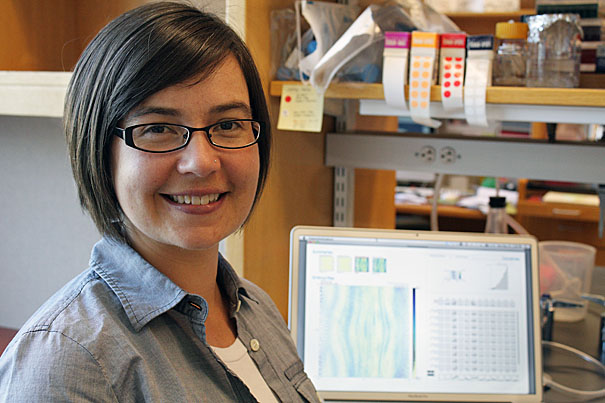
Miriah Myer, a postdoctoral fellow, is a computer scientist using technology to better model and clarify medical data.