
 Featured series
Tag: Computer Science
-
Nation & World
Creative, useful, and fun
From a “Bad Basketball” fantasy league to software that helps partygoers communicate with DJs, students at Harvard’s introductory computer science course created a wide array of programs on display during the annual fair.
-
Nation & World
Liu named Marshall Scholar
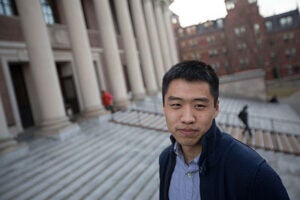
Brandon Liu has been named one of 36 students nationwide to receive a Marshall Scholarship, which will allow him to study for two years at a university in the United Kingdom.
-
Nation & World
Perfecting digital imaging
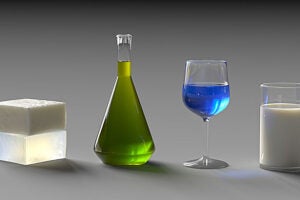
Despite advances, the best software and video cameras cannot seem to get computer-generated images and digital film to look exactly the way our eyes expect them to. Harvard’s Hanspeter Pfister and Todd Zickler are working to narrow the gap between “virtual” and “real” by asking the question: How do we see what we see?
-
Nation & World
Tech solutions for Tanzanian health care
A group of Harvard computer science students traveled to Tanzania in January to lend their programming skills to the mission of improving health care there. The trip included founders and the first cohort of fellows for a new program begun by the student group Tech in the World.

-
Nation & World
For a day, geek is chic
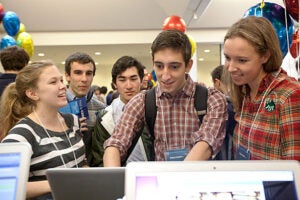
Hundreds of students — hackers and newcomers alike — showed off their programming chops at Monday’s CS50 Fair, a raucous exhibit of mobile apps, websites, and other projects created for Harvard’s wildly popular computer science class.
-
Nation & World
Action figures come to life
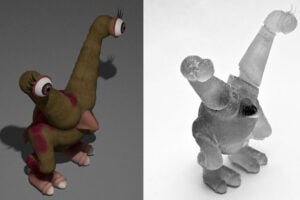
A group of graphics experts led by computer scientists at Harvard have created an add-on software tool that translates video game characters — or any other three-dimensional animations — into fully articulated action figures, with the help of a 3-D printer.
-
Nation & World
NaCl to give way to RockSalt
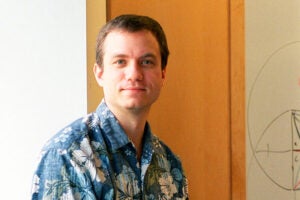
A team led by Harvard computer scientists, including two undergraduate students, has developed a new tool that could lead to increased security and enhanced performance for commonly used Web and mobile applications.
-
Nation & World
Touch, drag, learn
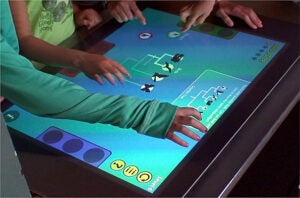
Research by computer scientists, biologists, and cognitive psychologists at Harvard, Northwestern, Wellesley, and Tufts suggests that collaborative touch-screen games have value beyond play.
-
Nation & World
Sharing design, in all its forms
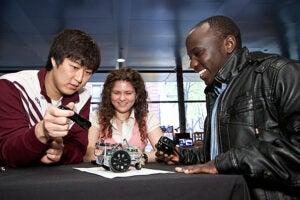
The first Design Fair at the Harvard School of Engineering and Applied Sciences (SEAS) displayed the wealth of ideas that have emerged at SEAS throughout this past academic year.
-
Nation & World
Creative pursuits
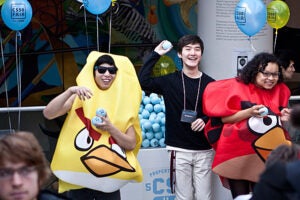
Projects on display at the CS 50 Fair ranged from a tool that limits procrastination, to a website that displays longitudinal market capitalization data, to an application that helps with music composition.
-
Nation & World
Two named ACM fellows
Susan Landau, a visiting scholar in computing science, and Herchel Smith Professor of Computer Science Margo Seltzer were two of 46 people who were recently named fellows by the Association for Computing Machinery.
-
Nation & World
Zuckerberg ‘friends’ Harvard during visit
Mark Zuckerberg returned to campus Nov. 7 to recruit computer science students for jobs and internships at Facebook, the popular social networking site that he created when he was a Harvard undergraduate.

-
Nation & World
Initiative challenges drug crisis
Taking aim at the alarming slowdown in the development of new and lifesaving drugs, Harvard Medical School is launching the Initiative in Systems Pharmacology, a comprehensive strategy to transform drug discovery by convening biologists, chemists, pharmacologists, physicists, computer scientists, and clinicians to explore together how drugs work in complex systems.
-
Nation & World
Texting their way to better health
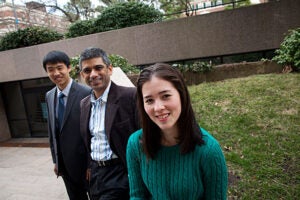
A student project seeks to improve maternal and child care in India by using the proliferation of cellphones in rural areas to remind women to visit local clinics.
-
Nation & World
Like computer science, only cooler
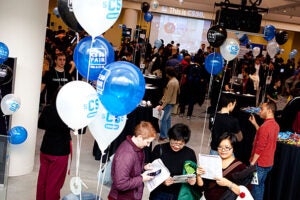
More than 500 students in the introductory computer science course CS 50 descended on the Northwest Science Building for a music-thumping, popcorn-eating fair where students showed off their projects.
-
Nation & World
Five SEAS computer science students named 2011 Siebel Scholars
Five students dedicated to the study of computer science at the Harvard School of Engineering and Applied Sciences were named among the recipients of the 2011 Siebel Scholars awards.
-
Nation & World
Easy blend of old and new
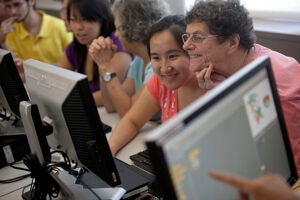
A group from the Harvard Institute for Learning in Retirement is taught Scratch, a basic programming tool, by teaching fellows and course assistants from CS50: “Introduction to Computer Science I,” a popular Harvard course taught by David Malan.
-
Nation & World
HLS Professor Jonathan Zittrain appointed to SEAS faculty
Harvard Law School Professor Jonathan Zittrain ’95 has been appointed to the faculty of the Harvard School of Engineering and Applied Sciences as professor of computer science.
-
Nation & World
The Postdocs – II
Miriah Meyer isn’t a biologist, but she helps biologists better understand their work. A postdoctoral research fellow in computer science in Harvard’s School of Engineering and Applied Sciences (SEAS), Meyer…
-
Nation & World
Former director of computer services, Lewis Law dies, at 77
Lewis (Lew) Law, 77, former director of computer services for the Faculty of Arts and Sciences (FAS), died in Belmont on Feb. 14 after suffering from Alzheimer’s disease for many years.
-
Nation & World
Inside electronic commerce
Harvard’s David C. Parkes studies the intersection of computer science and economics in order to simplify decision making.
-
Nation & World
Michael Rabin to share in $1M prize
Michael O. Rabin of Harvard’s School of Engineering and Applied Sciences (SEAS) has been named a 2010 Dan David Prize laureate.
-
Nation & World
Hunting for rhythm’s DNA
Radcliffe Fellow Godfried Toussaint taps computer science in a search for the evolutionary development of world music’s basic rhythms.
-
Nation & World
Humans and computers connect in Discovery Room
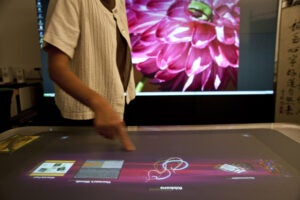
Chia Shen at the Scientists Discovery Room Lab is devising new ways for researchers to visually explore large data sets.
-
Nation & World
Computer scientists model cell division
Computer scientists at Harvard have developed a framework for studying the arrangement of tissue networks created by cell division across a diverse set of organisms, including fruit flies, tadpoles, and…
-
Nation & World
Understanding materials to make microdevices
In the 1990s, semiconductor companies began to incorporate a wider variety of materials into the construction of computer chips, selecting materials based on how they would perform electrically and not necessarily on how they would stand up to the rigors of the manufacturing process or continued use.
-
Nation & World
The way of the digital dodo
The National Science Foundation-funded, three-year effort aims to create 3-D digital models of each species represented in Harvard’s collection of 12,000 bird skeletons.
-
Nation & World
Diverse ‘connectomes’ hint at genes’ limits in the nervous system
Genetics may play a surprisingly small role in determining the precise wiring of the mammalian nervous system, according to painstaking mapping of every neuron projecting to a small muscle mice use to move their ears.