
 Featured series



Tag: Agriculture
-

-
Work & Economy
Can tech save us from worst of climate change effects? Doesn’t look good
Study by two Prize Fellows focuses on economic impact on agriculture.

-
Science & Tech
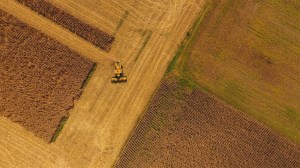
Relocating farmland to cut carbon emissions amid warming world
Reimagined world map of agriculture could turn back clock 20 years on carbon emissions.
-
Campus & Community
Making field to table work regionally
Nina Sayles’ love of gardening is blooming into a drive to provide more nutritious foods for us all.

-
Nation & World
Chance of sun in Michael Pollan’s climate forecast
Michael Pollan says odds of saving the planet aren’t great but people can change their behavior, sometimes rapidly.

-
Health
A diet that’s healthy for people and the environment
Walter Willett, professor of epidemiology and nutrition at the T.H. Chan School of Public Health, takes a closer look at a diet that is as healthy for you as it is the planet,

-
Work & Economy
Sustainability in Big Sky Country
Owners of ranch and nursery since the 1970s talk about the interdependence of financial and environmental viability.

-
Nation & World
Looking to China for lessons on helping the poor
Harvard scholar Nara Dillon is seeking lessons on poverty reduction from China’s success, part of Harvard’s long-running, broad engagement with the world’s most populous nation that continues over spring break when President Larry Bacow visits.

-
Science & Tech
CRISPR’s breakthrough implications
CRISPR pioneer Jennifer Doudna discussed the gene-editing technology’s rapid spread and the need for a robust discussion about the ethics of its applications.

-
Health
21 million in slavery
Experts on forced labor and sexual slavery outlined what remains a large-scale problem.

-
Health
Narrative of the body, with a nasty twist
Many modern chronic diseases result from mismatches between how our bodies evolved to be used and how we use them today, Harvard evolutionary biologist Daniel Lieberman writes in a new book.

-
Science & Tech
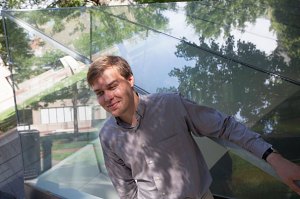
Seeds of violence in climate change
Nathan Black, the French Environmental Fellow, is studying how nations fall into civil war during the type of agricultural disruption possible with a changing climate — and what some nations might do to prevent it.
-
Health
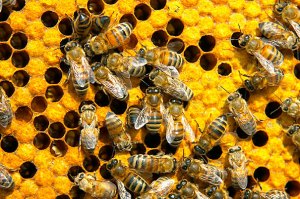
Pesticide tied to bee colony collapse
The likely culprit in sharp worldwide declines in honeybee colonies since 2006 is imidacloprid, one of the most widely used pesticides, according to a new study from the Harvard School of Public Health.
-
Arts & Culture
The New Harvest: Agricultural Innovation in Africa
Professor of the Practice of International Development at Harvard Kennedy School Calestous Juma presents three opportunities that can transform African agriculture: advances in science and technology; the creation of regional markets; and the emergence of entrepreneurial leaders dedicated to the continent’s economic improvement.
-
Nation & World
Taming Australia
The recent floods and drought experienced by Australia are extreme expressions of a naturally fluctuating water cycle that has been moderated with engineering and which the introduction of market reforms recently has made more efficient.

-
Arts & Culture
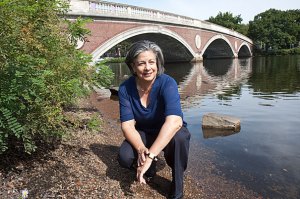
Spouting off
In their new book, “Running Out of Water: The Looming Crisis and Solutions to Conserve Our Most Precious Resource,” Peter Rogers and Susan Leal outline water’s global predicament as the world’s population soars to 8 billion.
-
Science & Tech
Time to change the menu
Climate change, population growth present fresh challenges to a global food supply system already showing cracks.
-
Health
Hey squash, time for your close-up
Bruce Smith, of the Smithsonian National Museum of Natural History, discusses the rise of agriculture in a talk at the Harvard Museum of Natural History.
-
Health
Culture skews human evolution
The rise of agriculture 10,000 years ago meant the end of the hunter-gatherer lifestyle for which human beings had been optimized by millions of years of evolution and the beginning of an era where culture encourages habits unhealthy for us and for the world around, with uncertain evolutionary outcomes.
-
Campus & Community
The pine beetle’s tale: Destructive insect has pharmaceutical potential
Researchers at Harvard Medical School and the University of Wisconsin, Madison, have discovered how beetles and bacteria form a symbiotic and mutualistic relationship — one that ultimately results in the destruction of pine forests. In addition, they’ve identified the specific molecule that drives this whole phenomenon.
-
Science & Tech
Impact of global warming on health debated
Disagreement over the public health impact of global warming emerged in a symposium Monday morning (Feb. 18) at the annual meeting of the American Association for the Advancement of Science. The colloquium, titled “Sustaining Human Health in a Changing Global Environment,” addressed what hazards can be expected as a result of rapid and continuing climate…
-
Science & Tech
Holdren talks back to skeptics of global warming
“Global warming is a misnomer,” said John P. Holdren, speaking Tuesday night (Nov. 6) at the John F. Kennedy Jr. Forum at the Kennedy School. “It implies something gradual, uniform, and benign. What we’re experiencing is none of these.”
-
Nation & World
Chidambaram talks about ‘rich poor’ India
At 60 years old, India is a young nation. It is also a country that is both rich and poor.
-
Health
Popular causes not necessarily best
Conservation policies favoring keystone animal species are insufficient to conserve the world’s biodiversity because many of these target animals don’t live in the world’s most biodiverse spots: lowland tropical forests under pressure from agriculture, logging, and other human activities.
-
Nation & World
Economics in the apple heartland
A Harvard doctoral student has traveled to the wild apple’s home in the mountains of Central Asia to lend a hand to an international nonprofit working with local apple farmers to improve how they grow, harvest, and sell their crops. Plamen Nikolov, a first-year Ph.D. student in health economics, has designed an assessment survey and…
-
Campus & Community
Eating plants that grow on plants
Parasitic plants are not just a biological curiosity. Every year, parasitic plants damage farmers’ fields, particularly in Africa. Kristin Lewis, a junior fellow at the Rowland Institute at Harvard, is learning more about plants and their parasites. For instance, in Africa, seeds of parasitic plants blow in from surrounding environments or are deposited in bird…
-
Science & Tech
Beetle mania
Grain weevils alone cost the global economy about $35 billion, or a third of the world’s grain crop, every year. Various other beetle species damage dozens of crops including bamboo, palm trees, bananas, grasses, sugarcane, pines, and irises. “My research is about the evolution of interactions of various sorts,” Professor Brian D. Farrell says, “including…