Featured series


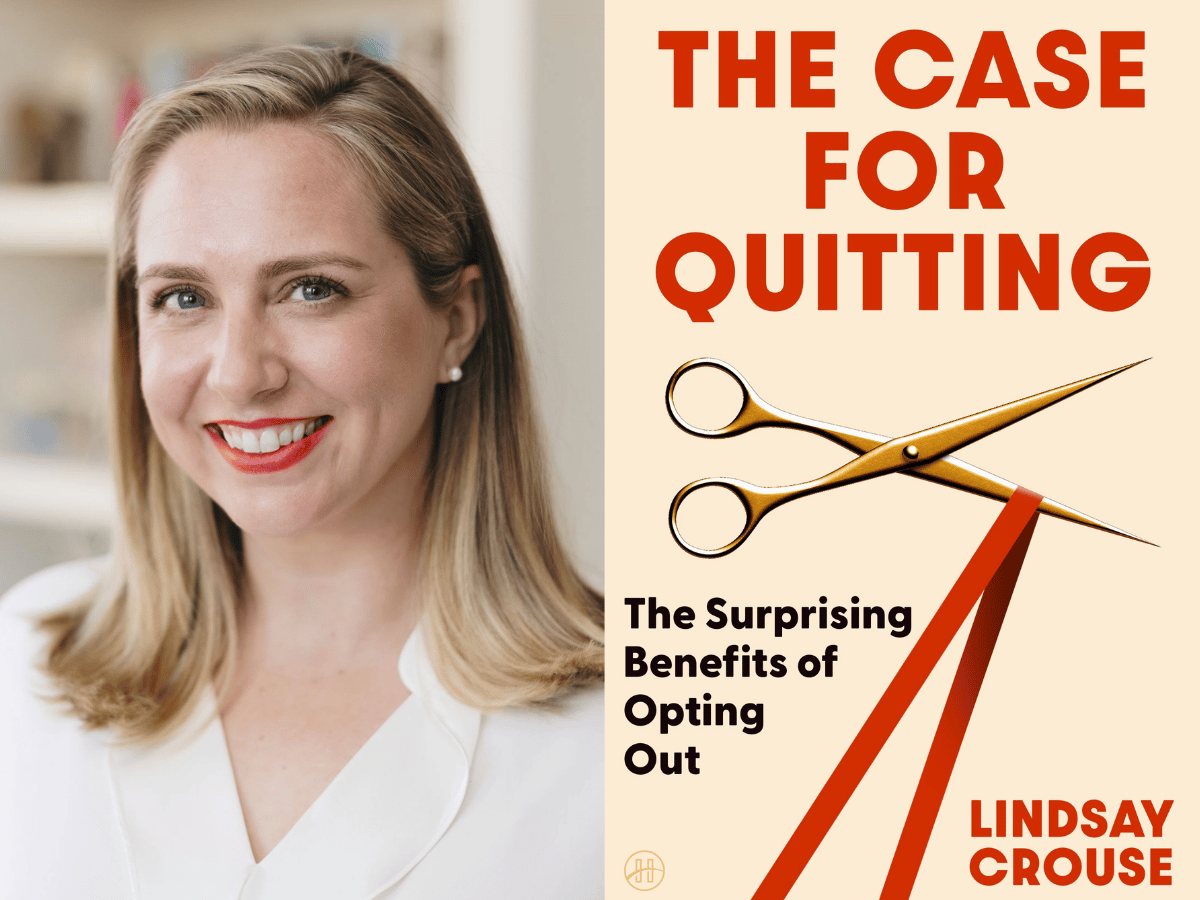
Lindsay Crouse.
Photo by Sophie Sahara
Health
Time to leave?
‘Case for Quitting’ author Lindsay Crouse on why you’re wrong when you answer ‘persevere’
You’ve probably heard some version of the message: “Don’t be a quitter.” But in journalist Lindsay Crouse’s new book, “The Case for Quitting: The Surprising Benefits of Opting Out,” she argues that giving up sometimes is the best decision. In an interview with the Gazette, which has been edited for clarity and length, Crouse ’06 discussed the benefits of learning when to say “enough is enough.”
Gazette: What made you question your own relationship with quitting?
Lindsay Crouse: A lot of us grow up embracing but never questioning the language of ambition: to go harder, keep going, do more, never give up. That was always my recipe for how to achieve my dreams. And it worked, to a certain degree. I grew up in a small town, went to Harvard, ran marathons. I moved to New York and eventually landed a job at The New York Times, where I reported on how perseverance helps us achieve our goals. I viewed quitting as the opposite of perseverance, almost like a flaw of weaker people compared to the superpower of perseverance for the successful.
But perseverance and quitting are not opposites; in fact, quitting is a tool of perseverance. I wanted to explore the value of learning to stop and how it can help you create not just a happy and balanced life but also help you succeed in ways that are more fulfilling.
In your book you mention the Finnish concept of sisu, the grim determination to push through adversity. How can sisu be a double-edged sword?
Sisu can be a superpower, but it can become a weakness when it’s misapplied to problems that should be questioned or challenged. That’s when sisu can become harmful. Researchers in Finland like Amelia Latu have done a lot of research on how sisu is beneficial for us. It helps us thrive. It builds our resilience. But harmful sisu can hold us back. It can isolate us or cause us to overlook our problems. It can also make us blame other people for having problems. Sisu is great when we need help overcoming problems, but it can also cause us to ignore situations in which we’d be better off quitting.
Why does wanting to quit sometimes feel like a character flaw?
We think of quitting as a passive action or thing that happens to us. Our culture doesn’t always make room for the idea of quitting as an active choice, of taking control of a situation where we might not have control. I would argue that quitting (in many cases) is one of the boldest agentic decisions you can make.
One example: Let’s say you’re middle-aged. You’re well established, but you look at the trajectory of where you’ll be in five or 10 years. Do you like what you see? If not, how is it going to change? It often requires quitting something that you’re doing. But again, our culture rewards continuing. It rewards completion, and quitting is the opposite of that. It’s countercultural to make the decision to not continue your current path.
“Our culture doesn’t always make room for the idea of quitting as an active choice, of taking control of a situation where we might not have control.”
Lindsay Crouse
What is the harm in not quitting when you should?
In the long run, if we want to do our best, we need to learn to quit. When we fail to quit, we waste precious resources — like our time, our energy, our money — on quests that will make us increasingly miserable while often falling short of what we want. We invest those resources in paths that don’t succeed. In my own life, I’ve been tormented by the tension between productive hard work and working pointlessly hard. They can feel the same, but they get very different outcomes. Focusing on work alone keeps us from registering the mounting costs of that work, especially when it’s achieving nothing.
In the book you ask if women should quit like men. Should they?
I wrote an article in 2018 for The New York Times detailing women’s abilities to persevere in brutal circumstances, in this case the Boston Marathon. Women have physical, mental, and social qualities that help us to endure more and quit less than men; that’s especially true when conditions are harsh and the stakes are high. But the question is, does this help women? Who benefits from women’s ability to endure?
It’s often not women, it’s everybody else.
Women live longer than men, but we don’t necessarily live better. We’re more likely to battle chronic pain, to experience insomnia, to suffer migraines, to take meds for anxiety and depression. Women graduate from school at higher rates than men, but our incomes haven’t gone up. We seldom occupy the C-suite. Motherhood is another arena where we keep showing up, keep going harder, and keep doing more. I think it’s fair to say that women sometimes look at life like a war of attrition, where suffering is success. But that’s not true. Suffering is not success, and we wind up with more suffering and less reward.
Let’s say I’m tempted to quit something, be it a relationship, a job, a goal. How can I tell if it’s the kind of impulse I should listen to or if it’s a situation where it might benefit me to keep going?
When we want to quit something, it’s common to have an impulsive response: I can’t. Why not? Is it because you want to avoid the pain of disruption or is it actually true? Maybe you’re not in a position to quit right now. But can you take active steps toward building yourself an off-ramp? Maybe it’s financial, a lifestyle adjustment, a gap in your skill set. Take steps to build that cushion for a softer landing in your quest for something else. It’s also important to think about what it is you’re trying to leave or quit. Is it the environment? Your team? The job itself? Your role or workload? It’s a process of figuring out what you want to leave, figuring out if you can change it, and finally figuring out where you’ll go next.
How can we change our relationship with quitting so that we view it as a potential form of liberation rather than failure?
Just as quitting is a choice, so is continuing. These are equal decisions. And it’s important to acknowledge that while quitting does give you that liberation, it doesn’t necessarily tell you what to do next. You need to either be at peace with that or take steps to mitigate the risks involved.
I think oftentimes when we look at quitting, we say, “I don’t know how bad it will be, when I don’t know what’s coming next.” I think we forget that we also don’t know how good it could be. Look at quitting with the same optimism that we might apply to continuing. I think these are all ways to give the act of quitting equal weight in our lives. We can think about what it can bring us, as opposed to simply what we’re going to lose.