Featured series



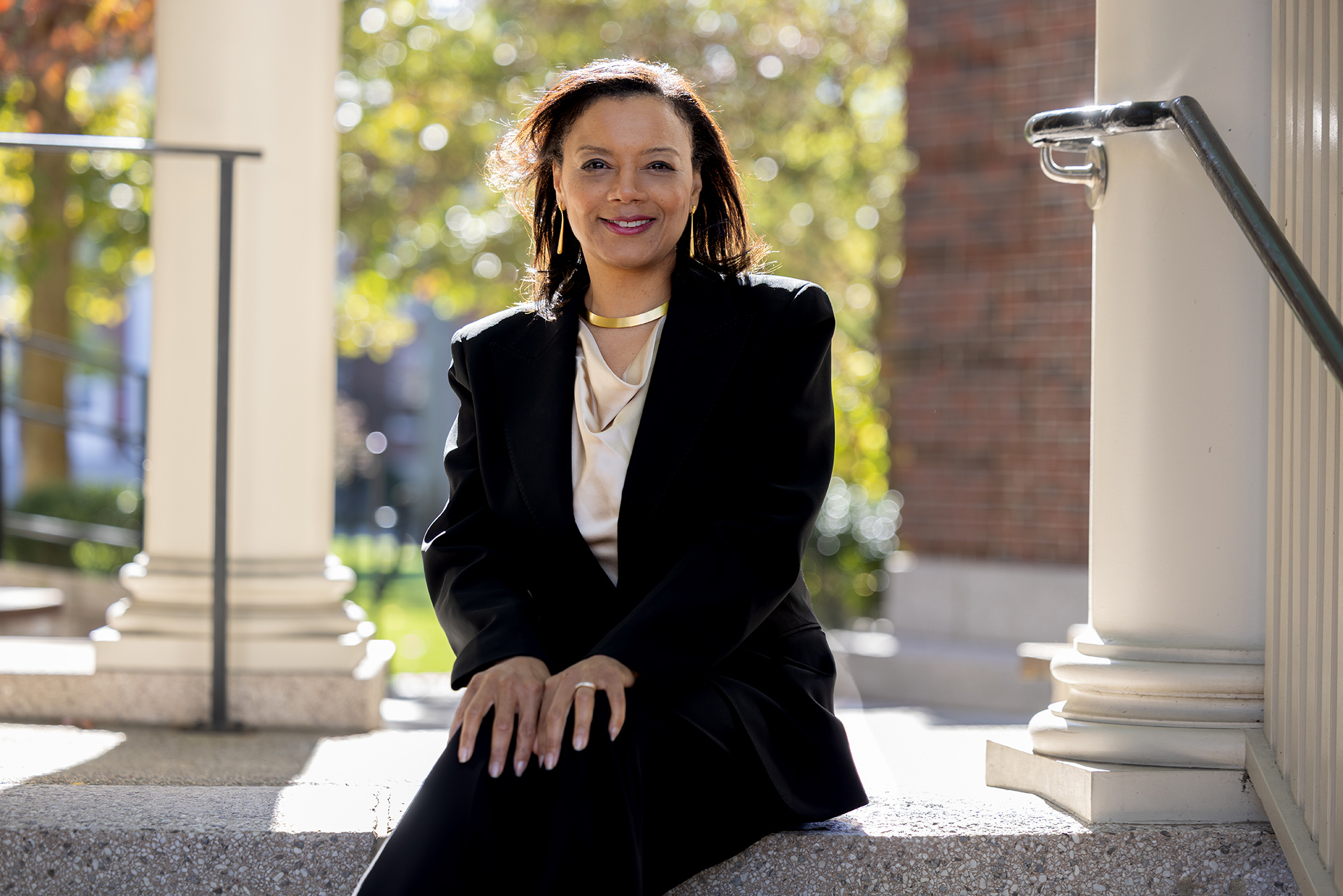
Photo by Melissa Blackall
Campus & Community
Parting words from a scholar who stepped up
Tomiko Brown-Nagin reflects on work as Radcliffe dean and as leader of high-stakes University initiatives
When she arrived on campus in 2012 as a legal scholar and historian, Tomiko Brown-Nagin never envisioned that she would one day lead the Harvard Radcliffe Institute.
Now, after eight years as Radcliffe’s dean, during which she also chaired two major University-wide efforts, Brown-Nagin is preparing to join Stanford University next month as the James Quillen Dean of its Graduate School of Education. She will also hold an appointment as professor of law at the Stanford School of Law.
In his Aug. 5 announcement to the Harvard community, President Alan Garber thanked Brown-Nagin for her “many lasting contributions” to Harvard, calling her an “outstanding dean” and “exemplary scholar.”
At Radcliffe, Brown-Nagin, RI ’17, spearheaded the development and implementation of a strategic plan that both affirmed the institute’s history as Radcliffe College and charted a bold path forward. She expanded Harvard’s faculty with key hires through jointly appointed Radcliffe Professorships, strengthened Radcliffe’s celebrated fellowship program, and launched a leadership program that partners local high school students with Harvard undergraduate mentors.
In 2019, President Lawrence S. Bacow asked Brown-Nagin to lead a comprehensive inquiry into the history and lasting impact of Harvard’s ties to slavery. The committee’s 2022 report identified “difficult truths” and offered recommendations for reparative steps the University should undertake. Garber called Brown-Nagin’s leadership of the effort “as humane as it was rigorous,” saying it “reflected the best of what it means to be a scholar in service to a community, an institution, and a nation.”
More recently, amid tensions related to political protest and civil discourse, Brown-Nagin co-chaired the University’s Open Inquiry and Constructive Dialogue Working Group, which Garber called a “tremendous contribution” to ensuring an improved campus climate. In its report, the group examined reluctance among many students, faculty, and staff to participate fully in the free exchange of ideas and viewpoints for fear of social, professional, or legal consequences and proposed concrete strategies and techniques to encourage respectful debate on campus.
In addition to her leadership of Radcliffe, Brown-Nagin is the Daniel P.S. Paul Professor of Constitutional Law at Harvard Law School and a professor of history in the Faculty of Arts and Sciences. In 2022, she authored a widely acclaimed book on Constance Baker Motley, the groundbreaking civil rights attorney, politician, and federal judge. In this edited conversation, she reflects on her time at Harvard and looks ahead to a new chapter at Stanford.
Gazette: Education — access to education as a means to opportunity — has been a central theme in your work as a historian, as a legal scholar, as dean, and in your family’s history. Did that guide your decision to join Stanford and lead its Graduate School of Education?
Tomiko Brown-Nagin: Absolutely it did. I would not depart Harvard but for an opportunity that I consider unique and entirely consistent with my longstanding commitment to education, access, and opportunity.
It is a throughline of my work — as a scholar and as a university administrator — that is also evident in my forthcoming book, which is a study of the nation’s fits and starts toward opportunity. The book is a sweeping survey of American history that also incorporates the history of the Deep South state where I was born and part of my family’s history, and my own experiences as a student who experienced the integration of public schools during the 1970s.
It’s a book about the transformational power of education and the power of individuals to find common ground across difference. That effort to seek commonality is a commitment that’s deeply important to me and something that I’ve been thinking a lot about over the past couple of years. It’s no secret that these have been — and continue to be — challenging times for educational systems, including colleges and universities, and for all of us who have invested our time in these institutions. We are being tested.
In your note to the Radcliffe community, you said in this new role, you “will be in a position to strengthen American education.” Where is American education today and what needs to be done?
Learning is declining, as evidenced by test scores since 2013. Researchers refer to the phenomenon as a “learning recession.”
In light of this trend, I’m eager to lead a faculty where a tremendous number and variety of researchers are pursuing projects that can illuminate why we are experiencing learning loss and can offer policy and legal recommendations. It fits my own interests so well. I’m looking forward to being a part of that — particularly now, when we are also experiencing disruption in education as a result of technological change, including AI. We really need to think deeply about what education is and what it is to become, and to speak in a way that can guide institutions that reflect the vast diversity of our education system. One of the first things that I will do at Stanford is lead a strategic planning process that I hope will help us speak to some of these issues.
You took on some of Harvard’s most complex challenges as chair of the Presidential Committee on Harvard and the Legacy of Slavery and as co-chair of the Working Group on Academic Freedom and Constructive Dialogue. Looking back, did those efforts accomplish what you had hoped?
President Bacow asked me to lead the first phase of the Harvard and Legacy of Slavery Initiative, which was focused on research. The charge that he put to me and the committee was to follow the evidence surrounding this very painful chapter in Harvard’s history and to make recommendations for how to move forward.
I’m very proud of the work that we were able to do. It was a monumental effort. It involved a lot of people: The committee included experts and faculty from every Harvard School. During the effort, I engaged the Harvard Corporation, vice presidents, the Harvard Board of Overseers, deans, faculty, students — virtually every stakeholder group that one can imagine — around that very difficult subject. It was not a foregone conclusion that we would be successful. The matter is fraught and frankly, not a lot of people other than a subset of scholars are interested in engaging with a subject that is so painful. Nevertheless, we were able to accomplish our scholarly mission.
As to the Open Inquiry work, I was asked by President Garber and Provost [John F.] Manning to take on that role with my colleague Eric Beerbohm, and I do think that our report successfully articulated aspirations for what our learning community should look like. We suggested tools and techniques for moving the University toward a better learning climate, things like the Chatham House Rule and new skills-building efforts across the Schools to teach students as well as educators how to engage with controversial issues in a constructive manner. I’m very pleased that Harvard approached that issue in the way that it did.
Radcliffe introduced the Emerging Leaders Program for high school students to work with College students to develop and hone their leadership skills. Why was that so important to initiate?
Universities like Harvard directly serve a very small and exclusive group of students. And yet it seems to me that while a relatively few students will have the benefits of an elite research education, institutions like Radcliffe can and should serve local communities and introduce a broader cross section of students to the life of the mind, to deep research, to interacting with serious scholars and students. And that’s what I have tried to do during my time at Radcliffe.
The Emerging Leaders Program is a leadership program, but it’s also a research program. One thing that makes it distinctive is that the undergraduates and the high schoolers learn about leadership using the collections of the Schlesinger Library — we introduce these students to archival research. It’s such an important learning tool, and it’s a creative way that our staff members and our students engage these high school students in thinking about how they can contribute productively to whatever social reform issues they find compelling. We also teach them about women leaders, which is important to me and important to us as an institution at Radcliffe.
As you prepare to leave Cambridge, what do you think you’ll miss most?
I will miss Harvard deeply. And I am filled with gratitude for the opportunities that I’ve had to help strengthen this great university. I’m so grateful to Larry Bacow, Drew Faust, and Alan Garber for the opportunities they gave me in the Radcliffe role. I’m a scholar first, and it never occurred to me that my scholarly path would lead me to this administrative role.
I’m also grateful for the opportunity to have served with a wonderful group of deans during very challenging circumstances. And although I am going on to a different institution, I would like to think that through the relationships that I’ve built over 14 years, and the work that I’ve done, I will remain connected to Harvard. Wherever I am in the world, I will always be a champion of Harvard and of Radcliffe.