
 Featured series
Science & Tech
-

Rethinking — and reframing — superintelligence
Microsoft researcher says separating AI from people makes systems dangerous and unproductive
-
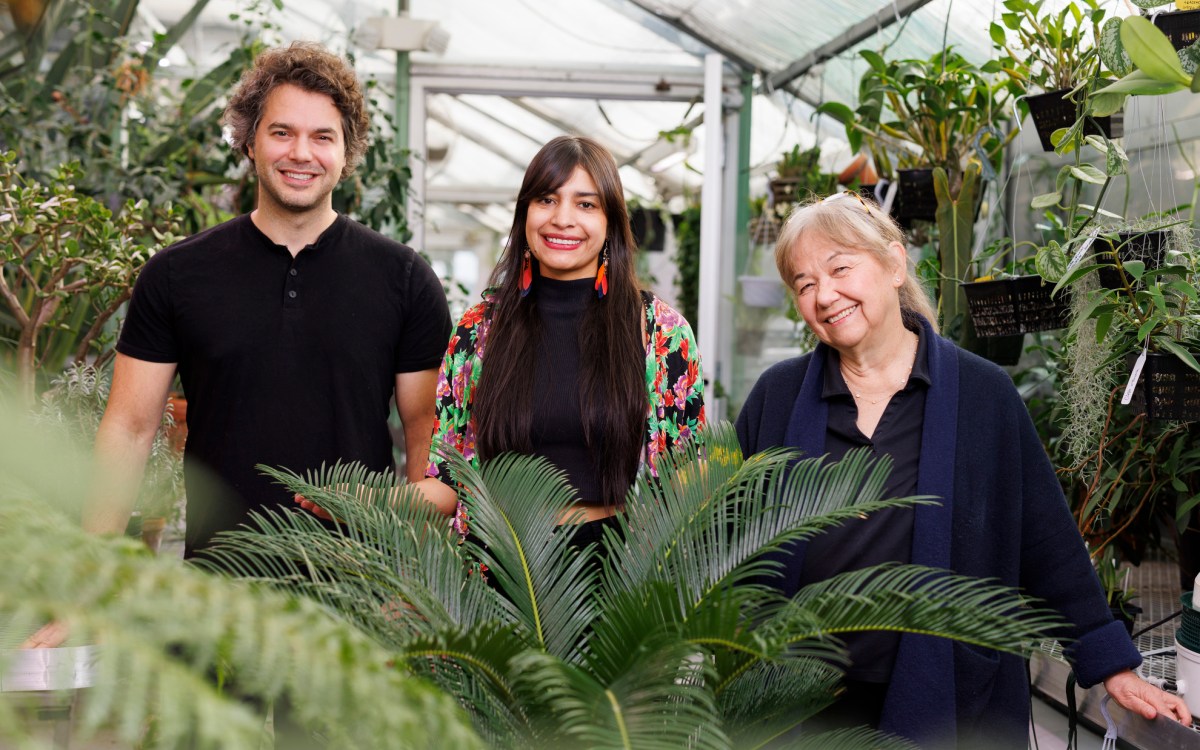
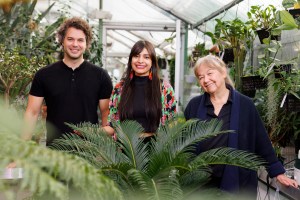
First, male gets heated up, then female, and then, you know
Study shows infrared radiation from plants serves as invitation to pollinating insects
-

‘Consciousness’
What we know and don’t know about the life of your mind
-
Science needs contrarians, and contrarians need support
Institute of Quantitative Social Science initiative tailored to researchers exploring provocative ideas
-

Cracking the code of why, when some choose to ‘self-handicap’
New research also offers hints for devising ways to stop students from creating obstacles to success

-
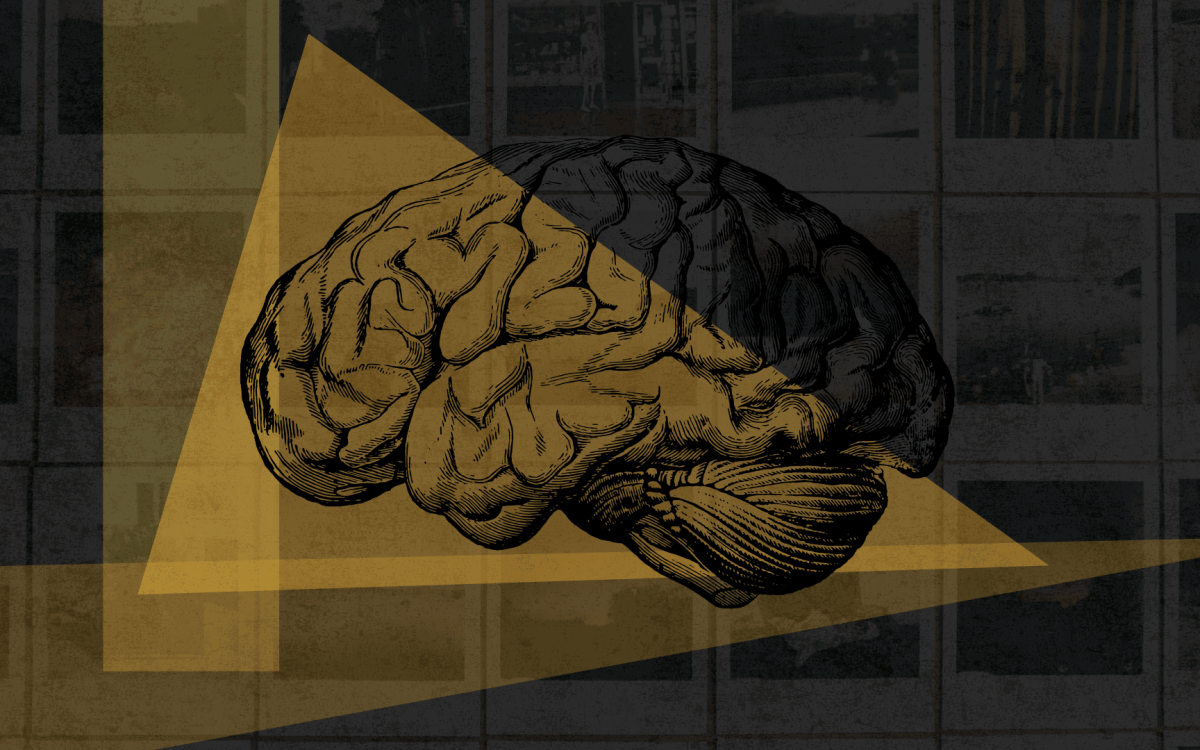
How memory works (and doesn’t)
In podcast, scientists explain why remembering is more reconstruction than replay
 Podcast
-
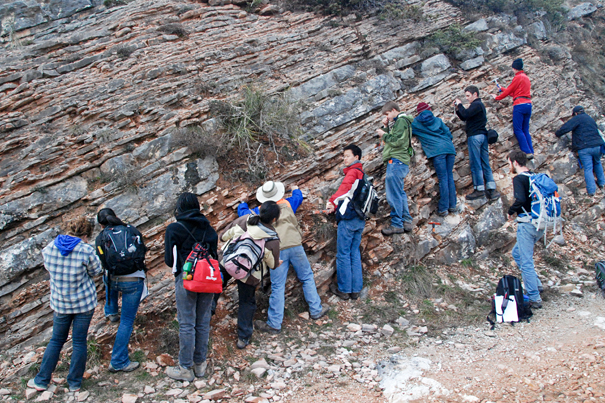
The record in the rocks
Students travel to Italy to study how geologic records show how life on Earth shifted after a cataclysmic event.
-
‘The art of seeing things invisible’
“This is a wonderful story of collaboration and imagination,” said Harvard President Drew Faust, moments before cutting a ribbon yesterday afternoon to open the new Harvard Center for Biological Imaging (CBI). The facility,…
-
Neanderthal genome tells a human story
A preliminary draft of the genome of the Neanderthal, our closest evolutionary relative, reveals in exquisite detail how this long-extinct member of the Homo genus relates to modern humans.
-
Rising seas, raising hopes
Harvard design students, capping a two-year project, encourage the Dutch to look beyond engineering to cope with rising sea levels.

-
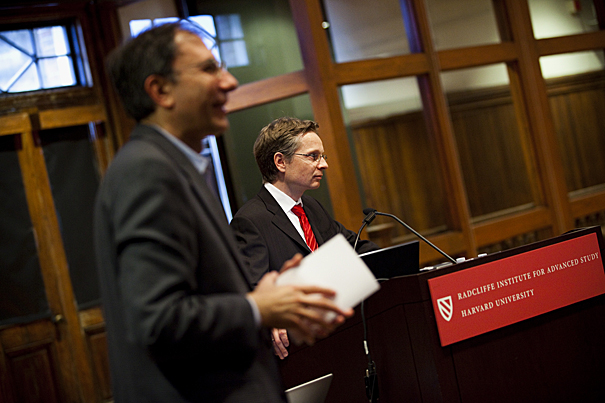
From the cosmos to the cell
A conference at the Radcliffe Institute for Advanced Study examined the prevalence of patterns in the natural world, from enormous ones that order the cosmos to cellular and molecular patterns in living things.
-
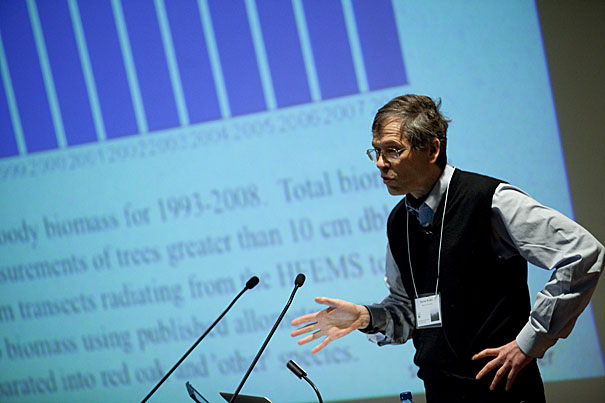
Trees tell of shifting world
Trees from the Harvard Forest to the Amazon rainforest are experiencing changing climactic conditions, with rising temperatures potentially making tropical trees a significant source of carbon dioxide.
-
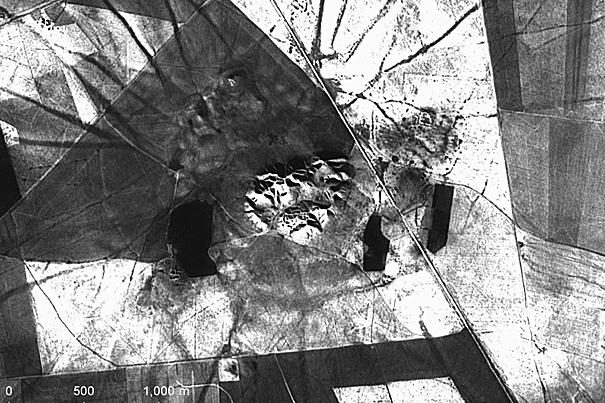
Getting a bird’s-eye view of the past
The archaeological work of Harvard students, using satellite photos to locate ancient structures, is on display at the Peabody Museum of Archaeology and Ethnology.
-
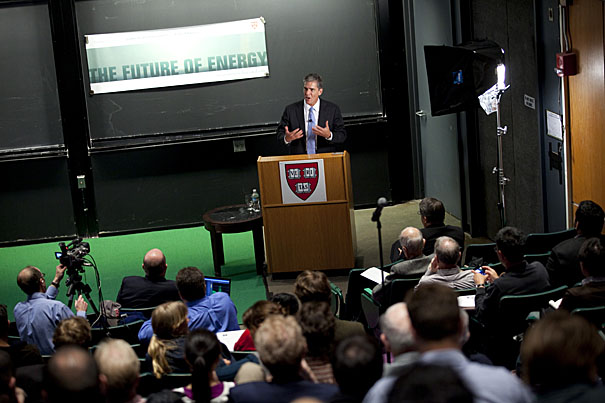
The future energy mix
Shell Oil President Marvin Odum said he expects global energy demand to double by mid-century, with renewables making up 30 percent of the total and fossil fuels remaining an important part of the mix.
-
Panel examines New England’s contributions, role in global health
A new report on global health policy calls for the United States to maintain its commitment to fight HIV, malaria, and tuberculosis and to double the funds committed to maternal and child…
-
Bill Gates on green technology
Bill Gates speaks about how someone following in his footsteps might contribute toward the efforts made in the area of green technology.
-
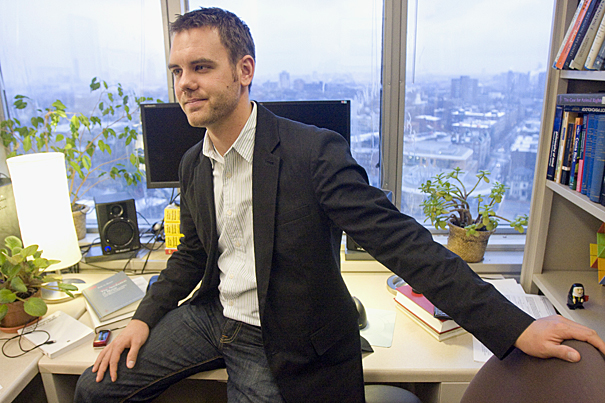
Strength in naughty or nice
Research suggests that when people are convinced they’re engaging in a moral act, either for good or ill, they become stronger in performing physical tasks.
-
The Postdocs
Some physicists spend their lives obsessed with questions about the possibility of parallel universes, or of travel at the speed of light. Amy Rowat is obsessed with the mechanical properties of the tiny…
-
Circling Saturn:
Carolyn Porco is on a mission. As she explained to an audience of several hundred gathered at the Radcliffe Gymnasium earlier this month, in a lecture titled “At Saturn: Tripping the Light Fantastic,”…
-
Mathematician Sophie Morel:
Sophie Morel turned 30 on December 16 of last year, the day after she was appointed a professor of mathematics in Harvard’s Faculty of Arts and Sciences and a Radcliffe Alumnae Professor…
-
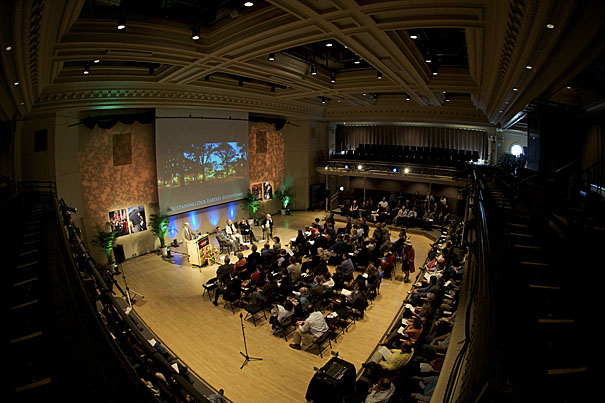
Ecosystems under siege
Environmental panel discusses the problems facing the Earth, and what it would take to reverse the damaging trends.
-
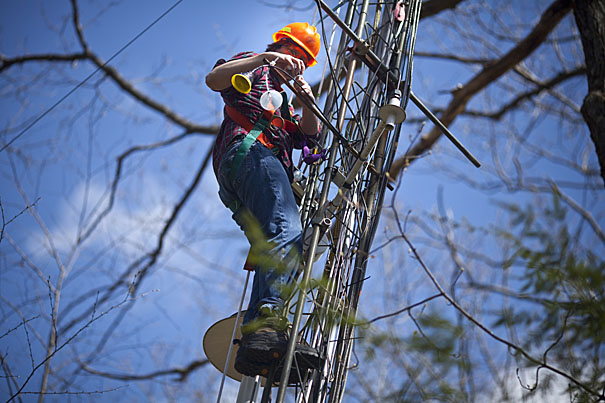
Battling climate change on all fronts
Harvard’s research spans the gamut from the sciences to the humanities, examining key questions about this critical challenge facing humanity.
-
Ambitious undertaking
U.S. Undersecretary of Energy Kristina Johnson said the United States plans to have 80 percent of its energy come from alternative and unconventional fossil fuels by 2050. She spoke as part of the “Future of Energy” discussion series sponsored by the Harvard University Center for the Environment.

-
What are the “Hard Problems” in the social sciences?
Just over a century ago, one of the world’s leading mathematicians posed this question to a number of his colleagues: What are the most important unsolved questions in mathematics? The…
-
Cold atoms and nanotubes come together in an atomic ‘black hole’
Carbon nanotubes, long touted for applications in materials and electronics, may also be the stuff of atomic-scale black holes. Physicists at Harvard University have found that a high-voltage nanotube can…
-
‘Settle down,’ warns E.O. Wilson
Esteemed biologist Edward O. Wilson called for renewed efforts to understand and conserve the planet’s biodiversity, in the first of three Prather Lectures being presented this week.

-
Understanding tiny reactions
Scientists believe that tiny carbon nanotubes may also create something like atomic-scale black holes.

-
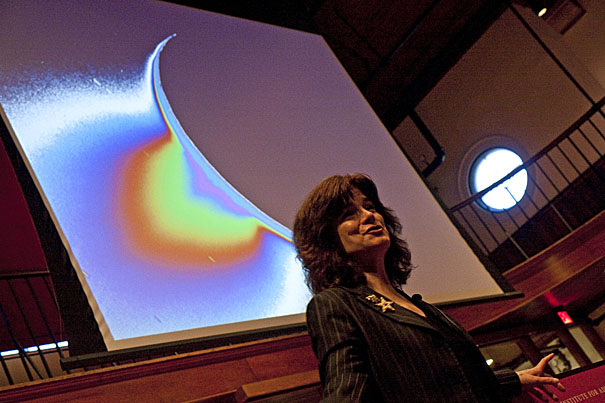
Looking for life beyond Earth
Scientist Carolyn Porco explored the deeper regions of the solar system and her work with the Cassini mission to Saturn during a talk at Radcliffe.
-
Kicking the habit
Clean, renewable wind and solar power may be the most-preferred fossil fuel alternatives, but their land-hungry collecting requirements make them difficult options for replacing more conventional power sources, according to a British energy…
-
An addiction to fossil fuels
David MacKay, physics professor at Cambridge University and scientific adviser to the United Kingdom’s Department of Energy and Climate Change, outlines challenges facing efforts to eliminate fossil fuels from the world’s energy mix.

-
Posing the Big Questions
In 1900, renowned mathematician David Hilbert laid down a challenge to future generations: 23 handpicked mathematical problems, all difficult, all important, and all unsolved. Since then, countless mathematicians around the world have struggled…
-
Women in life sciences still lag in compensation, advancement
Women conducting research in the life sciences continue to receive lower levels of compensation than their male counterparts, even at the upper levels of academic and professional accomplishment, according to…
-
Media reporting HSPH professor to be named head of federal Medicare, Medicaid programs
Major media outlets are this weekend reporting that President Barack Obama has selected Harvard School of Public Health (HSPH) professor Donald M. Berwick, MD, MPP, to head the federal government’s…
-
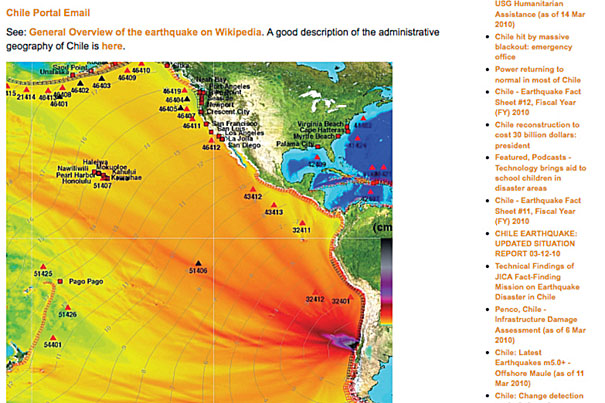
Online portal, created by Harvard center, improved on-the-ground earthquake response
Count Harvard computer experts among those who responded swiftly to the deadly earthquakes in Haiti and Chile, throwing their expertise behind an effort to improve information flow for responders on…
-
Portals into Haiti, Chile
Harvard’s Center for Geographic Analysis created Web clearinghouses to aid information flow in response to Haiti’s and Chile’s earthquakes.
-
This is CS50
Creative vibe colors enormous CS 50 innovation fair