134 stories tagged ‘Astrophysics’
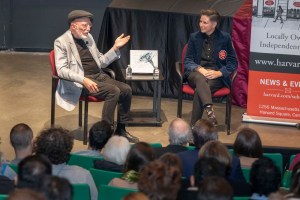
Stars align at astronomy reunion
Harvard astronomers past and present gathered in Cambridge Friday (April 5) for the first-ever reunion of the Harvard Astronomy Department.
A learner’s guide to the universe
Harvard’s Avi Loeb is helping prepare the next generation of astronomers with a new textbook, “The First Galaxies in the Universe.”
Key amino acids important for biological life are among the ones most easily formed in nature, according to Ralph Pudritz from McMaster University.
At last, the edible science fair
Final projects were displayed Dec. 7 for the “Science and Cooking: From Haute Cuisine to the Science of Soft Matter” science fair. Illustrating the tenacious bond between science and cooking, students used physics, chemistry, and biology to manipulate recipes and create foods that stretch the imagination.
Star count of the universe may triple, new study suggests
A study suggests the universe could have triple the number of stars scientists previously calculated.
Harvard undergraduate Derek Robins recounts his summer spent doing astronomy research on campus.
Two GSAS physics students named Hertz Foundation Fellows
The Fannie and John Hertz Foundation has awarded Hertz Fellowships to Adam Marblestone, a Ph.D. candidate in the Harvard Biophysics Program, and Tony Pan, a theoretical astrophysics Ph.D. candidate at Harvard.
Around the Schools: Faculty of Arts and Sciences
Astronomers at the Harvard-Smithsonian Center for Astrophysics discovered a record-breaking gamma-ray burst located 13 billion light-years from Earth.
Visitors will gravitate to ‘Black Holes’ exhibit
On Sunday, June 21, a new exhibit developed by educators and scientists at the Harvard-Smithsonian Center for Astrophysics (CfA) will open at the Boston Museum of Science. Called “Black Holes: Space Warps & Time Twists,” the traveling exhibition pulls visitors into the modern search for real black holes – the most mysterious and powerful objects [...]
Peculiar, junior-sized supernova discovered by New York teen
In November 2008, Caroline Moore, a 14-year-old student from upstate New York, discovered a supernova in a nearby galaxy, making her the youngest person ever to do so.
Charbonneau gets prestigious ‘young researcher’ award
David Charbonneau, the 34-year-old Thomas D. Cabot Associate Professor of Astronomy, has been named the recipient of the National Science Foundation’s 2009 Alan T. Waterman Award, and will receive $500,000 over a three-year period for scientific research or advanced study in his field. The annual Waterman Award recognizes an outstanding young researcher in any field [...]
Our own Milky Way galaxy, long considered a “little sister” to the larger Andromeda Galaxy, is all grown-up, according to new research. The findings, presented at a Jan. 5 meeting of the American Astronomical Society in Long Beach, Calif., by Harvard-Smithsonian Center for Astrophysics (CfA) researchers, show that the galaxy has about 50 percent more mass — about the same as Andromeda — and is rotating about 100,000 mph faster than previously thought.
Riding — and reading — the Earth tide
Once a day, Miaki Ishii rides the Earth tide, rising slowly — along with her desk, chair, and entire office — 20 to 30 centimeters before sinking back again.
Strong evidence brown dwarfs form like stars
Astronomers have uncovered strong evidence that brown dwarfs form like stars. Using the Smithsonian’s Submillimeter Array (SMA), they detected molecules of carbon monoxide shooting outward from the object known as ISO-Oph 102. Such molecular outflows typically are seen coming from young stars or protostars. However, this object has an estimated mass of 60 Jupiters, meaning [...]
Solar system’s twin has two asteroid belts
Astronomers have discovered that the nearby star Epsilon Eridani has two rocky asteroid belts and an outer icy ring, making it a triple-ring system. The inner asteroid belt is a virtual twin of the belt in our solar system, while the outer asteroid belt holds 20 times more material. Moreover, the presence of these three rings of material implies that unseen planets confine and shape them.
Solar system’s young twin has two asteroid belts
Astronomers have discovered that the nearby star Epsilon Eridani has two rocky asteroid belts and an outer icy ring, making it a triple-ring system. The inner asteroid belt is a virtual twin of the belt in our solar system, while the outer asteroid belt holds 20 times more material. Moreover, the presence of these three [...]
Black holes are the heart of galaxies
Astronomers think that many — perhaps all — galaxies in the universe contain massive black holes at their centers. New observations with the Submillimeter Array now suggest that such colossal black holes were common even 12 billion years ago, when the universe was only 1.7 billion years old and galaxies were just beginning to form. The new conclusion comes from the discovery of two distant galaxies, both with black holes at their heart, which are involved in a spectacular collision.
Star quest knowledge provides new view of ourselves
In a basement laboratory at the Harvard-Smithsonian Center for Astrophysics (CfA), surrounded by instruments built to detect the universe’s distant secrets, sits a machine that will help us look not outward to the stars, but inward at our own bodies.
J. Richard Bond awarded Gruber Prize at CfA
Theoretical work on the evolution and structure of the universe landed Canadian cosmologist J. Richard Bond the 2008 Cosmology Prize of the Peter and Patricia Gruber Foundation, awarded Sept. 17 at the Harvard-Smithsonian Center for Astrophysics (CfA).
CfA to host focus group on aesthetics and astronomy
The Harvard-Smithsonian Center for Astrophysics (CfA) is sponsoring a focus group survey on Dec. 3 at Phillips Auditorium, 60 Garden St., to gather information on how NASA scientists create astronomical imagery. CfA experts will be on hand for the 3 p.m. talk and discussion. Astronomy enthusiasts are invited to register for the survey, which will last approximately 15 minutes, at http://astroart.cfa.harvard.edu/focus/. Food, drinks, and souvenirs will be provided for all participants. For more information, visit http://astroart.cfa.harvard.edu/.
Interdisciplinary conference takes micro, macro look at origins of life
How did we get here? That’s not the first line in a hangover joke. It’s a question that has been asked for centuries about the origins of life on Earth. At Harvard last week, an A-list of astronomers, physicists, Earth scientists, and chemists met in the Radcliffe Gymnasium to look at this and other fundamental questions. (What is life? Are we alone in the universe?)
Publications recognize three CfA astronomers
Three astronomers at the Harvard-Smithsonian Center for Astrophysics (CfA) were recently recognized for their innovative work by three leading national magazines. The trio was selected from hundreds of scientists across the country for their leadership and achievements in their respective research fields.
White dwarf ‘sibling rivalry’ explodes into supernova
Astronomers at the Harvard-Smithsonian Center for Astrophysics (CfA) have found that a supernova discovered last year was caused by two colliding white dwarf stars.
Statistics captures unpredictability of real world
Harvard’s small but active statistics department celebrated its 50th anniversary last week. There were two days of lectures and panels Oct. 26-27 at the Gutman Conference Center, and a noisy, social, and musical banquet at the Harvard Club of Boston.
Massive black hole smashes record for sizeMassive black hole smashes record for size
Using two NASA satellites, astronomers have discovered a black hole that obliterates a record announced just two weeks ago. The new black hole, with a mass 24 to 33 times that of our sun, is the heftiest known black hole to orbit another star.
White dwarf “sibling rivalry” explodes
The new find, supernova 2006gz, was classified as a Type Ia due to the lack of hydrogen and other characteristics. However, an analysis combining CfA data with measurements from The Ohio State University suggested that SN 2006gz was unusual and deserved a closer look.
CfA reveals Magellanic Clouds are first-time visitors
The Large Magellanic Cloud (LMC) and Small Magellanic Cloud (SMC) are two of the Milky Way’s closest neighboring galaxies. A stunning sight in the southern hemisphere, they were named after the Portuguese explorer Ferdinand Magellan, who explored those waters in the 16th century. For hundreds of years, these galaxies were considered satellites of the Milky Way, gravitationally bound to our home galaxy. But new research by Gurtina Besla of the Harvard-Smithsonian Center for Astrophysics (CfA) and her colleagues shows that the Magellanic Clouds are recent arrivals — on their first visit to the Milky Way’s neighborhood.
Astronomers have discovered the first negatively charged molecule in space, identifying it from radio signals that were a mystery until now. While about 130 neutral and 14 positively charged molecules are known to exist in interstellar space, this is the first negative molecule, or anion, to be found. “We’ve spotted a rare and exotic species, [...]
Astronomers nab culprit in galactic hit-and-run
The Andromeda galaxy, the closest large spiral to the Milky Way, appears calm and tranquil as it wheels through space. But appearances can be deceiving. Astronomers have new evidence that Andromeda was involved in a violent head-on collision with the neighboring dwarf galaxy Messier 32 (M32) more than 200 million years ago. “Like a CSI [...]
Cosmic blast announces a future supernova
It’s one thing to theorize about an exploding star the size of our sun, it’s another to look up in the sky and watch one getting ready to blow. Astronomers are now doing this. On Feb. 12, a star known as RS Ophiuchi, some 8,000 trillion miles away, erupted in an explosion so bright it [...]
Jupiter’s ‘big brother’ has moon-forming dust disk
Earth’s moon was created by an early collision with another large planetary body. It was a “chip off the old block.” Mars captured its asteroidal moons as they passed by. But Jupiter made its own moons out of dust and gas remaining from its formation. Now, observations by astronomer Subhanjoy Mohanty of the Harvard- Smithsonian [...]
Neutron star swaps lead to short gamma-ray bursts
Gamma-ray bursts are the most powerful explosions in the universe, emitting huge amounts of high-energy radiation. For decades their origin was a mystery. Scientists now believe they understand the processes that produce gamma-ray bursts. However, a new study by Jonathan Grindlay of the Harvard- Smithsonian Center for Astrophysics (CfA) and his colleagues, Simon Portegies Zwart [...]
Two exiled stars are leaving our galaxy forever
TV reality show contestants aren’t the only ones under threat of exile. Astronomers using the MMT Observatory in Arizona have discovered two stars exiled from the Milky Way galaxy. Those stars are racing out of the Galaxy at speeds of more than 1 million miles per hour – so fast that they will never return. [...]
Cosmic jet looks like giant tornado in space
While examining a region where new stars are forming with NASA’s Spitzer Space Telescope, astronomers found a surprise – an object that looks like a giant tornado in space. The apparent tornado is shaped by a cosmic jet packing a powerful punch as it plows through clouds of interstellar gas and dust. They released an [...]
A star that looks like a planet
Astronomers using NASA’s Spitzer Space Telescope have discovered a remarkably small brown dwarf surrounded by a dusty disk. The brown dwarf contains only about eight times the mass of Jupiter, making it one of the smallest known brown dwarfs. It is even smaller than several planets around other stars, leading to the question of whether [...]
A harvest of dozens of new stars
A new infrared image of the reflection nebula NGC 1333, located about 1,000 light-years from Earth in the constellation Perseus, reveals dozens of stars like the Sun but much younger. “These newborns are less than a million years old – babies by astronomical standards,” said Rob Gutermuth of the Harvard- Smithsonian Center for Astrophysics (CfA). [...]
Space telescope captures cosmic ‘Mountains of Creation’
Captured by the Spitzer Space Telescope’s infrared eyes, a new majestic image resembles the iconic “Pillars of Creation” picture taken of the Eagle Nebula in visible light by NASA’s Hubble Space Telescope in 1995. Both views feature star-forming clouds of cool gas and dust that have been sculpted into pillars by radiation and winds from [...]
Hubble’s iconic images include many shots of cosmic clouds of gas and dust called nebulae. For example, the famous “Pillars of Creation” mark the birthplace of new stars within the Eagle Nebula. Yet despite their beauty, visible-light images show only the nebulae surfaces. Baby stars may hide beneath, invisible even to Hubble’s powerful gaze. Harvard [...]
It takes three Smithsonian observatories to decipher one mystery object
In an exercise that demonstrates the power of a multiwavelength investigation using diverse facilities, astronomers at the Harvard-Smithsonian Center for Astrophysics (CfA) have deciphered the true nature of a mysterious object hiding inside a dark cosmic cloud. They found that the cloud, once thought to be featureless, contains a baby star, or possibly a failed [...]
The first stars are so distant and formed so long ago that they are invisible to our best telescopes. Until they explode. Hypernovas (more powerful cousins of supernovas) and their associated gamma-ray bursts offer astronomers the possibility of detecting light from the first generations of stars. NASA’s Swift satellite already has seen a gamma-ray burst [...]
First baby photo of stellar twins
Newborn stars are difficult to photograph. They tend to hide in the nebulous stellar nurseries where they formed, enshrouded by thick layers of dust. Now, Smithsonian astronomer T.K. Sridharan (Harvard-Smithsonian Center for Astrophysics) and his colleagues have photographed a pair of stellar twins in infrared light, which penetrates the dust. And these babies are whoppers, [...]
Fastest pulsar speeding out of galaxy
A speeding, superdense neutron star somehow got a powerful “kick” that is propelling it completely out of our Milky Way Galaxy into the cold vastness of intergalactic space. Its discovery is puzzling astronomers who used the National Science Foundation’s Very Long Baseline Array (VLBA) radio telescope to directly measure the fastest speed yet found in [...]
The most massive stars in our galaxy weigh as much as 100 small stars like the Sun. How do such monsters form? Do they grow rapidly by swallowing smaller protostars within crowded star-forming regions? Some astronomers thought so, but a new discovery suggests instead that massive stars develop through the gravitational collapse of a dense [...]
Laser’s inventor predicts meeting of science, religion
Nobel laureate and laser inventor Charles H. Townes told a packed Science Center lecture hall Monday (June 13) that science and religion are parallel, rather than antagonistic, disciplines and that he sees them ultimately coming together. “I look at science and religion as quite parallel, much more similar than most people think and that in [...]
Pros and amateurs team up for discovery
For the first time, amateur and professional astronomers have teamed up to discover a new planet circling a distant star. The planet was detected by looking for the effect of its gravitational field on light from a more distant star, a technique known as “microlensing.” It is only the second world to be discovered using [...]
Amateur and professional astronomers team to find new planet
Astronomer Scott Gaudi of the Harvard-Smithsonian Center for Astrophysics believes that microlensing has the potential for wide use in the future: “With improving technologies and techniques, the first Earth-sized planet may be found by microlensing.” Last year marked the first discovery made using microlensing. This second find establishes the immediate usefulness of the technique in [...]
Robotic telescope penetrates heart of universe’s most powerful explosion
Cullen Blake, a graduate student at the Harvard-Smithsonian Center for Astrophysics and lead author on the paper, said that the simultaneous observation of infrared light with a gamma-ray burst was unprecedented. This observation was made possible by PAIRITEL’s ability to aim at objects quickly and automatically. PAIRITEL pointed at the burst minutes after the Integral [...]
Case of Sedna’s ‘missing moon’ solved
In trying to solve the riddle of Sedna’s “missing moon,” scientists Scott Gaudi, Krzysztof (Kris) Stanek and colleagues at the Harvard-Smithsonian Center for Astrophysics took measurements that have cleared up the mystery by showing that a moon wasn’t needed after all. Sedna is rotating much more rapidly than originally believed, spinning once on its axis [...]
Light detected from alien planets
Light from two worlds far from our solar system has been detected for the first time. The planets that emit it are too hot to be inhabited, at least by intelligent beings, but an Earthly satellite has gotten the best views yet of planets orbiting other stars like the sun. “It’s an awesome experience to [...]
Astronomers measure slowest motion across the sky
“A snail crawling on Mars would appear to be moving across the surface more than 100 times faster than the motion we measured for this galaxy,” said Mark Reid of the Harvard-Smithsonian Center for Astrophysics, a co-author on the paper. Reid and his colleagues used the National Science Foundation’s Very Long Baseline Array (VLBA) to [...]
Partly Cloudy, 68° F