
 Featured series


Tag: Neurology
-
Health
Learning not to fear
A study using mindfulness meditation showed changes over time in neural responses to pain and fear. The researchers found that changes in the hippocampus after mindfulness training were associated with enhanced ability to recall a safety memory, and thus respond in a more adaptive way.

-
Health
Love interrupted
A new study by researchers at Beth Israel Deaconess Medical Center examines the neuroanatomy behind delusional misidentification syndromes.

-
Science & Tech
Turning the brain green
Harvard neurosurgeon Ann-Christine Duhaime thinks a better understanding of the brain’s reward system might help encourage greener living.

-
Health
Nerve damage and fibromyalgia
About half of a small group of patients with fibromyalgia — a common syndrome that causes chronic pain and other symptoms — were found to have damage to nerve fibers in their skin and other evidence of a disease called small-fiber polyneuropathy.
-
Arts & Culture
He wrote the book of love
A neurologist who teaches at Harvard Medical School ponders love and its complexities in his latest book, “What to Read on Love, Not Sex: Freud, Fiction, and the Articulation of Truth in Modern Psychological Science.”

-
Arts & Culture
Using the bully pulpit
In his new memoir, former Harvard Medical School Dean Joseph Martin recalls a small-town childhood, an attraction to medicine, and the ups and downs of leadership.

-
Health
New approach to traumatic brain injuries
Bioengineers at Harvard have, for the first time, explained how the blast of an exploding bomb can translate into subtly disastrous injuries in the nerve cells and blood vessels of the brain.
-
Health
Study: Ibuprofen cuts Parkinson’s risk
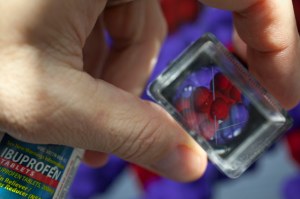
A new study by Harvard School of Public Health researchers shows that adults who regularly take ibuprofen, a nonsteroidal anti-inflammatory drug, have about one-third less risk of developing Parkinson’s disease than nonusers.
-
Health
Alzheimer’s for humans only
Disorders that result in severe neurological decline, such as Alzheimer’s disease, are not found in other animals, meaning that humans acquired their predisposition to the disease during recent evolution.

-
Health
Alzheimer’s-associated protein may be part of the innate immune system
Amyloid-beta protein – the primary constituent of the plaques found in the brains of Alzheimer’s disease patients – may be part of the body’s first-line system to defend against infection. In their report in the open-access journal PLoS One, a team led by Harvard Medical School (HMS) researchers at Massachusetts General Hospital (MGH) describe their…
-
Health
Light worsens migraine headaches
Normal 0 0 1 701 4001 33 8 4913 11.1282 0 0 0 Ask people who suffer from migraine headaches what they do when they’re having attacks, and you’re likely to hear “go into a dark room.” Although it’s long been known that light makes migraines worse, the reason why has been unclear. Now Harvard…
-
Health
Finding the seat of language?
A team of Harvard and University of California, San Diego (UCSD), researchers report having pinpointed an area of the brain where three essential components of language — word identification, grammar, and word pronunciation — are processed. Ned T. Sahin, a postdoctoral fellow in both Harvard’s Psychology Department and UCSD’s Radiology Department, and colleagues at both…
-
Health
Drug for MS reactivates virus causing deadly brain disease
The virus responsible for progressive multifocal leukoencephalopathy (PML), a rare brain disease that typically affects AIDS patients and other individuals with compromised immune systems, has been found to be reactivated in multiple sclerosis patients being treated with natalizumab (Tysabri). The findings by Harvard researchers at Beth Israel Deaconess Medical Center (BIDMC) and collaborators at Johns…
-
Health
Some vocal-mimicking animals, particularly parrots, can move to a musical beat
Researchers at Harvard University have found that humans aren’t the only ones who can groove to a beat — some other species can dance, too. The capability was previously believed to be specific to humans. The research team found that only species that can mimic sound seem to be able to keep a beat, implying…
-
Health
New ALS gene identified
A collaborative research effort spanning nearly a decade between Harvard researchers at Massachusetts General Hospital (MGH) and King’s College London (KCL) has identified a novel gene for inherited amyotrophic lateral sclerosis (ALS, also known as Lou Gehrig’s disease). This is the fourth gene associated with familial forms of the devastating neurological disorder. Two papers, published…
-
Health
Predicting risk of stroke from one’s genetic blueprint
A new statistical model could be used to predict an individual’s lifetime risk of stroke, according to the results of a study by Harvard researchers at the Children’s Hospital Boston Informatics Program.
-
Health
Diverse ‘connectomes’ hint at genes’ limits in the nervous system
Genetics may play a surprisingly small role in determining the precise wiring of the mammalian nervous system, according to painstaking mapping of every neuron projecting to a small muscle mice use to move their ears.
-
Health
The Improvising Brain
What’s involved when a musician sits down at the piano and plays flurries of notes in a free fall, without a score, without knowing much about what will happen moment to moment? Is it possible to find the sources of a creative process? Is it possible to determine how improvisation occurs? Aaron Berkowitz, a Harvard…
-
Health
Another step forward in ALS and stem cell research
A Harvard Stem Cell Institute research team has succeeded in deriving spinal motor neurons from human embryonic stem cells, and has then used them to replicate the Amyotrophic Lateral Sclerosis (ALS) disease process in a laboratory dish.
-
Health
Common surgical anesthetic induces Alzheimer’s-associated changes in mouse brains
For the first time researchers have shown that a commonly used anesthetic can produce changes associated with Alzheimer’s disease in the brains of living mammals, confirming previous laboratory studies. In their Annals of Neurology report, which has received early online release, a team of Harvard researchers at Massachusetts General Hospital (MGH) shows how administration of…
-
Health
MGH study shows how amyloid plaques may damage brain cells in Alzheimer’s disease
One of the major unanswered questions surrounding Alzheimer’s disease – whether and how the amyloid plaques found in the brains of patients with the neurodegenerative disorder actually damage neurons – may be closer to an answer.
-
Health
Middle Eastern families yield intriguing clues to autism
Research involving large Middle Eastern families, sophisticated genetic analysis and groundbreaking neuroscience has implicated a half-dozen new genes in autism. More importantly, it strongly supports the emerging idea that autism stems from disruptions in the brain’s ability to form new connections in response to experience – consistent with autism’s onset during the first year of…
-
Health
Scientists isolate a toxic key to Alzheimer’s disease in human brains
Scientists have long questioned whether the abundant amounts of amyloid plaques found in the brains of patients with Alzheimer’s actually caused the neurological disease or were a by-product of its progress. Now, using new research techniques, scientists have shown that a two-molecule aggregate (or dimer) of beta-amyloid protein fragments may play a role in initiating…
-
Science & Tech
Study identifies food-related clock in the brain
In investigating the intricacies of the body’s biological rhythms, scientists at Beth Israel Deaconess Medical Center (BIDMC) have discovered the existence of a “food-related clock” which can supersede the “light-based” master clock that serves as the body’s primary timekeeper. The findings, which appear in the May 23 issue of the journal Science, help explain how…
-
Health
Elevated urate levels may slow progression of Parkinson’s disease
Naturally elevated levels of the antioxidant urate may slow the progression of Parkinson’s disease in men. Researchers from the MassGeneral Institute for Neurodegenerative Disease (MGH-MIND) and Harvard School of Public Health (HSPH) examined data from an earlier study and found that, among recently diagnosed Parkinson’s patients, those with the highest urate levels had a significantly…
-
Health
Reprogrammed adult skin cells treat Parkinson’s disease in animal model
Researchers at the Whitehead Institute and Harvard Stem Cell Institute(HSCI) have reported successfully reducing symptoms in a Parkinson’s disease rat model by using dopamine producing neurons derived from reprogrammed adult skin cells(iPS). The work was reported in a study published in the online Early Edition of Proceedings of the National Academy of Science. “This is the…
-
Health
Slow reading in dyslexia tied to disorganized brain tracts
Dyslexia marked by poor reading fluency — slow and choppy reading — may be caused by disorganized, meandering tracts of nerve fibers in the brain, according to researchers at Children’s Hospital Boston, Beth Israel Deaconess Medical Center (BIDMC), and the Harvard Graduate School of Education (HGSE) at the time the work was done. Their study,…
-
Health
Cerebral cortex thicker in people with migraines
People who suffer from migraine headaches have differences in an area of the brain that helps process sensory information, including pain, according to a study published in the November 20, 2007, issue of Neurology, the medical journal of the American Academy of Neurology. The study found that part of the cortex area of the brain…