
 Featured series


Tag: Alzheimer’s disease
-
Health
A decade of breakthroughs
The Harvard Stem Cell Institute is now 10 years old. What began as an idea embracing cross-disciplinary research quickly became a generator of scientific discoveries.
-
Health
Hope for aging brains, skeletal muscle
Researchers at the Harvard Stem Cell Institute have shown that a protein, one they previously demonstrated can make failing hearts in aging mice appear more like those of young and healthy mice, similarly improves brain and skeletal muscle function in aging mice.

-
Health
Alzheimer’s in a dish
Harvard stem cell scientists have successfully converted skins cells from patients with early onset Alzheimer’s into the types of neurons affected by the disease, making it possible for the first time to study this leading form of dementia in living human cells.

-
Health
Environment counts, Alzheimer’s research suggests
A new study led by Harvard Medical School Professor Dennis Selkoe provides specific, pre-clinical scientific evidence supporting the concept that prolonged and intensive stimulation by an enriched environment may have beneficial effects in delaying one of the key negative factors in Alzheimer’s disease.

-
Health
The future of self-knowledge
Anne Wojcicki, chief executive officer and co-founder of 23andMe, talked about growth in personal genomics in an event sponsored by the Program on Science, Technology and Society.

-
Health
An opening against Alzheimer’s
Findings by a team at Harvard-affiliated Beth Israel Deaconess Medical Center suggest a new strategy for diagnosing and treating Alzheimer’s disease.

-
Health
Slowing neurodegeneration in Huntington’s
Harvard researchers have found a treatment that increases brain levels of an important regulatory enzyme may slow the loss of brain cells that characterizes Huntington’s disease and other neurodegenerative disorders.

-
Health
Brain changes found in normal elders
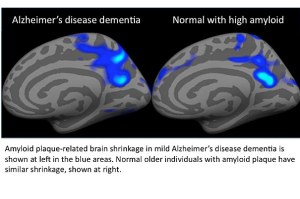
Harvard-affiliated researchers using two brain-imaging technologies have found that apparently normal older individuals with brain deposits of amyloid beta — the primary constituent of the plaques found in the brains of Alzheimer’s disease patients — also had changes in brain structure similar to those seen in Alzheimer’s patients.
-
Health
Did rapid brain evolution make humans susceptible to Alzheimers?
Of the millions of animals on Earth, including the relative handful that are considered the most intelligent — including apes, whales, crows, and owls — only humans experience the severe age-related decline in mental abilities marked by Alzheimer’s disease. To Bruce Yankner, professor of pathology and neurology at Harvard Medical School (HMS), it’s pretty clear…
-
Health
Alzheimer’s-associated protein may be part of the innate immune system
Amyloid-beta protein – the primary constituent of the plaques found in the brains of Alzheimer’s disease patients – may be part of the body’s first-line system to defend against infection. In their report in the open-access journal PLoS One, a team led by Harvard Medical School (HMS) researchers at Massachusetts General Hospital (MGH) describe their…
-
Health
Alzheimer’s-associated plaques may have impact throughout the brain
The impact of the amyloid plaques that appear in the brains of patients with Alzheimer’s disease may extend beyond the deposits’ effects on neurons — the cells that transmit electrochemical signals throughout the nervous system. In an article in the Feb. 27 issue of Science, Harvard researchers from the MassGeneral Institute for Neurodegenerative Disease (MGH-MIND)…
-
Health
Common surgical anesthetic induces Alzheimer’s-associated changes in mouse brains
For the first time researchers have shown that a commonly used anesthetic can produce changes associated with Alzheimer’s disease in the brains of living mammals, confirming previous laboratory studies. In their Annals of Neurology report, which has received early online release, a team of Harvard researchers at Massachusetts General Hospital (MGH) shows how administration of…
-
Health
Gene scan of Alzheimer’s families identifies four new suspect genes
The first family-based genome-wide association study in Alzheimer’s disease has identified the sites of four novel genes that may significantly influence risk for the most common late-onset form of the devastating neurological disorder. In their report in the Nov. 7 American Journal of Human Genetics, first released online, a team led by Harvard researchers from…
-
Health
MGH study shows how amyloid plaques may damage brain cells in Alzheimer’s disease
One of the major unanswered questions surrounding Alzheimer’s disease – whether and how the amyloid plaques found in the brains of patients with the neurodegenerative disorder actually damage neurons – may be closer to an answer.
-
Health
Scientists isolate a toxic key to Alzheimer’s disease in human brains
Scientists have long questioned whether the abundant amounts of amyloid plaques found in the brains of patients with Alzheimer’s actually caused the neurological disease or were a by-product of its progress. Now, using new research techniques, scientists have shown that a two-molecule aggregate (or dimer) of beta-amyloid protein fragments may play a role in initiating…
-
Health
Even in healthy elderly, brain systems become less coordinated
Some brain systems become less coordinated with age even in the absence of Alzheimer’s disease, according to a new study from Harvard University. The results help to explain why advanced age is often accompanied by a loss of mental agility, even in an otherwise healthy individual. The study, published in the Dec. 6 issue of…
-
Health
Finding the start of Alzheimer’s disease
Faces are hard to remember. Even harder are the names that go with them. It’s one of the most common problems people face as they get older. In puzzling over why that is, Reisa Sperling and her colleagues at Harvard Medical School have discovered startling things about how memories are made and why people lose…
-
Campus & Community
Important signal uncovered in brain development
Nobody has counted them, but the best estimates put the number of human brain cells in the trillions. The best known among them, called neurons, do the heavy thinking and remembering. Each of these cells can connect to 10 or more others, forming a vast network of feelings, thoughts, memories, prejudices, and PINS. But neurons…
-
Health
Potential Alzheimer’s vaccine improves learning and memory deficits in mice
Researchers have found that a vaccine for Alzheimer’s disease improves learning and memory deficits in mice. “Our findings show promise for a potentially safer and more effective Alzheimer’s vaccine in humans,” says senior researcher and Harvard Medical School associate professor Cynthia Lemere. Lemere and colleagues at Brigham and Women’s Hospital report combined immunological, neuropathological, and…
-
Health
Enzyme key in preventing Alzheimer’s onset
A new discovery has found that Pin1, an enzyme previously shown to prevent the formation of the tangle-like lesions found in the brains of Alzheimer’s disease patients, also plays a pivotal role in guarding against the development of amyloid peptide plaques, the second brain lesion that characterizes Alzheimer’s. These new findings, shown in an animal…
-
Campus & Community
Work progressing on Alzheimer’s, but too slowly
Actor David Hyde Pierce made an emotional plea for increased activism around Alzheimer’s disease Monday (Oct. 17), saying that federal funding has leveled off despite scientific progress in understanding and treating the disease in the last 15 years. Pierce, a member of the Alzheimer’s Association’s National Board, watched both his father and grandfather deteriorate and…
-
Health
Vaccine may clear Alzheimer’s brain plaques
While there is still no consensus about the role of waxy amyloid plaques that fill the brains of Alzheimer’s patients, many in the field believe they are a root cause of neurodegeneration and that clearing them may improve the cognitive function of patients. A major strategy has been to remove amyloid-beta by creating antibodies against…
-
Health
Compound traces brain plaques in real time
Alzheimer’s disease is notoriously difficult to diagnose. Though sophisticated functional and cognitive tests can help, they often fail to distinguish between Alzheimer’s and other non-amyloid-based dementias, particularly frontotemporal dementia. The ability to measure plaques in vivo would not only provide clinicians with an immediate and reliable diagnosis, but over time would allow them to gauge…
-
Health
Early molecule fingered as an Alzheimer’s cause
“The way we look at it, Alzheimer’s disease is really cancer of the brain,” says Rachael Neve, Harvard Medical School associate professor of psychiatry at McLean Hospital. “But neurons cannot divide and form tumors so they undergo apoptosis (cell death) instead.” Neve; Donna McPhie, Harvard Medical School instructor in psychiatry; and their colleagues show in…
-
Health
Alzheimer’s disease: New theory on how it damages brain
Studies have shown that the buildup in the brain of certain toxic proteins, called amyloids, leads to the emergence of the symptoms of Alzheimer’s disease. Research has traditionally focused on how to eliminate or lower the levels of these proteins in the brain as a potential treatment for the disease. But now researchers believe that…
-
Health
Alzheimer’s-associated enzyme elevated in key brain areas
A research report that appears in the September 2002 issue of the journal Archives of Neurology may improve understanding of the most common form of Alzheimer’s disease. “Our key finding is that beta-secretase activity — the efficiency of how the enzyme works — is increased in Alzheimer’s diseased brains specifically in those areas affected by…
-
Health
Lack of protein ApoE in brain may raise Alzheimer’s risk
Brain cells are protected from possible contamination by substances in circulating blood by what is known as “the blood-brain barrier.” Researchers have many questions about precisely how this protective mechanism works. Recently, Harvard Medical Sschool researchers identified a protein that supports the blood-brain barrier. When a molecule, apolipoprotein E (apoE), is absent, the barrier becomes…
-
Health
Study shows strong public interest in genetic testing for Alzheimer’s disease
A genetic test to determine a person’s chance of getting Alzheimer’s disease is still hypothetical. But scientists are getting closer and closer to being able to determine who is likely to get the disease. A study by Harvard researchers and their colleagues found that, once such a genetic test is developed, approximately 80 percent of…
-
Health
An alternate take on Alzheimer’s
Much of Alzheimer’s research has focused on the role of a protein, amyloid-beta, found at high levels in the brains of Alzheimer’s patients and which coagulates into plaques. Researcher Ashley Bush, a Harvard Medical School associate professor of psychiatry at Massachusetts General Hospital, believes that something else causes Alzheimer’s dementia: oxidation of trace metals in…
-
Health
Circadian rhythms may distinguish Alzheimer’s disease
Researcher David Harper and his colleagues monitored two key components of the circadian system — the rise and fall of core body temperature and the waxing and waning of spontaneous motor activity — in 38 dementia patients with either Alzheimer’s disease or another form of dementia, frontotemporal degeneration. They found that body temperature reached its…