Featured series
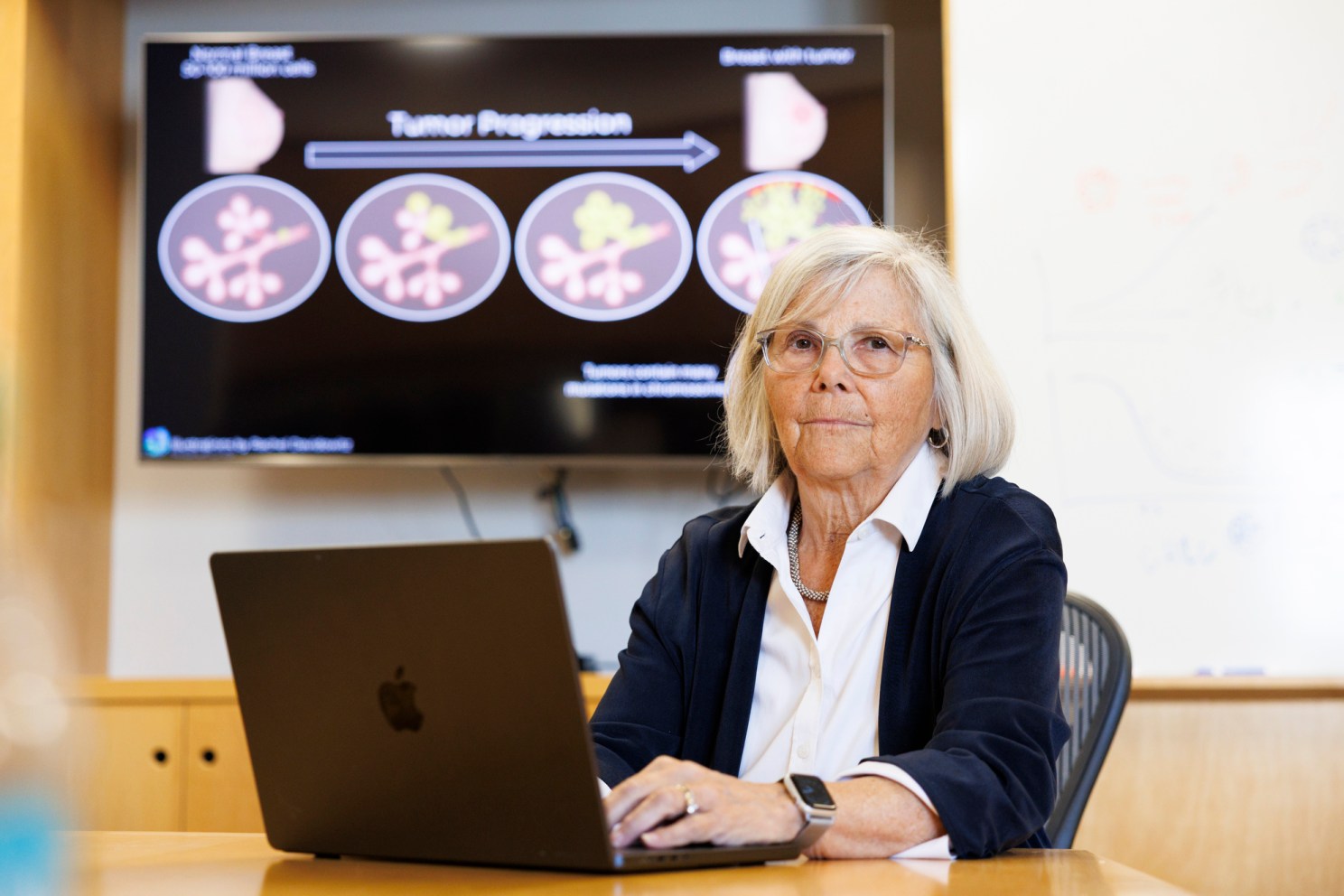
Joan Brugge.
Niles Singer/Harvard Staff Photographer
Health
How did her sister become so sick so fast?
Joan Brugge’s decadeslong professional fight against cancer began when she tried to make sense of a tragedy

A series focused on the personal side of Harvard research and teaching.
Joan Brugge was on track to graduate from Northwestern University in a few years and launch into a career teaching math when a single phone call changed the direction of her life.
“I was a sophomore and I got this call from my parents, sobbing, asking could I please come home because my sister was going to be operated on,” Brugge said.
It turned out that her sister, who was 21, had a malignant brain tumor and was set to undergo treatment in their hometown of Cincinnati. Repeated radiation treatments ultimately damaged her sister’s brain to the point where she could not function independently, forcing her into a nursing home. In 1970, a little more than a year after the treatments began, Brugge’s sister died.
In an attempt to make sense of how her sister had gone from healthy and vibrant to so sick in a matter of months, Brugge said on that first trip back to Ohio she had started asking her sister’s doctors questions. She wanted to understand if they knew what caused the tumor, because then they might be able to fix what was wrong. Or at least, prevent it from happening to others.
“The doctor said we don’t know, but they were beginning to look at viruses. So I went back to Northwestern and asked my adviser if I could do an independent literature study on viruses and cancer,” Brugge said. “That was my first exposure to scientific literature, and it really was fascinating, just to see how a hypothesis was generated or question was raised in the introduction and then experiments were done to address it. I was hooked after I started doing that.”
Instead of being the math teacher she once imagined, Brugge is now the Louise Foote Pfeiffer Professor of Cell Biology in the Blavatnik Institute at Harvard Medical School and director of HMS’s Ludwig Center, where she helps bring together interdisciplinary cancer research.
As for the career path she abandoned, she said she probably wouldn’t have lasted all four years studying numbers.
“I really liked math because I liked to solve problems,” Brugge said. “But I think when we got into some of the really heavy math, I might have faded out in terms of the really esoteric math.”
“But,” she added, “I’m still really addicted to solving problems.”
“After seeing what my family went through and what my sister went through, that was the motivation. Just to be part of research that could potentially make a difference.”
Brugge studied biology as an undergraduate, going on to earn a Ph.D. in virology from Baylor College of Medicine. As a postdoc in 1975, she was on the foreground of one of the most significant cancer discoveries, one that still shapes researchers’ understanding of the disease today.
At that time Harold Varmus and Michael Bishop, scientists at the University of California, San Francisco, found that a virus causing tumors in animal models was actually a cellular gene called SRC captured by the virus, indicating that our own genes can become tumorigenic when abnormally regulated. Brugge and her advisor, working at the University of Colorado, isolated the protein encoded by the SRC gene, making it possible to understand the mechanisms transforming normal cells into cancer cells.
“We then found that the SRC protein didn’t specifically control proliferation and that it played different roles in different cell types, some of which are important for the normal health,” Brugge said. “That made it clear that I wasn’t going to be discovering a eureka cure for cancer by blocking SRC … just trying to understand as much as we could about the pathways that are disrupted in cancer in order to find more specific ways to kill tumor cells.”
Brugge went on to have professorships at SUNY-Stony Brook and the University of Pennsylvania, before branching out to become the scientific director and senior vice president at ARIAD Pharmaceuticals. She returned to academia as a professor of cell biology at HMS in 1997 and chaired the department from 2004-2014, when she became co-director of the Ludwig Center.
Through it all, Brugge said her thoughts have always come back to her sister.
“After seeing what my family went through and what my sister went through, that was the motivation,” she said. “Just to be part of research that could potentially make a difference.”
In addition to her sister, Brugge lost her mother to cancer — ovarian in 1998 — spurring her involvement in Harvard research analyzing human tumors before and after chemotherapy, to figure out how to kill cells that survive treatment.
“It was just after my mom had passed away, so I definitely leapt on that,” Brugge said.
Brugge was brought on with enthusiasm, as her lab had experience using cutting-edge tools including 3D/organoid cell cultures, genetically engineered and transplantation-based animal models, single-cell analysis, metabolomics, and high-throughput microscopy.
“I was brought in not because I had ovarian cancer research experience, but because I had been working with these 3D models where cells are able to grow in a context that more closely mimics the tumor context in vivo, because tumors don’t grow on a really hard plastic petri dish,” Brugge said.
The single-cell approach has been especially important in studying the highly volatile BRCA 1 and 2 mutations in breast cancer. The hope is to one day identify the precursors of cancer in order to eliminate the cells before they accumulate and become almost untreatable.
“We think we have a handle on the cells that could be the precursors of cancer, and now we’re trying to figure out what alterations they’re causing, and what are the vulnerabilities of the cells that carry those, so we could try to eliminate them or prevent them from progressing into cancer,” Brugge said.
Despite all the progress, Brugge said one of her biggest worries is continuing to find funding.
“What gets me down, and in those states where I’m like, ‘What am I doing? How much longer can I do this?’ is the funding,” she said. “When we went through the terminations, that was really tough.”
Last year, Brugge’s lab lost significant federal money, forcing her and her team to seek out private funding to finish their work. While they were able to cover costs for projects in their later stages, Brugge said it’s especially disheartening to see research defunded when important cancer breakthroughs are on the horizon.
“There’s great promise in checkpoint inhibitors, which wake up the immune cells and can work really great in some tumors. And there hasn’t been super rapid progress in figuring out how to manipulate the immune system in those tumors where the first therapies aren’t working. But it’s going to come,” she said.
And when she runs up against a roadblock, Brugge said memories of her sister remind her of the importance of her work.
“She definitely comes to mind,” Brugge said. “Definitely.”
Share this article


Also in this series:
-
Making music is magic. Understanding it is even better.
Why Sophia Zervas traded a career in the arts for academia
-
One answer but with more than one way to get there
Jon Star, professor of teaching and learning, finds flexibility is key to helping students master math
-
Pursuit of justice borne of personal experience with injustice
Rosalie Abella, the first Jewish woman on Canada’s Supreme Court, was shaped by her parents’ resilience after Holocaust
-
Numbers tell one story about climate change. People tell another.
Policy expert Dustin Tingley studies transition to renewable energy, knows from work, life how economic shifts rattle through communities
-
Aha moment in psych class clarifies childhood mystery
Inspires Susan Kuo’s research probing role of genetics in schizophrenia, autism
-
Seeing is believing
Personal and global history made Jeremy Weinstein want to change the world. As dean of the Kennedy School, he’s found the perfect place to do it.