Featured series

Nation & World
Where U.S. has lost ground since 9/11
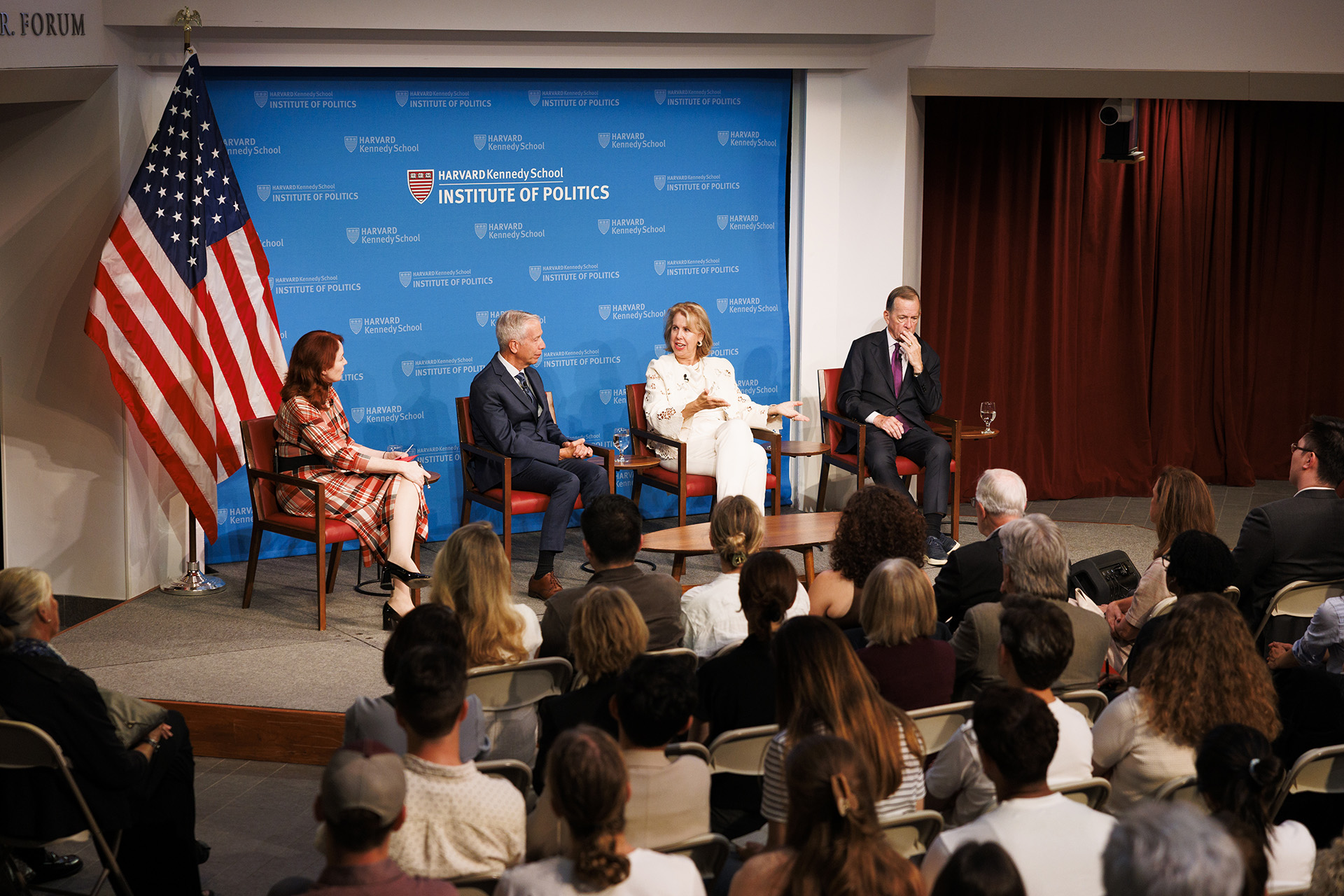
Moderator Meghan O’Sullivan (from left), Joseph Pfeifer, Nancy Gibbs, and Michael Mullen.
Niles Singer/Harvard Staff Photographer
FDNY chief, admiral who survived Pentagon attack, Time journalist say decline in national unity since then is perhaps most damaging problem
After the terrorist attacks on Sept. 11, 2001, the nation rallied under the cry “Never forget.”
But 25 years later, several lessons that emerged from that day of death and destruction have been forgotten, according to a panel of experts at a John F. Kennedy Jr. Forum at the Institute of Politics on Tuesday night.
Three panelists — the first New York Fire Department chief to respond to the attack, a Navy admiral who was in the Pentagon that day, and a journalist who covered it for Time magazine — were all personally impacted by the attack.
Chief of Counterterrorism and Emergency Preparedness for the Fire Department of New York, Joseph Pfeifer, now a Kennedy School senior fellow and author of “Ordinary Heroes: A Memoir of 9/11,” was inspecting a suspected gas leak nearby in lower Manhattan at 8:46 that morning when the first plane hit the North Tower of the World Trade Center.
“Every first responder looked at the burning building and knew they were going to the most dangerous fire of their lives,” he recalled.
Recognizing immediately that the crash was deliberate, he also explained how, nearly an hour later, when the South Tower was collapsing, he had to make a fateful decision. Trusting his “gut feeling” and years of training, he called for all firefighters to evacuate.
“It was probably the first time in history a fire chief pulled firefighters out when there were thousands of people in the building,” he said.
Adm. Michael Glenn “Mike” Mullen, who would go on to serve as President George W. Bush’s chairman of the Joint Chiefs of Staff (2007–2011), was in the Pentagon when it was hit by a third plane that day.
At the Tuesday discussion, which was co-sponsored by the Belfer Center for Science and International Affairs and the Shorenstein Center on Media, Politics and Public Policy, he recalled how at first he associated the resulting explosion with earthquakes he’d experienced growing up in California.
On realizing what had happened, the Pentagon immediately went “into crisis mode” and called on everyone in the complex to evacuate. But, he told the audience, many of whom had not been born in 2001, confusion ruled the day.
“What sometimes gets lost is how little we knew,” he said. “We didn’t know how many planes it would be or where they were coming from.”
“Everyone understood we were living in an illusion that had been shattered, but no one knew what that was going to mean in a day, a week, a month, or 25 years.”
Nancy Gibbs
Nancy Gibbs, Lombard Director of the Shorenstein Center and Edward R. Murrow Professor of the Practice of Press, Politics and Public Policy, was working for Time magazine when she got the assignment to write about that day.
Although she was in Westchester with a sick child at the time of the attacks, her immersive cover story, “If You Want to Humble an Empire,” brought her into close contact with survivors, first responders, and officials, among others.
That day’s legacy, she said, included an end to the “certainty of safety that we [Americans] took for granted.”
“Everyone understood we were living in an illusion that had been shattered, but no one knew what that was going to mean in a day, a week, a month, or 25 years,” said Gibbs, who would go on to become the magazine’s first female editor-in-chief.
One result, she continued, was “the unbelievable heroism” of ordinary people, recalling “lines looping around hospitals of people wanting to give blood, and people opening their homes to dust-covered, traumatized” survivors.
Twenty-five years later, said Pfeifer, “we are in a better position” in terms of national security.
In large part that is due, Mullen said, to tighter cooperation resulting from the establishment of the Department of Homeland Security, which was made up of all or parts of 22 departments and agencies. Before Sept. 11, he pointed out, “We had all the information we needed to put it together ahead of time, and yet we couldn’t do that.”
In the past 25 years, we haven’t had another such attack.
Citing the “thousands and thousands [of people] working to make sure it didn’t happen again,” he said that the effort is ongoing. “We have to stay vigilant.”
Like the intelligence services, all three panelists agreed, the nation at large learned how much stronger we are together.
Pfeifer, for example, turned his three watchwords — connect, collaborate, and coordinate — into a challenge coin, which he presented to Mullen.
But all three stressed that hard-won unity is now under threat.
“When we’re put under stress, our stress response is to turn into our own groups. What we need to do is have a sense of crisis empathy, working with our partners and exchanging ideas, and, as we move ahead, to coordinate our efforts,” said Pfeifer.
On Sept. 11, said Mullen, “We had a moment of unity. That coming together was really important.”
The highly divisive responses to the pandemic, said Gibbs, revealed how that sense of national unity has fractured.
After the Sept. 11 attacks, she noted, the nation engaged in a hard conversation over what measures might be required to ensure our security. One potential sticking point was the question of which was more important: privacy or security.
But that debate was possible because of a shared understanding of what had happened.
“We were having an intensive debate over values, but we could have that kind of argument because it was taking place on top of a baseline of shared assumptions,” Gibbs said. “A large majority of people in this country believe that no longer exists.”
In large part, she concluded, this fragmentation is due to social media. While in 2001, there was no TikTok or Facebook, the current climate has created a situation where “all of us are living in different information environments.”