
 Featured series

Tag: Mikhail Lukin
-
Science & Tech
Researchers create first logical quantum processor
Key step toward reliable, game-changing quantum computing
-
Science & Tech
Self-correcting quantum computers within reach?
Harvard team’s method of reducing errors tackles a major barrier to scaling up technology.
-
Campus & Community
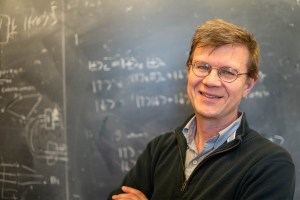
Mikhail Lukin named University Professor
A pioneer and leader in quantum science and quantum computing, Mikhail Lukin will hold the Friedman University Professorship.
-
Science & Tech
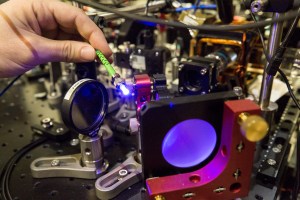
Harvard partners with Amazon Web Services in quantum internet push
Harvard faculty leaders explain implications for the field — and the future.
-
Science & Tech
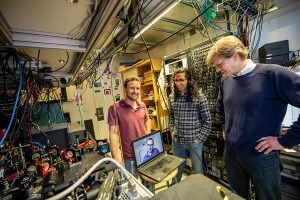
New approach may help clear hurdle to large-scale quantum computing
A team of physicists have created a new method for shuttling entangled atoms in a quantum processor at the forefront for building large-scale programmable quantum machines.
-
Science & Tech
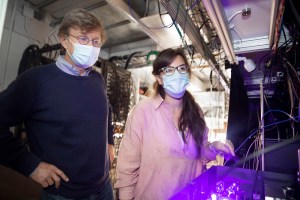
Step in quest for quantum computing
Harvard researchers observe a state of matter predicted and hunted for 50 years, but never previously observed.
-
Science & Tech
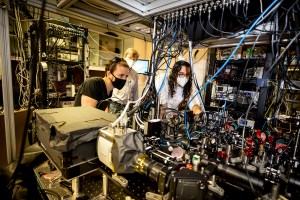
Harvard-led physicists take big step in race to quantum computing
A Harvard-led team has created a 256-qubit programmable quantum simulator that represents the cutting edge in the world-wide quantum race.
-
Campus & Community
Harvard president reflects on past year, and looks ahead
Harvard President Larry Bacow reflects on how the Harvard community has met the challenges posed by COVID-19, and to look ahead how the University is tackling some of the world’s most pressing problems.
-
Campus & Community
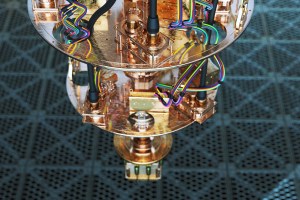
Harvard partners with national labs on quantum computing
The White House Office of Science and Technology Policy and the U.S. Department of Energy announced the creation of five new Quantum Information Science Research Centers across the country. Harvard researchers will play important roles in three of the centers.
-
Science & Tech
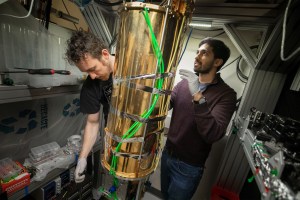
Toward an unhackable quantum internet
Harvard and MIT researchers have found a way to correct for signal loss with a prototype quantum node that can catch, store, and entangle bits of quantum information. The research is the missing link toward a practical quantum internet.
-
Science & Tech
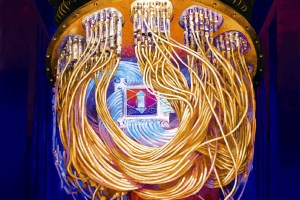
Riding the quantum computing ‘wave’
Google engineers claimed to have created a quantum computer that exhibited “quantum supremacy.” The Gazette spoke with Harvard Quantum Initiative Co-Director Mikhail Lukin about the achievement, about similar work at Harvard.
-
Science & Tech
Shining a light on quantum bits
A Ph.D. student working in the lab of Professor Mikhail Lukin, co-director of the Quantum Science and Engineering Initiative, has demonstrated a method for engineering an interaction between two qubits using photons.
-
Science & Tech
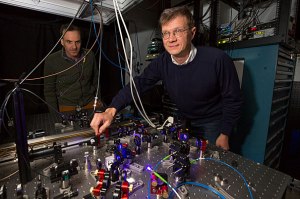
Researchers create quantum calculator
Researchers have developed a special type of quantum computer, known as a quantum simulator, that is programmed by capturing super-cooled rubidium atoms with lasers and arranging them in a specific order, then allowing quantum mechanics to do the necessary calculations.
-
Science & Tech
Flipping the switch
Harvard researchers have succeeded in creating quantum switches that can be turned on and off using a single photon, an achievement that could pave the way for the creation of highly secure quantum networks.
-
Science & Tech
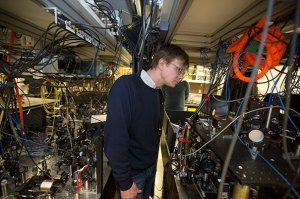
Seeing light in a new way
Working with colleagues at the Harvard-MIT Center for Ultracold Atoms, Professor of Physics Mikhail Lukin and post-doctoral fellow Ofer Firstenberg have managed to coax photons into binding together to form molecules — a state of matter that, until recently, had been purely theoretical.
-
Campus & Community
AAAS names 7 fellows from Harvard
Seven faculty from Harvard University are named fellows of the American Association for the Advancement of Science.

-
Science & Tech
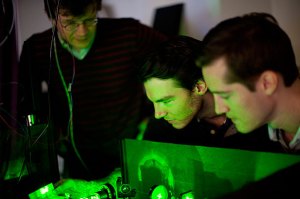
Quantum computing, no cooling required
Using a pair of impurities in ultra-pure, laboratory-grown diamonds, researchers have created room-temperature quantum bits and have stored information in them for nearly two seconds — an increase of nearly six orders of magnitude over the life span of earlier systems. The work, described in the June 8 issue of Science, is a critical first…
-
Science & Tech
Quantum networks advance with entanglement of photons, solid-state qubits
A team of Harvard physicists led by Mikhail D. Lukin has achieved the first-ever quantum entanglement of photons and solid-state materials. The work marks a key advance toward practical quantum networks, as the first experimental demonstration of a means by which solid-state quantum bits, or “qubits,” can communicate with one another over long distances. Quantum networking applications such as…
-
Science & Tech
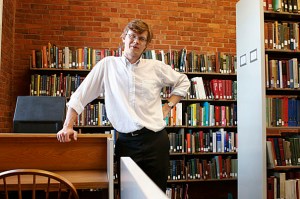
Quantum connections
Harvard physicists demonstrate the first quantum entanglement of photons and solid-state materials, in work that marks a key advance toward practical quantum networks that can communicate over long distances.
-
Science & Tech
Lukin illuminates quantum science
Mikhail Lukin thinks that devices based on quantum science are at the same stage as radios were about 100 years ago. To catch up, the recently tenured professor of physics is stopping and storing light, making artificial atoms behave in new ways, and doing engineering with superconductivity. When quantum does overtake kilowatts, you can expect…
-
Science & Tech
Have light, will not travel
Harvard researchers fired a short signal pulse of red laser light into a sealed glass cylinder containing a hot gas of rubidium atoms illuminated by a strong control beam. While the pulse was traveling through the rubidium gas, they switched off the control beam, resulting in the storage of a holographic imprint of the signal…
-
Science & Tech
Harvard researchers stop, restart, light
Albert Einstein theorized that light cannot travel faster than 186,282 miles per second. But he never said it couldn’t go slower. Lene Hau, a physics professor in the Faculty of Arts and Sciences at Harvard University, says Einstein would “probably be stunned” at the results of her recent experiments. Working in her laboratory at the…