Featured series
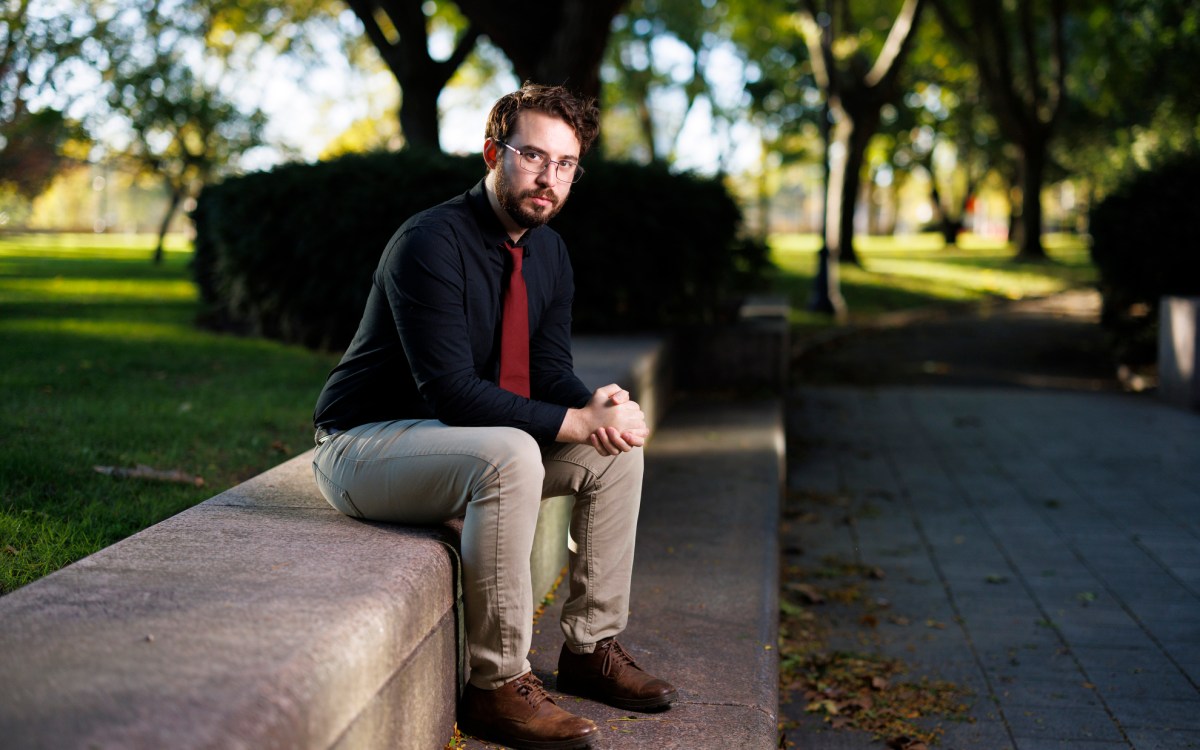
Niles Singer/Harvard Staff Photographer
Science & Tech
Digital life doesn’t have to be this way
Writer, activist Cory Doctorow wants you to be mad about tech monopoly — but not blindly terrified of AI
Cory Doctorow wants you to know it doesn’t have to be this way.
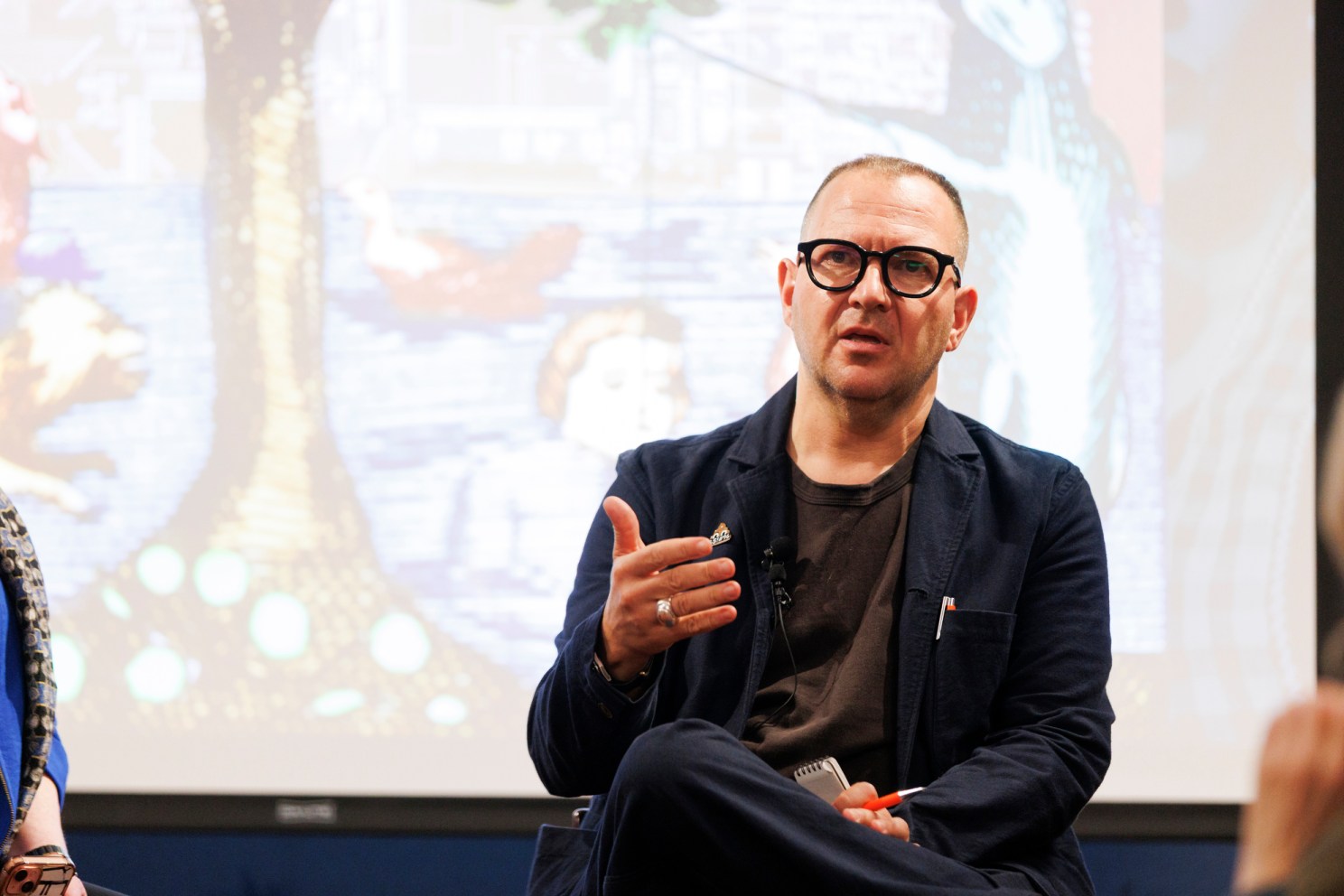
At a discussion Wednesday night moderated by Elizabeth Mynatt, dean of Northeastern’s Khoury College of Computer Sciences, the Canadian-British writer and activist addressed a friendly room at the Berkman Klein Center.
Doctorow has been a longtime comrade in the fight for an open, safe, and humanistic internet for which the center was founded 30 years ago.
But he also belongs to another, older lineage: one of enraged populism and antitrust militancy.
At the event, Doctorow issued a call to arms against the digital age’s new monopolies. And he cast doubt on the possibility that AI, the tech industry’s latest “disruption,” would improve human lives or justify its costs as — to date — “the money-losingest thing the human race has ever done.”
He also warned that the much-touted potential of AI to change the world, for good or for ill, may miss real risks the technology poses.
Recently Doctorow achieved a one-word breakthrough with “enshittification,” a neologism describing a three-step process by which big tech platforms lure in users with promises, say, to respect the privacy of their data, betray them to business clients — then betray those business clients, too, in service of their own bottom lines.
The end state, Doctorow argued, may be the worst of all possible worlds: for users, services they’ve grown to hate using but struggle to leave, for companies, a “brittle” equilibrium, with the ever-present threat of a mass exodus.
It’s a partisan story, but then Doctorow is a partisan — he’s been an activist affiliated with the Electronic Frontier Foundation for more than 20 years. It’s also a plausible one, as user dissatisfaction grows with a series of once generally favored tools — from Amazon Marketplace to Google Search — even as tech stocks keep on rising.
In any event, “enshittification” has been a hit. The American Dialect Society named it “Word of the Year” in 2023, and it has since been added to the Oxford English Dictionary (“major bucket-list stuff right there,” Doctorow said).
That isn’t in spite of the word’s unprintability in polite outlets, Doctorow argued, but because of it: “There’s just something about the minor license to vulgarity — especially when you’re very angry … that seems to unlock a willingness to listen to a more thoroughgoing policy analysis.”
And woven in between schoolyard jokes and righteous indignation, Doctorow offers that analysis: a political economy of Silicon Valley firms incentivized not to do one thing well but to sell the public on Next Big Things.
A “mature” public company, he notes, grows slowly, pays regular dividends, and supports stock prices of 10 to 20 times their annual earnings per share.
By contrast, tech companies — the archetypal “growth” businesses — sustain price-to-earnings ratios twice that high, often with the promise that they are about to conquer or absorb some existing profitable sector: Think taxis or trucking, bookstores or newspapers.
And, when much of their top talent is at least partially paid in company stock, it becomes vitally important that those promises are believed.
The latest promise is the subject of Doctorow’s latest book, “The Reverse Centaur’s Guide to Life After AI,” published in June. He referred to it as “the greatest literary blunder of his life,” as his attempt to wave away most AI panic instead invited more angsty conversation.
At 55, Doctorow is arguably one of the world’s oldest and most venerable “digital natives”: a godfather of blogging and open-source software developer, co-founder of Boing Boing, and a Wired contributor.
And he’s had moments of awe at the “super-cool, interesting” things the latest AI models can do: from generating their own stochastic collages to finding and transcribing a memorable quote from a recent podcast.
These are “centaur” experiences, where a technology endows a human user with superhuman strength, expediting their work and improving their lives. (It’s a tale as old as corrective lenses, Mynatt pointed out.)
But Doctorow worries that — with AI — many humans will have reverse-centaur experiences, where employers, aiming to lower labor costs, force them to use the technology on far-from-human terms.
For example, he speculated, a hospital might lay off all but a few of its human radiologists, with the remainder “marking the AI’s homework.”
Given the algorithms’ speed and the statistical plausibility of their findings, those few remaining humans will be looking for errors that are devilishly hard to spot — and will take the blame whenever mistakes are made.
Asked about the potential existential risks that trouble AI engineers, Doctorow scoffed. He argues that LLMs, at bottom “word-guessing machines,” still cannot research themselves, remain relentlessly error-prone, and are “nowhere near recursive self-improvement.”
His own AI worry is the firms’ growing centrality in the unequal global economy.
Doctorow noted that the seven companies making big bets on AI now represent 35 percent of the total value of the S&P 500. That value could be “vaporized overnight, when investors lose confidence,” he said. From there, he argued, the story is all too human: financial crisis, austerity, and a further lurch into hard-right politics.
Doctorow’s first writing as a teenager was science fiction. He still publishes in the genre, and in “Reverse Centaurs,” he celebrates it as an “anti-inevitabilist” literature.
In sci-fi, “many different writers have imagined many different futures, each of which can feel possible and even desirable,” he writes. And “the fact that social relations between people and their technology can be different means that the current arrangement is a choice, and — crucially — it means that we can choose something else.”
If digital life is less fun than ever — characterized by worsening user experience, false promises, ubiquitous advertising, and threats of doom — “it’s not because of the iron laws of history,” he said. “It’s because named individuals in living memory decided this was the environment we should have … But we can make different decisions.”