Featured series


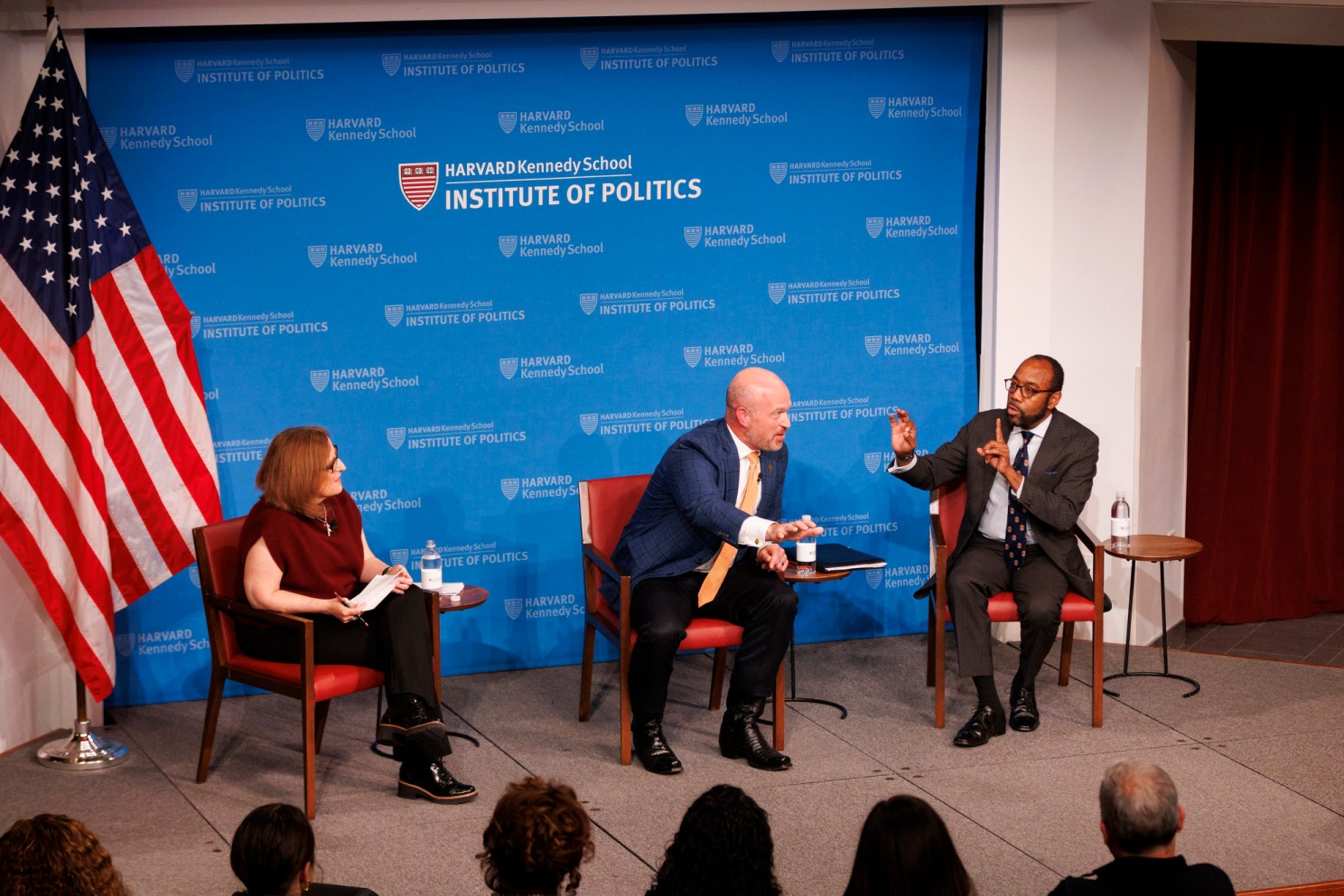
Moderator Laura Meckler (from left), Kevin Roberts, and Cornell William Brooks.
Niles Singer/Harvard Staff Photographer
Nation & World
What role should ‘diversity,’ ‘pluralism’ play in higher education?
Cornell William Brooks, Kevin Roberts spar over whether race-conscious programs still needed
The participants at a John F. Kennedy Jr. Forum debate last week on “diversity” and “pluralism” in higher education were clearly suitably matched.
Kevin Roberts is president of the conservative Heritage Foundation think tank. His group published Project 2025, a 900-page policy document that has heavily influenced President Trump’s second-term agenda and pushed for the end of diversity, equity, and inclusion (DEI) programs.
Cornell William Brooks, a civil rights attorney, formerly led the National Association for the Advancement of Colored People and is currently Hauser Professor of the Practice of Nonprofit Organizations and professor of the practice of public leadership and social justice at Harvard Kennedy School.
The two did agree on this one broad principle: Universities should be composed of people from a wide range of backgrounds.
But Brooks called the concept “diversity”; Roberts preferred the term “pluralism.”
And the pair sharply diverged on how far the country has progressed on racial discrimination and whether race-conscious programs are still needed — a divide that likely came as no surprise to Brooks, who said in his opening remarks, “When the school asked me to debate, I asked them to ask Kevin Roberts.”
Asked by moderator Laura Meckler, a Washington Post reporter, what higher education has gotten right and wrong in their efforts, the two outlined these disagreements.
Roberts said race-conscious programs had outlived their usefulness.
“In 1964 or ’65, did we need programs — that then weren’t called DEI — in order to level the playing field? Perhaps so,” he said. “But our problem at Heritage, my problem as a scholar in this work, is that we are denying the progress that’s been made over the intervening several decades.”
Brooks said, “When we talk about racism, antisemitism, xenophobia, Islamophobia in American society, we’re not talking about some distant age in the past. No new administration will bring about some new era in America where we don’t have to be vigilant with respect to fighting bigotry of all forms.”
Meckler pushed both speakers to defend their arguments.
She asked Roberts to rationalize how the current administration could argue for a smaller governmental role in education while also aggressively “telling universities and K-12 schools what to do.”
Roberts said the administration is trying to correct injustices and argued that if Harvard doesn’t want to listen to the government, the University should reject federal funding, which he did as president of Wyoming Catholic College.
Meckler asked Brooks to respond to the idea that some students won’t be admitted because they don’t check the right demographic box.
Brooks said that many white students at Harvard benefit from kinds of advantages not available to most Black and brown students. He also argued that conservative voices are overly focused on scholarship programs for Black and brown students, ignoring financial aid earmarked exclusively for members of other racial, ethnic, or religious groups.
Summarizing the event, Roberts said the disagreements between the two speakers came down to an “honest-to-goodness policy disagreement about the kinds of policies that work.”
He argued that race-neutral policies that emphasized socioeconomics and geography would better serve the public.
Brooks invoked the story of civil rights attorney Pauli Murray, who was rejected by Harvard Law School because of her gender but ended up crafting the legal strategy that cleared a path for the landmark Brown v. Board of Education ruling.
To live in a racially diverse democracy, Brooks said, “We have to fight for it every day, all the time.”