
 Featured series

Tag: Department of Psychology
-
Science & Tech
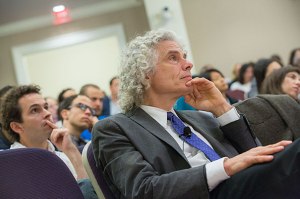
Giving ‘good’ a rigorous inspection
Harvard scholars Joshua Greene and Steven Pinker were joined by Princeton philosopher Peter Singer in a conversation examining how to be moral — and happy.
-
Campus & Community
Ellen Langer joins group of geniuses
Ellen Langer, professor of psychology, is among the 2016 recipients of the Liberty Science Center Genius Awards.

-
Campus & Community
Seeing again, for the first time
Mahzarin Banaji delivered the final Diversity Dialogue of the year titled “Blindspot: The Hidden Biases of Good People.”

-
Science & Tech
Nice guys can finish first
Nice guys can finish first — a new paper, published in the Proceedings of the National Academy of Sciences, has found that complex social networks like those of everyday life encourage members to be friendlier and more cooperative, with the possible payoff coming in an expanded social sphere. The study said selfish behavior can lead…
-
Science & Tech
Oh, the humanity
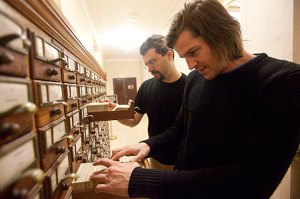
Using digitized books as a “cultural genome,” a team of researchers from Harvard, Google, Encyclopaedia Britannica, and the American Heritage Dictionary, unveil a quantitative approach to centuries of trends.
-
Health
Obesity rate will reach at least 42%
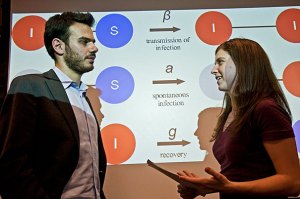
Researchers at Harvard University say America’s obesity epidemic won’t plateau until at least 42 percent of adults are obese, an estimate derived by applying mathematical modeling to 40 years of Framingham Heart Study data.
-
Campus & Community
Brendan Arnold Maher
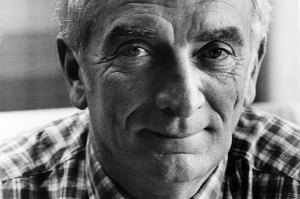
At a Meeting of the Faculty of Arts and Sciences on April 6, 2010, the Minute honoring the life and service of the late Brendan Arnold Maher, Edward C. Henderson Professor of the Psychology of Personality, Emeritus, was placed upon the records. Maher’s scholarship centered on the complex theoretical and empirical problems surrounding human psychopathology.
-
Science & Tech
Major moral decisions use general-purpose brain circuits to manage uncertainty
Harvard researchers have found that humans can make difficult moral decisions using the same brain circuits as those used in more mundane choices related to money and food. These circuits, also found in other animals, put together two critical pieces of information: How good or bad are the things that might happen? What are the…
-
Health
What’s right for me?
In a new study, Harvard scientists find that humans can make difficult moral decisions using the same brain circuits as those used on more mundane choices such as money or food.

-
Health
Warnings of suicidal intent
Two powerful new tests developed by Harvard psychologists show great promise in predicting patients’ risk of attempting suicide, researchers say. These tests may help clinicians to overcome their reliance on self-reporting by at-risk individuals, information that often proves misleading when suicidal patients wish to hide their intentions. Both tests are easily administered within minutes on…
-
Science & Tech
Posing the Big Questions
In 1900, renowned mathematician David Hilbert laid down a challenge to future generations: 23 handpicked mathematical problems, all difficult, all important, and all unsolved. Since then, countless mathematicians around the world have struggled to solve the 23 “Hilbert Problems.” To date, 10 have been fully solved, 11 are partly solved or simply cannot be solved, and two remain at large…
-
Health
A ‘mind-blowing’ day
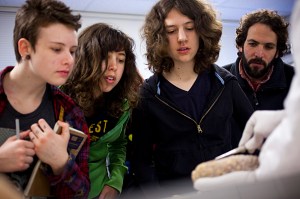
Vermont high school students explore the human brain, with help from Harvard scholars.
-
Science & Tech
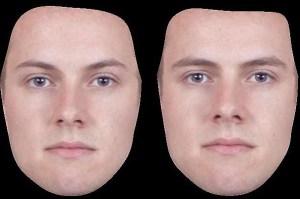
Facing your preferences
Researchers discover that similar qualities of observation drive gay and straight men in their judgments on attractiveness.
-
Health
Finding the seat of language?
A team of Harvard and University of California, San Diego (UCSD), researchers report having pinpointed an area of the brain where three essential components of language — word identification, grammar, and word pronunciation — are processed. Ned T. Sahin, a postdoctoral fellow in both Harvard’s Psychology Department and UCSD’s Radiology Department, and colleagues at both…
-
Science & Tech
What really matters
Outcomes matter more than intention when choosing to punish or reward individuals who’ve caused accidents, according to new research from Harvard University.
-
Health
‘Super-recognizers’ never forget a face
Some people say they never forget a face, a claim now bolstered by psychologists at Harvard University who’ve discovered a group they call “super-recognizers”: those who can easily recognize someone they met in passing, even many years later. The new study suggests that skill in facial recognition might vary widely among humans. Previous research has…
-
Health
Some vocal-mimicking animals, particularly parrots, can move to a musical beat
Researchers at Harvard University have found that humans aren’t the only ones who can groove to a beat — some other species can dance, too. The capability was previously believed to be specific to humans. The research team found that only species that can mimic sound seem to be able to keep a beat, implying…
-
Science & Tech
Susan Carey receives David E. Rumelhart Prize
Susan Carey, a Harvard psychologist whose work has explored fundamental issues surrounding the nature of the human mind, has been awarded the 2009 David E. Rumelhart Prize, given annually since 2001 for significant contributions to the theoretical foundation of human cognition. Carey, the Henry A. Morss Jr. and Elisabeth W. Morss Professor of Psychology in…
-
Science & Tech
Roads not taken disappear more quickly than we realize
Researchers have identified a key reason why people make mistakes when they try to predict what they will like. According to the findings presented Sunday at the annual meeting of the American Association for the Advancement of Science, when predicting how much we will enjoy a future experience, people tend to compare it to its…
-
Science & Tech
Hauser presents theory of “humaniqueness”
Shedding new light on the great cognitive rift between humans and animals, a Harvard University scientist has synthesized four key differences in human and animal cognition into a hypothesis on what exactly differentiates human and animal thought. In new work presented for the first time at the annual meeting of the American Association for the…
-
Science & Tech
Neuroimaging fails to demonstrate ESP is real
Psychologists at Harvard University have developed a new method to study extrasensory perception that, they argue, can resolve the century-old debate over its existence. According to the authors, their study not only illustrates a new method for studying such phenomena, but also provides the strongest evidence yetobtained against the existence of extrasensory perception, or ESP.…
-
Health
Even in healthy elderly, brain systems become less coordinated
Some brain systems become less coordinated with age even in the absence of Alzheimer’s disease, according to a new study from Harvard University. The results help to explain why advanced age is often accompanied by a loss of mental agility, even in an otherwise healthy individual. The study, published in the Dec. 6 issue of…
-
Science & Tech
Tracking down the seat of moral reasoning
Moral philosophers have long grappled with ethical questions, creating hypotheticals that test basic beliefs about right and wrong. For example: A trolley is running down a track out of control. If it keeps going, it will run over the five unsuspecting people hanging out on the track. You can prevent this disaster by throwing a…
-
Health
Ursano: Stopping post-traumatic stress disorder before it happens
Mental health professionals are aware of the importance of understanding the kinds of illnesses — such as depression and post-traumatic stress disorder (PTSD) — that can result from disasters both natural and human-made. But perhaps even more crucial, according to Robert J. Ursano, is that they understand the behaviors associated with such events.