
 Featured series

Tag: Cosmology
-
Science & Tech
Hawking at Harvard
Acclaimed theoretical physicist and cosmologist Stephen Hawking discussed the mysterious qualities of black holes during his lecture at a packed Sanders Theatre.

-
Science & Tech
The fast-firing universe
Nobel laureate and astrophysicist Brian Schmidt returns to Harvard this week to deliver the Morris Loeb and David M. Lee Lectures in Physics. Schmidt will discuss his discovery that the expansion of the universe is accelerating, as well as the SkyMapper survey of the southern skies and the first stars that emerged after the universe’s…

-
Science & Tech
Insignificant, with a lousy future
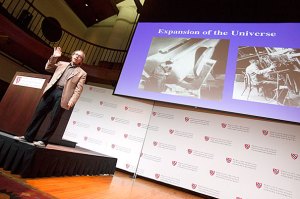
Theoretical physicist Lawrence Krauss described a universe with mysterious particles popping in and out of existence, in which the discoveries of dark energy and dark matter have made mankind more insignificant than ever.
-
Science & Tech
Stars align at astronomy reunion
Harvard astronomers past and present gathered in Cambridge Friday (April 5) for the first-ever reunion of the Harvard Astronomy Department.

-
Science & Tech
Tweaking the universe
In a question-and-answer session, Harvard astronomy chair Avi Loeb explains the new data from the European Space Agency’s Planck satellite.

-
Science & Tech
A learner’s guide to the universe
Harvard’s Avi Loeb is helping prepare the next generation of astronomers with a new textbook, “The First Galaxies in the Universe.”

-
Health
Using galaxies as yardsticks
Astronomy Professor Daniel Eisenstein is using a new understanding of spacing between galaxies to build a 3-D map of the cosmos and confirm theories about its structure.
-
Science & Tech
Forward, into the past
Harvard undergraduate Derek Robins recounts his summer spent doing astronomy research on campus.

-
Science & Tech
Hyperfast star was booted from Milky Way
A hundred million years ago, a triple-star system was traveling through the bustling center of our Milky Way galaxy when it made a life-changing misstep. The trio wandered too close to the galaxy’s giant black hole, which captured one of the stars and hurled the other two out of the Milky Way.
-
Science & Tech
Cosmic blast announces a future supernova
It’s one thing to theorize about an exploding star the size of our sun, it’s another to look up in the sky and watch one getting ready to blow. Astronomers are now doing this. On Feb. 12, a star known as RS Ophiuchi, some 8,000 trillion miles away, erupted in an explosion so bright it…
-
Science & Tech
Jupiter’s ‘big brother’ has moon-forming dust disk
Earth’s moon was created by an early collision with another large planetary body. It was a “chip off the old block.” Mars captured its asteroidal moons as they passed by. But Jupiter made its own moons out of dust and gas remaining from its formation. Now, observations by astronomer Subhanjoy Mohanty of the Harvard- Smithsonian…
-
Science & Tech
Two exiled stars are leaving our galaxy forever
TV reality show contestants aren’t the only ones under threat of exile. Astronomers using the MMT Observatory in Arizona have discovered two stars exiled from the Milky Way galaxy. Those stars are racing out of the Galaxy at speeds of more than 1 million miles per hour – so fast that they will never return.…
-
Science & Tech
Cosmic jet looks like giant tornado in space
While examining a region where new stars are forming with NASA’s Spitzer Space Telescope, astronomers found a surprise – an object that looks like a giant tornado in space. The apparent tornado is shaped by a cosmic jet packing a powerful punch as it plows through clouds of interstellar gas and dust. They released an…
-
Science & Tech
Space telescope captures cosmic ‘Mountains of Creation’
Captured by the Spitzer Space Telescope’s infrared eyes, a new majestic image resembles the iconic “Pillars of Creation” picture taken of the Eagle Nebula in visible light by NASA’s Hubble Space Telescope in 1995. Both views feature star-forming clouds of cool gas and dust that have been sculpted into pillars by radiation and winds from…
-
Science & Tech
Cosmic cloudshine
Hubble’s iconic images include many shots of cosmic clouds of gas and dust called nebulae. For example, the famous “Pillars of Creation” mark the birthplace of new stars within the Eagle Nebula. Yet despite their beauty, visible-light images show only the nebulae surfaces. Baby stars may hide beneath, invisible even to Hubble’s powerful gaze. Harvard…
-
Science & Tech
It takes three Smithsonian observatories to decipher one mystery object
In an exercise that demonstrates the power of a multiwavelength investigation using diverse facilities, astronomers at the Harvard-Smithsonian Center for Astrophysics (CfA) have deciphered the true nature of a mysterious object hiding inside a dark cosmic cloud. They found that the cloud, once thought to be featureless, contains a baby star, or possibly a failed…
-
Science & Tech
Black holes aren’t so black
As gas is pulled into a black hole by its strong gravitational force, the gas heats up and radiates. That radiation can be used to illuminate the black hole and paint its profile. Within a few years, astronomers believe they will be able to peer close to the horizon of the black hole at the…
-
Science & Tech
Ferreting out the first stars
The first stars are so distant and formed so long ago that they are invisible to our best telescopes. Until they explode. Hypernovas (more powerful cousins of supernovas) and their associated gamma-ray bursts offer astronomers the possibility of detecting light from the first generations of stars. NASA’s Swift satellite already has seen a gamma-ray burst…
-
Science & Tech
First baby photo of stellar twins
Newborn stars are difficult to photograph. They tend to hide in the nebulous stellar nurseries where they formed, enshrouded by thick layers of dust. Now, Smithsonian astronomer T.K. Sridharan (Harvard-Smithsonian Center for Astrophysics) and his colleagues have photographed a pair of stellar twins in infrared light, which penetrates the dust. And these babies are whoppers,…
-
Science & Tech
How to build a big star
The most massive stars in our galaxy weigh as much as 100 small stars like the Sun. How do such monsters form? Do they grow rapidly by swallowing smaller protostars within crowded star-forming regions? Some astronomers thought so, but a new discovery suggests instead that massive stars develop through the gravitational collapse of a dense…
-
Science & Tech
Fastest pulsar speeding out of galaxy
A speeding, superdense neutron star somehow got a powerful “kick” that is propelling it completely out of our Milky Way Galaxy into the cold vastness of intergalactic space. Its discovery is puzzling astronomers who used the National Science Foundation’s Very Long Baseline Array (VLBA) radio telescope to directly measure the fastest speed yet found in…
-
Science & Tech
Robotic telescope penetrates heart of universe’s most powerful explosion
Cullen Blake, a graduate student at the Harvard-Smithsonian Center for Astrophysics and lead author on the paper, said that the simultaneous observation of infrared light with a gamma-ray burst was unprecedented. This observation was made possible by PAIRITEL’s ability to aim at objects quickly and automatically. PAIRITEL pointed at the burst minutes after the Integral…
-
Campus & Community
Zaldarriaga probes universe’s start
Matias Zaldarriaga is peering back into time to find his roots – and the roots of everything else ever created. Zaldarriaga, named professor of astronomy in July, is an expert in cosmology, which is the study of the origins and evolution of the universe. A theoretical astrophysicist, Zaldarriaga is trying to understand the faint cosmic…
-
Science & Tech
Simulations show growth of black holes
Using a new computer model of galaxy formation, researchers have shown that growing black holes release a blast of energy that fundamentally regulates galaxy evolution and black hole growth itself. The model explains for the first time observed phenomena, and promises to deliver deeper insights into our understanding of galaxy formation and the role of…
-
Science & Tech
Growing supermassive black holes from seeds
Astronomers announced Jan. 12, 2006 that they have found the first sample of intermediate-mass black holes in active galaxies – a discovery that will help in understanding the early universe. “These are local analogues of the `seed’ black holes from which supermassive black holes formed,” said Jenny E. Greene of the Harvard-Smithsonian Center for Astrophysics…
-
Science & Tech
New maser measurements trace detail in active galactic core
The roiling cores of many active galaxies are difficult to see in detail because of surrounding gas and interstellar dust. Smithsonian astronomers announced Jan. 12, 2006, however, a first-time measurement that may help to better trace the structure of these unusual regions. Elizabeth M. L. Humphreys and other Harvard-Smithsonian Center for Astrophysics (CfA) research team…
-
Science & Tech
Going beyond Einstein
Observations by two astronomers confirm one important theory about how a black hole’s extreme gravity can stretch light. The data also paint an intriguing image of how a spinning black hole can drag the very fabric of space around with it, creating a choppy spacetime sea that distorts everything falling into the black hole. Jon…
-
Science & Tech
See-through galaxy
To peer into the galactic center of our own Milky Way galaxy, astronomers Silas Laycock and Josh Grindlay used the unique capabilities of the 6.5-meter-diameter Magellan Telescope in Chile. By gathering infrared light that more easily penetrates dust, the astronomers were able to detect thousands of stars that otherwise would have remained hidden. Their goal…
-
Science & Tech
Scientists find black hole’s ‘point of no return’
By a score of 135 to zero, scientists using NASA’s Rossi X-ray Timing Explorer have compared suspected neutron stars and black holes and found that the black holes behaved as if each one has an event horizon, the theoretical border from beyond which nothing, not even light, can escape. The team found that X-ray light…
-
Science & Tech
Taking a CAT scan of the early universe
Reporting in the Nov. 11, 2004, issue of Nature, astrophysicists J. Stuart B. Wyithe (University of Melbourne) and Abraham Loeb (Harvard-Smithsonian Center for Astrophysics) have calculated the size of cosmic structures that will be measured when astronomers effectively take CAT scan-like images of the early universe. Those measurements will show how the universe evolved over…