
 Featured series


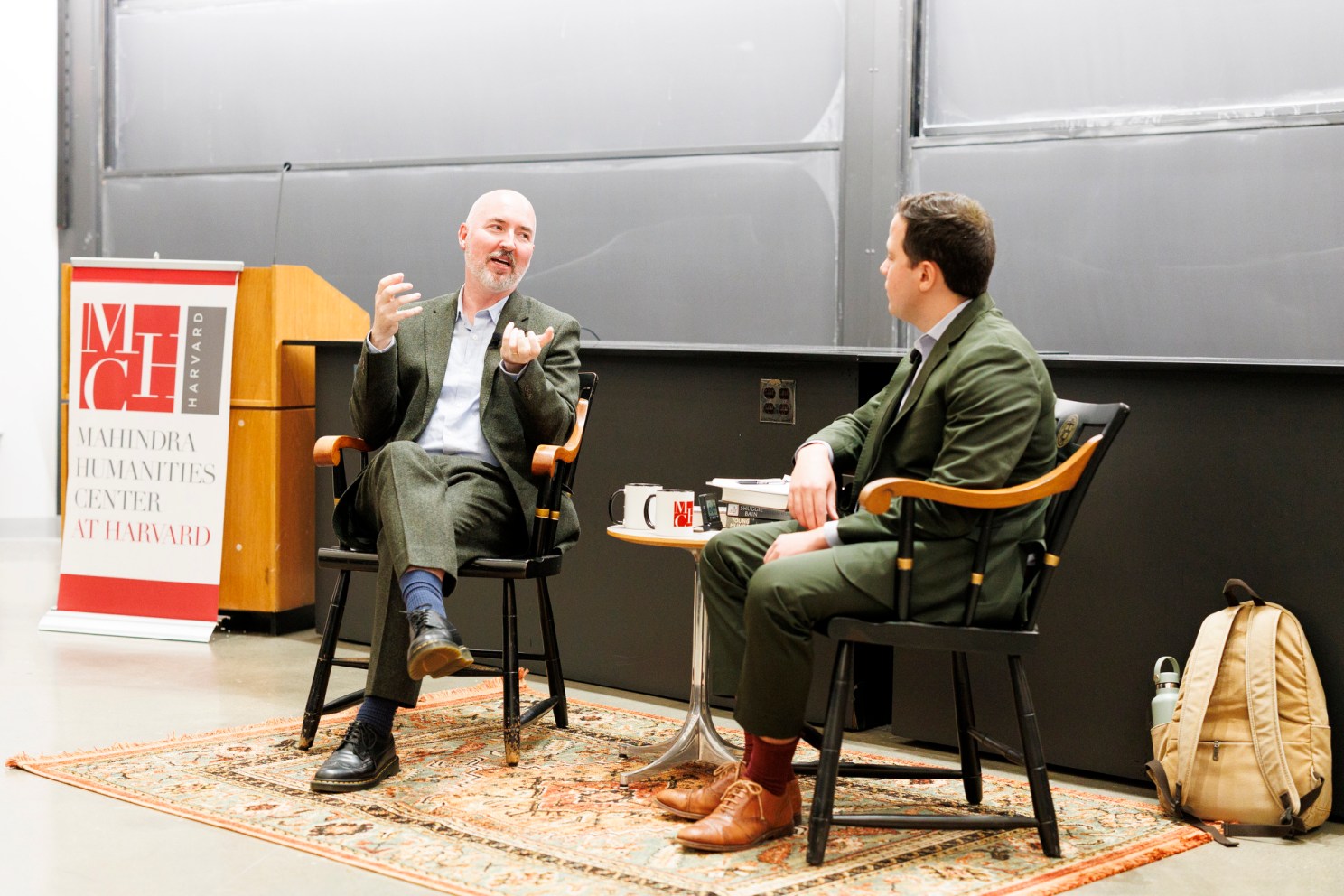
Douglas Stuart (left) talks with Charlie Tyson.
Veasey Conway/Harvard Staff Photographer
Arts & Culture
Writing a novel? Just like being a fashion designer.
Douglas Stuart, Booker winner for ‘Shuggie Bain,’ traces career path at Mahindra event
Writing, said Douglas Stuart, is a lot like fashion.
“In fashion you’re always prototyping,” said the award-winning novelist who spent more than two decades as a designer. “You start with a dream, and then you sketch it in pencil, and then you throw that sketch out. You draw it in ink, and you throw that out, and then you draw it in a way that a pattern maker can understand. … Then make a prototype; then you get the first version. You fit it, and it’s a constant redoing of an idea.”
Stuart made the observation during a recent Mahindra Center conversation with Charlie Tyson, Harvard Society of Fellows Junior Fellow, to discuss the Scottish writer’s third novel, “John of John,” released in May. The book chronicles the tale of a father and son set against the backdrop of the textile industry of the Outer Hebrides.
Stuart became a breakout literary sensation with his Booker Prize-winning 2020 debut, the semi-autobiographical “Shuggie Bain,” which follows a young man in 1980s Glasgow as he deals with poverty, violence, and complicated familial love. His second book, 2022’s “Young Mungo,” is a love story between two young men of different religious backgrounds who find solace in each other despite violence and economic struggle.
When he began working on “Shuggie,” Stuart said he looked for inspiration in other writers.
“At first I really wanted to be Cormac McCarthy, and I imitated him, and it was terrible,” he said. “And I realized actually, you’ve got to just use what you have.”
Stuart grew up in Glasgow under the free-market policies of Thatcherism, which sped up the decline of state-sponsored industry and coal mining and resulted in high unemployment. He watched his older brother and others of his generation struggle to find economic footing.
Stuart said he took advantage of opportunities his brother didn’t have, going to art school and getting a bachelor’s degree at the Scottish College of Textiles and earning a master’s in design from the Royal College of Art in London.
“Shuggie Bain” took shape over more than a decade, as Stuart balanced working at several fashion houses in New York City. In 2019, as his book was getting ready to publish, he quit designing and turned to writing full-time.
That’s when the first seeds of “John of John” were planted.
“It takes 18 months for a book to publish, and about three months into it, I’ve been working my whole life, and so I’m starting to get so distracted and so anxious, and I say to my husband one day, ‘I think I’m going to go to the Hebrides,’” Stuart said. “He went, ‘OK …’ he was so keen to get rid of me and my anxiety.”
“After my first two novels about gang violence and about the decline in the city, I wanted to also show that the working class were very capable of loving beauty in all its forms.”
Douglas Stuart
Stuart said the sojourn, which started as a way to discover his own country, turned into a research trip.
“I thought I was going to write a story of return. You’ve gone. You’ve seen some of the world. You’re coming home to a small town.”
“John of John” follows Cal, a young man returning to his small island village under the pretense of caring for his ailing grandmother Ella. But in reality, it’s an opportunity for art school graduate Cal to connect with his father — a weaver working in traditional tweed manufacturing. Both men struggle to share their lives with one another and find ways to connect through the craft.
“I wanted to write a novel about working-class men who love beauty,” Stuart said. “That was one of the first things I wanted to do. After my first two novels about gang violence and about the decline in the city, I wanted to also show that the working class were very capable of loving beauty in all its forms.”
Cal and his father share a love of color and creation. The Isle of Harris, where they live, is dominated by residents (including Cal’s father) with devout Protestant and Calvinist beliefs. Both father and son are queer — a fact each keeps hidden from the other.
Stuart recalled the moment the book really took shape during his trip to the isles.
He noticed many of the older men he came across were single. Talking to a local woman, he mentioned he thought some of them must be gay.
“And the woman sort of looked at me, and pulled back a little, and said, ‘That’s not possible,”‘ he said. “And I thought, in that moment, it’s not about the son returning home; it’s about the father he left behind. It’s about the men and women that have lost their progress in that way.”