
 Featured series


Tag: Broad Institute of Harvard and MIT
-
Health
Following the genomic road map
Harvard President Drew Faust hosted a panel discussion on the legacy of the Human Genome Project Feb. 22 at Sanders Theatre.

-
Health
Genes tied to prostate cancer uncovered
For the first time, researchers have laid bare the full genetic blueprint of multiple prostate tumors, uncovering alterations that have never before been detected and offering a deep view of the genetic missteps that underlie the disease.

-
Health
Two studies prove value of iPS cells
A team of Harvard Stem Cell Institute (HSCI) researchers, in collaboration with scientists at Columbia University, have demonstrated that many iPS cells (stem cells created by reprogramming adult cells) are the equal of human embryonic stem cells in creating human motor neurons, the cells destroyed in a number of neurological diseases, including Parkinson’s.

-
Health
Critical finding for skin cancer treatment
Researchers’ findings pinpoint a critical gene involved in melanoma growth, and provide a framework for discovering ways to tackle cancer drug resistance.

-
Health
Detailed metabolic profile gives “chemical snapshot” of the effects of exercise
Using a system that analyzes blood samples with unprecedented detail, a team led by Harvard Medical School (HMS) researchers at Massachusetts General Hospital (MGH) has developed the first “chemical snapshot” of the metabolic effects of exercise. Their findings, reported today’s edition of Science Translational Medicine, may improve understanding of the physiologic effects of exercise and…
-
Science & Tech
Another piece of cancer puzzle falls into place
An international team of researchers has created a genome-scale map of 26 cancers, revealing more than 100 genomic sites where DNA from tumors is either missing or abnormally duplicated compared to normal tissues. The study, the largest of its kind, finds that most of these genetic abnormalities are not unique to one form of cancer, but are shared across multiple…
-
Health
Zebrafish point the way
A new technique for screening drugs’ effects on zebrafish behavior is pointing Harvard University scientists toward unexpected compounds and pathways that may govern sleep in humans.

-
Health
Fishing for new medications
A robust new technique for screening drugs’ effects on zebrafish behavior is pointing Harvard scientists toward unexpected compounds and pathways that may govern sleep and wakefulness in humans. Among their more intriguing findings, described this week in the journal Science: Various anti-inflammatory agents in the immune system, long known to induce sleep during infection, may…
-
Health
Tracking our traits
Researchers devise method to pinpoint key genetic variations under positive natural selection that may impact human health.

-
Health
Tracking genetic traits over time
Fossils may provide tantalizing clues to human history, but they also lack some vital information, such as revealing which pieces of human DNA have been favored by evolution because they confer beneficial traits — resistance to infection or the ability to digest milk, for example. These signs can only be revealed through genetic studies of…
-
Health
Researchers ‘NOTCH’ a victory in war on cancer
Normal 0 0 1 819 4673 38 9 5738 11.1282 0 0 0 Scientists have devised an innovative way to disarm a key protein considered to be “undruggable,” meaning that all previous efforts to develop a drug against it have failed. Their discovery, published in today’s edition of the journal Nature, lays the foundation for…
-
Health
Three-dimensional structure of human genome deciphered
Scientists have deciphered the three-dimensional structure of the human genome, paving the way for new insights into genomic function and expanding our understanding of how cellular DNA folds at scales that dwarf the double helix. In a paper featured this week on the cover of the journal Science, they describe a new technology called Hi-C…
-
Health
A look inside
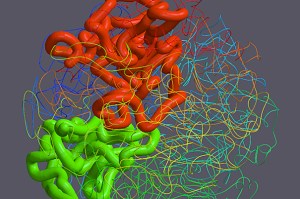
Scientists have deciphered the three-dimensional structure of the human genome, paving the way for new insights into genomic function and expanding our understanding of how cellular DNA folds at scales that dwarf the double helix.
-
Health
Three Harvard teams to receive $9 million each in federal funding for stem cell research
Three teams of Harvard Stem Cell Institute (HSCI) researchers are slated to receive $27 million over seven years in National Heart Lung and Blood Institute (NHLBI) grants for the development of stem-cell based tools and treatments to understand and treat cardiovascular and blood disorders. The NHLBI Progenitor Cell Biology Consortium will consist of nine research…
-
Health
Genome of Irish potato famine pathogen decoded
A large international research team has decoded the genome of the notorious organism that triggered the Irish potato famine in the mid-19th century and now threatens this season’s tomato and potato crops across much of the United States Published today in the online edition of the journal Nature, the study reveals that the organism boasts…
-
Health
Researchers discover chemical that kills cancer stem cells
A multi-institutional team of Boston-area researchers has discovered a chemical that works in mice to kill the rare but aggressive cells within breast cancers that have the ability to seed new tumors. These cells, known as cancer stem cells, are thought to enable cancers to spread — and to reemerge after seemingly successful treatment. Although…
-
Health
Search for new tuberculosis drugs outlined
A new drug candidate that attacks the cell walls of tuberculosis bacteria offers a promising alternative in the fight against a disease that has been resurgent in the global age of AIDS, according to findings highlighted by a key researcher Friday (June 12) at the Broad Institute of Harvard and MIT.
-
Health
Broad scientists to sequence multiple myeloma samples
The Multiple Myeloma Research Foundation (MMRF) announced today a collaboration with the Broad Institute of Harvard and MIT to systematically uncover the molecular changes underlying multiple myeloma by whole-genome sequencing of individual patient tumors. The MMRF will provide both patient samples for analysis as well as funding for the project. All data from this collaboration…
-
Health
New ALS gene identified
A collaborative research effort spanning nearly a decade between Harvard researchers at Massachusetts General Hospital (MGH) and King’s College London (KCL) has identified a novel gene for inherited amyotrophic lateral sclerosis (ALS, also known as Lou Gehrig’s disease). This is the fourth gene associated with familial forms of the devastating neurological disorder. Two papers, published…
-
Health
Common gene variants increase risk of hypertension
A new study has identified the first common gene variants associated with an increased incidence of hypertension — a significant risk factor for heart attack, stroke, and kidney failure. The report, receiving early online release in the journal Nature Genetics, identifies variants in genes for proteins involved with cardiovascular response to stress that also appear…
-
Health
International study identifies gene variants associated with early heart attack
The largest study ever completed of genetic factors associated with heart attacks has identified nine genetic regions — three not previously described — that appear to increase the risk for early-onset myocardial infarction. The report from the Myocardial Infarction Genetics Consortium, based on information from a total of 26,000 individuals in 10 countries, was given…
-
Health
Scientists uncover new class of mammalian genes with key functions
A research team at the Broad Institute of Harvard and MIT and Beth Israel Deaconess Medical Center has uncovered a vast new class of previously unrecognized mammalian genes that do not encode proteins, but instead function as long RNA molecules. Their findings, presented in the Feb. 1 advance online issue of the journal Nature, demonstrate…
-
Science & Tech
Researchers find new molecule to block ‘Hedgehog’ signaling in cancer, development
Researchers have achieved a feat drug developers had thought difficult, if not impossible, discovering a compound that blocks the functioning of a key developmental protein by binding to an “undruggable” target — an advance that may provide a new avenue to fight skin, pancreatic, prostate, and other cancers. A team led by Stuart Schreiber, the…
-
Science & Tech
John P. Holdren named President-elect Obama’s Science Advisor
President-elect Barack Obama today announced that he has selected Harvard’s John P. Holdren to serve as Assistant to the President for Science and Technology in the new administration. The post, popularly known as “the President’s science advisor,” also includes directorship of the Office of Science and Technology Policy in the Executive Office of the President…
-
Health
New obesity-related genes identified
A large international consortium has made significant inroads into uncovering the genetic basis of obesity, adding six new genetic variants to the two already linked to higher body mass index (BMI) in previous studies. Most of the newly discovered genes had never before been suspected of having a role in body weight and, curiously, many…
-
Health
Advanced blood analysis may speed diagnosis of heart attacks
Someday doctors may be able to use a blood test to confirm within minutes, instead of hours, if a patient is having a heart attack, allowing more rapid treatment that could limit damage to heart muscle. A study led by investigators from Massachusetts General Hospital (MGH) and the Broad Institute of Harvard and MIT reports…
-
Health
Eli and Edythe L. Broad endow the Broad Institute of Harvard and MIT with additional $400 million
Los Angeles-based philanthropists Eli and Edythe Broad today declared the Broad Institute of Harvard and MIT an unprecedented success as an experiment in science and philanthropy, and announced that they have increased their total gift to the Broad by $400 million to $600 million. The $400 million will be an endowment to convert the institute…
-
Health
Broad Institute awarded $86 million NIH grant
Researchers at the Broad Institute of Harvard and MIT have been chosen to receive a six-year, $86M grant from the National Institutes of Health (NIH) to identify and develop molecular tools known as “small molecules,” which can probe the proteins, signaling pathways and cellular processes that are crucial to human health and disease. The Broad…