Featured series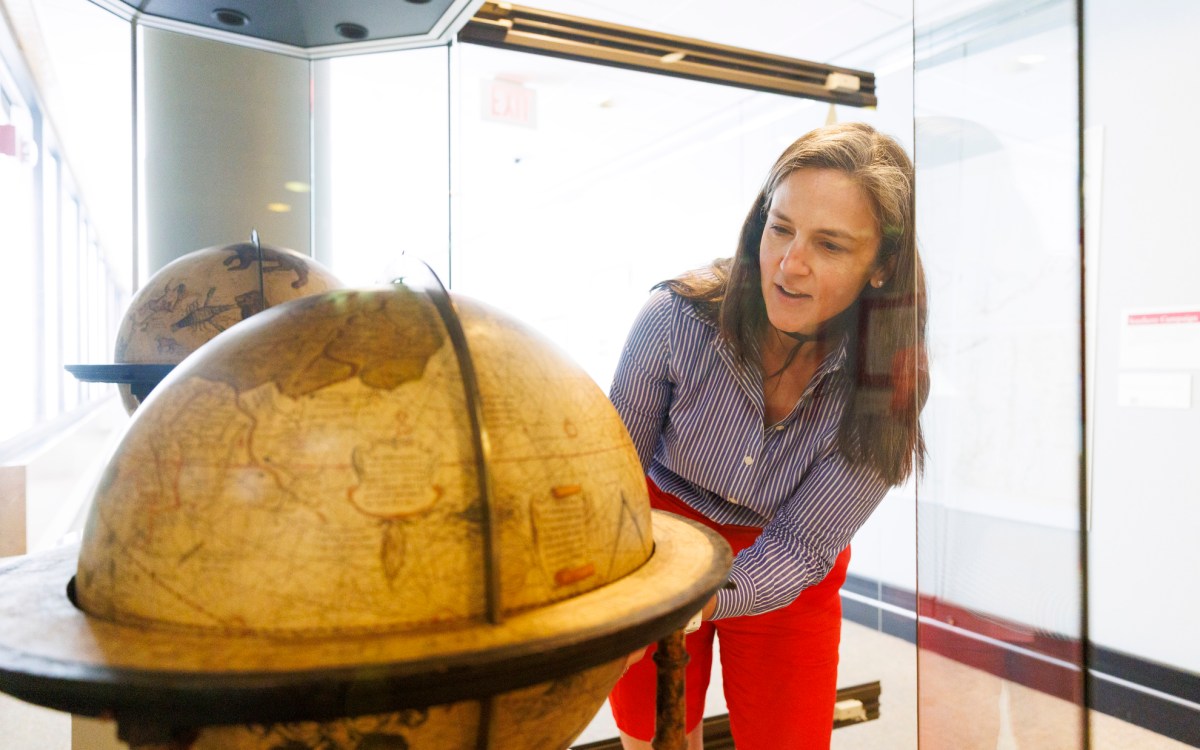


Veasey Conway/Harvard Staff Photographer
Nation & World
Linda Bilmes is doing the math
Kennedy School budget analyst has made it her life’s mission to elucidate the heavy toll of war: ‘If we don’t account for something, we don’t value it.’
At a session of the Senate Appropriations Committee in July, U.S. Defense Secretary Pete Hegseth told lawmakers that the first six months of the fitful war with Iran had cost taxpayers an estimated $37.5 billion.
Or not exactly — a little less, he clarified. The estimate included “MILPAY, O&M and other anticipated costs through September 30.”
In a rancorous hearing marked by charges of recklessness and countercharges of “cowardice,” it was a bureaucratic aside.
And yet, of course, it was that moment that drew the particular attention of Linda Bilmes, the Daniel Patrick Moynihan Senior Lecturer in Public Policy at the Harvard Kennedy School.
“Thirty-seven and a half billion dollars, that’s not a serious number,” said Bilmes. “There’s no way it’s less than $100 billion — but then that’s only the tip of the iceberg.”
It can be difficult, Bilmes admits, to sum up her varied career in the private sector, public service, and academia.
But there have been a few throughlines, she says, notably the idea that “accounting really matters. If we don’t account for something, we don’t value it.”
Bilmes is no firebrand. But quietly, laboriously, she has pushed thousands of students, fellow citizens, and public officials to a wholesale reappraisal of the assets Americans take for granted and the terrible liabilities we shudder to contemplate.
Bilmes has become one of the nation’s leading experts on the cost of the wars that have followed the Sept. 11 attacks, which she reckons in the trillions. Her next book, “The Ghost Budget,” forthcoming this fall, will build on that work, arguing that the scale, complexity, and opacity of American military operations have led to fraud, disillusionment, and strategic errors.
Bilmes graduated from Harvard College in 1980 and from Harvard Business School in 1984. She worked as a consultant before rising to the No. 3 job in Bill Clinton’s Department of Commerce.
As the administration wound down, she had the inside track at a number of high-profile jobs in the private sector. But she had just survived a major medical episode, with three young children — so an offer to teach at the Kennedy School seemed like an appealing shift.
“I was shocked at what the numbers were telling me. I became sort of obsessed.”
So in 2002, it was as a first-semester teacher that Bilmes watched the successor administration on its march to war with Iraq.
That November, Defense Secretary Donald Rumsfeld projected that the conflict would cost under $50 billion — and dismissed higher estimates as “baloney.”
Bilmes’ students wanted to know: How much would the war cost, really? She found strikingly little by way of a “serious number,” except for a 2002 article by Yale economist William Nordhaus.
In the best case, Nordhaus calculated, the war could cost as little as $100 billion. But things could also deteriorate. If, he wrote, “the war drags on, occupation is lengthy, nation building is costly, [and] there is lingering military and political resistance in the Islamic world to U.S. occupation,” the Iraq invasion could cost as much as $1.9 trillion.
Thereafter Nordhaus returned to the work that led to his Nobel, in 2018. But he encouraged Bilmes to keep up the tally — and she did. “I was shocked at what the numbers were telling me,” Bilmes said. “I became sort of obsessed.”
One could imagine war costs as an upscaled household budget, simply balancing — as Hegseth did in July — appropriations with expenses: recruiting, training, transporting and equipping soldiers and sailors; building and repairing bases; buying, maintaining and replacing jets, ships and missile batteries.
But that would be a mistake, Bilmes has argued. It imagines a simple budgetary stream — but any modern war represents a spreading, untraceable Amazon of costs and liabilities.
A stockpiled missile, once it explodes, must be replaced at a new — and often higher — price. When soldiers are injured, sickened, or killed, it creates not just a moral debt but a fiscal obligation that will stay with their country for decades. And when a war is funded by borrowing, every dollar spent also opens a long horizon of repayment.
Whatever their failings, many wartime presidents have been candid about those costs, Bilmes argues, citing tax hikes and budget cuts imposed by Woodrow Wilson and Harry Truman.
The result, she argues, was a reliable fiscal pattern: “During those wars, one, people who were upper-class, even upper-middle-class, paid higher taxes than they do now. And two, they paid higher taxes at the end of the war than they did at the beginning.”
Starting in 2001, that pattern substantially ended.
As presidents of both parties continued military operations or started new ones, calls for collective national sacrifice were dropped, as were marginal tax rates. That left military expenses of every stripe to be financed by borrowing.
The new approach troubles Bilmes not just as a self-styled “fiscal conservative” but also as a parent: “Speaking as an old person, the cost of the Iraq war is not going to be paid by me, but by your generation, by my three sons, by their children.”
Her concerns don’t end there. The daughter of a WWII veteran, Bilmes is aware of the way a war weighs on the people who fight it — and that the nature of their sacrifice weighs differently today.
“The good news is that there’s a much higher survival rate” for service members involved in an exchange of fire, she said, and much more social acceptance of conditions like post-traumatic stress.
More veterans of all ages are classified — and compensated — as suffering from higher rates of disability. “That is the right thing to do,” Bilmes noted. But the culture change has created a “much broader eligibility pool,” and higher costs associated with the average veteran’s care.
Finally, there’s Bilmes’ practice as a Quaker. While she doesn’t often make the categorical antiwar claims associated with that tradition, it was in a Quaker meeting that this part of her career was — as it were — ratified.
“I did sit in silent prayer and asked the higher power if there was anything that I personally could do about all this,” she recalled. “And it came to me that I could help put a price tag on it. I have felt called to do that ever since.”
Bilmes’ peak media exposure came by doing that very plainly.
“The Three Trillion Dollar War,” a book co-authored with the Nobel Prize-winning economist Joseph Stiglitz, argued that, five years in, the Iraq war’s cost had exceeded Rumsfeld’s initial estimate by a factor of 60,000, and that even Nordhaus’ worst-case scenario was too optimistic.
The book, published in 2008, was a sober reckoning of missed opportunities and overlooked risks — and turned out to be a New York Times bestseller, not that Bilmes has trumpeted that about.
In fact, Philip Tizzani didn’t immediately make the connection between his professor in public finance in 2013 and her arguments, which he’d first come upon as an undergrad.
“When I graduated in 2008, there was a lot of disillusionment about the political moment — but it was only then sort of taking form, what precisely about that war was so perplexing and so bad,” said Tizzani, today a Democratic staff member on the House Appropriations Committee.
Together, Bilmes and Stiglitz had shown that it wasn’t just a “gut feeling,” Tizzani added — that “we could actually quantify all the off-the-book costs that this thing has incurred.”
“I tell my students that ‘a million seconds ago’ was about 11 days ago. A billion seconds ago is more like 30 years — like roughly, when the movie ‘The Lion King’ came out. A trillion seconds ago, wooly mammoths existed.”
Even as she dug deeper into the cost of combat, Bilmes discovered a second vocation at Harvard, as a teacher of a very practical kind. The spark came more than 20 years ago from the late Thomas Menino, then mayor of Boston. He served as matchmaker between her and Joe Curtatone, then the newly elected mayor of Somerville.
Curtatone hoped to implement good-government policies from City Hall, but without enlisting an army of high-price consultants. “Menino told him, ‘Get Linda to do it. Get her students to do it,’” Bilmes recalled with a smile.
Curtatone presented Bilmes’ class with an offer. Come work long hours, helping his fledgling office with budget design, operations, finance. The position is unpaid, but you don’t have to complete the course’s final paper.
“And the Kennedy School students, being the tire-biters that they are, said yes — 67 of them,” Bilmes laughed. “And they swarmed Somerville that semester.”
That city-government field lab endures to this day, and — along with her scrutiny of the Iran war — occupies much of Bilmes’ time.
“The Ghost Budget” will highlight the fact that military expenditures once debated in Congress and in the press are increasingly hidden from view: in supplemental and contingency budgets, in borrowing that circumvented congressional approval, and payments to private contractors, among other things.
As a budget expert and a citizen, Bilmes sets a high value on transparency. If disclosures must sometimes be limited in the interest of national security, she said, that doesn’t explain why “the Pentagon flunks its audit year after year … If that was a company in the private sector, it couldn’t carry on.”
It can be thankless, serving as the unofficial financial watchdog of the most sophisticated military in the history of the world, one that is capable of serious mistakes. And Bilmes has sometimes struggled to convey the awesome amounts of spending that wars can so quickly involve.
“One of the problems in the English language is the fact that the words ‘million,’ ‘billion’ and ‘trillion’ rhyme,” said Bilmes. Each number can seem to suggest, simply, “a large amount,” especially within a torrent of daily news and information.
But she has learned ways to emphasize their radical differences in meaning. Early in the semester, Bilmes tackles the problem this way: “I tell my students that ‘a million seconds ago’ was about 11 days ago. A billion seconds ago is more like 30 years — like roughly, when the movie ‘The Lion King’ came out.”
She wraps up by pointing out that “a trillion seconds ago, wooly mammoths existed.”
Whatever the increments, Bilmes remains passionately committed to tracking the value, too often uncounted, of what is preserved, pursued — or frittered away.
That kind of practicality, and perseverance, makes students like Tizzani very grateful for the role Bilmes has played in their lives.
“There’s just such deep virtue, I think, in giving future public servants the tools that will make them useful,” he said. “It may not get appreciated alongside other things happening there, but she is a bedrock institution, to me.”
Share this article


Also in this series:
-

Almost everyone she knew growing up were laborers. Now she researches inactivity.
Epidemiologist I-Min Lee has published hundreds of papers on exercise and heart health in her time with the Harvard Alumni Health Study and the Women’s Health Study
-

She studies cell lineage in the eye. Now she’s leaving research lineage of her own.
Award-winning biologist Connie Cepko, who advanced work on vision-threatening disease, passes the torch to scientific successors
-

Finding ways to ‘drug the undruggable’ diseases
Greg Verdine’s approach embraces improvisational thinking, ‘crazy stuff,’ and he thinks it may be future of medical research
-
Demystifying migraine
‘It’s not an imagined headache, and it’s not a mild condition,’ says Michael Moskowitz, Brain Prize recipient for his dogma-defying research
-
An Alzheimer’s breakthrough 10 years in the making
After latest study, Bruce Yankner’s inbox exploded: ‘I try to get back to everybody … I try to provide hope.’
-

In the grip of ‘horror and anger,’ Gawande grows more determined
As global health suffers, his focus on patient-first systems feels more urgent than ever
-

Reeling in a big scientific discovery
William Kaelin pursued Nobel-winning findings using a fisherman’s instinct
-
‘Shared humanity’ is their call to action, here and there
No letup in doctors’ commitment to easing suffering in world’s danger zones