A diverse range of expertise presented by panelists and participants from around the world sparked thought-provoking discussion and dissent at Globalization and Education, a conference at the Graduate School of Education (GSE) Thursday (Feb. 26). The conference, sponsored by the GSE, the Nieman Foundation for Journalism, and Ross Institute Agenda, drew from findings presented in the forthcoming book of essays, Globalization: Culture and Education in the New Millennium (University of California Press in association with the Ross Institute, April 2004). With commentary by faculty experts in education, history, economics, and social studies, and by international journalists from the Nieman Foundation and elsewhere, the conference shed light on the promise and perils of globalization and educations fitness to meet it.
Stanley Cavell, the Walter M. Cabot Professor of Aesthetics and the General Theory of Value Emeritus, has received the 2004 Romanell-Phi Beta Kappa Professorship in Philosophy. Cavell is the first Harvard professor to receive the award.
Joel Hirschhorn, assistant professor of genetics (pediatrics), has been named the recipient of the 2004 Young Investigator Award by the Society for Pediatric Research (SPR). This award recognizes the achievements of scientists and physician scientists embarking on careers investigating the diseases that affect children.
The Harvard campus got a little greener last week, and it has nothing to do with the coming of spring. Rather, the Universitys Transportation Services opened its own biodiesel filling station in Allston, allowing Harvards 25 diesel vehicles – shuttle buses, maintenance and mail trucks, and dining services vehicles – to run on cleaner-burning biodiesel. Harvard is the first Ivy League school to use biodiesel as the primary fuel for its entire diesel fleet.
The de Gaspé Beaubien Foundation, a family foundation based in Montreal, has donated $7.5 million to Harvard Business School (HBS) in honor of Philippe de Gaspé Beaubien (M.B.A. 54) and his wife, Nan-b. The gift will fund the de Gaspé Beaubien Family Endowment at Harvard Business School and focus on supporting a wide range of new and innovative activities, projects, and outreach programs associated with the Historical Collections of the Schools Baker Library.
Louise Richardson, executive dean of the Radcliffe Institute for Advanced Study and an expert on international terrorism, opened Radcliffes 2004 Voices of Public Intellectuals series on Confronting Terrorism: Democracys Response to the Terrorist Threat Thursday (Feb. 26). In her lecture, The Nature of the Terrorist Threat, she put terrorism in context, providing historical, psychological, religious, and international lessons from which the United States might learn.
Postmenopausal women taking estrogen are more than twice as likely to develop asthma than their counterparts not taking the hormone, according to a new study from Harvard researchers.
Harvard researchers identified eight chemicals that induce a change in leukemia cells out of more than 1,700 candidates in a trial of a process they say holds promise as a way to rapidly identify potential drug candidates.
Marshaling the resources of business, government, academia, and civil society to address pressing social challenges in the United States and globally is the goal of a new Corporate Social Responsibility (CSR) Initiative, being launched today (March 4) by Harvards Kennedy School of Government (KSG).
The Student Mental Health Task Force, convened in December 2003 by Harvard University Provost Steven Hyman and Dean of Harvard College Benedict Gross, has released an interim report that recommends the administrative integration of the Bureau of Study Counsel (BSC) and University Health Services (UHS) Mental Health Service. The recommendations – which include creating a seamless administrative structure for mental health care, counseling for students, and hiring a mental health leader to oversee all aspects of mental health services at the University – are aimed at improving the Universitys ability to support students who are challenged by mental health problems.
Taking their inspiration from South African laborers during apartheid, the Gumboots Dance Troupe, sponsored by the Harvard African Students Association, performs its subversive moves at Sanders Theatre on Feb. 28 at the 19th Annual Cultural Rhythms. Actor, comedian George Lopez (left) was 2004 Artist of the Year. (Staff photos Gail Oskin/Harvard News Office)
Rands elected to American Academy of Arts & Letters The American Academy of Arts and Letters has elected Walter Bigelow Rosen Professor of Music Bernard Rands as a new member.…
Men’s squash falls in nationals, 5-4 The No. 1 Trinity men’s squash team came back to defeat Harvard, 5-4, in the finals of the College Squash Association’s National Team Tournament…
A sea of parents, family, and friends brought a storm of support to Blodgett Pool last week for the 2004 Ivy League Womens Swimming and Diving Championships. Brandishing pom-poms and banners, and dressed in their team-color best, they came by plane, car, and the Red Line to cheer on their favorite student-athletes in the big kahuna, to quote one fan, of ancient eight swimming.
Samuel Johnson, creator of “A dictionary of the English language,” is one of the most quoted of English writers, second only to Shakespeare; and the latter part of the 18th century is often called, simply, the Age of Johnson.
The Faculty of Arts and Sciences (FAS) Administrative/Professional Prize is awarded in even-numbered years to four members of the FAS administrative or professional staff who have made extraordinary contributions above and beyond the immediate requirements of their positions. The prize consists of $8,000 and one months paid leave from the University, both of which must be used for travel. Exempt staff with at least five years of service at the University are eligible for nomination.
Harvard President Lawrence H. Summers announced today a major new initiative designed to encourage talented students from families of low and moderate income to attend Harvard College.
Harvard researchers have implicated a particular molecule in the destruction of Earth’s ozone layer. The molecule, made up of two chlorine atoms and two oxygen atoms, is called a chlorine…
The cancer drugs effectiveness surprised everyone. Called TNP-470, it stunted the growth of every malignancy it touched – animal tumors, human tumors, and spreading tumors. It suppressed tumors of the ovaries, colon, prostate, and breasts. In some cases the tumors shrank in others, they disappeared.
At its eighth meeting of the year (Feb. 25) the Faculty Council discussed three research policy issues with Professor Paul Martin (physics), dean for Research and Information Technology in the Faculty of Arts and Sciences. Professor James Alt (government) participated in a discussion of co-principal-investigator privileges for research associates, and Professor Caroline Hoxby (economics) contributed to a discussion of so-called full-time postdoctoral fellows. Martin also presented a report on bio-hazard materials.
Feb. 29, 1672 – President Charles Chauncy dies in office. Feb. 11, 1941 – President James Bryant Conant testifies before the Senate Foreign Relations Committee in support of H.R. 1776,…
John Dearden memorial Feb. 27 A memorial service for John Dearden, Herman C. Krannert Professor of Business Administration Emeritus, will be held on Friday (Feb. 27) at 10:30 a.m. in…
Following are some of the incidents reported to the Harvard University Police Department for the week ending Feb. 21. The official log is located at 1033 Massachusetts Ave., sixth floor.
Winthrop House will hold a memorial service for Harvard junior Anthony Fonseca at St. Pauls Church, 29 Mount Auburn St., on Thursday, March 4, at 4 p.m. The ceremony will be followed by a reception in the masters house at 5:30.
A stroll through Harvard Yard immediately reveals the rich diversity of the University. Passersby – students, faculty, and staff – reflect a dizzying range of cultures, races, and ethnicities. Posters around campus reinforce this proud multiculturalism with events and services – from a South Indian dance performance to an informational meeting for black scientists to a support group for gay, lesbian, bisexual, and transgender students.
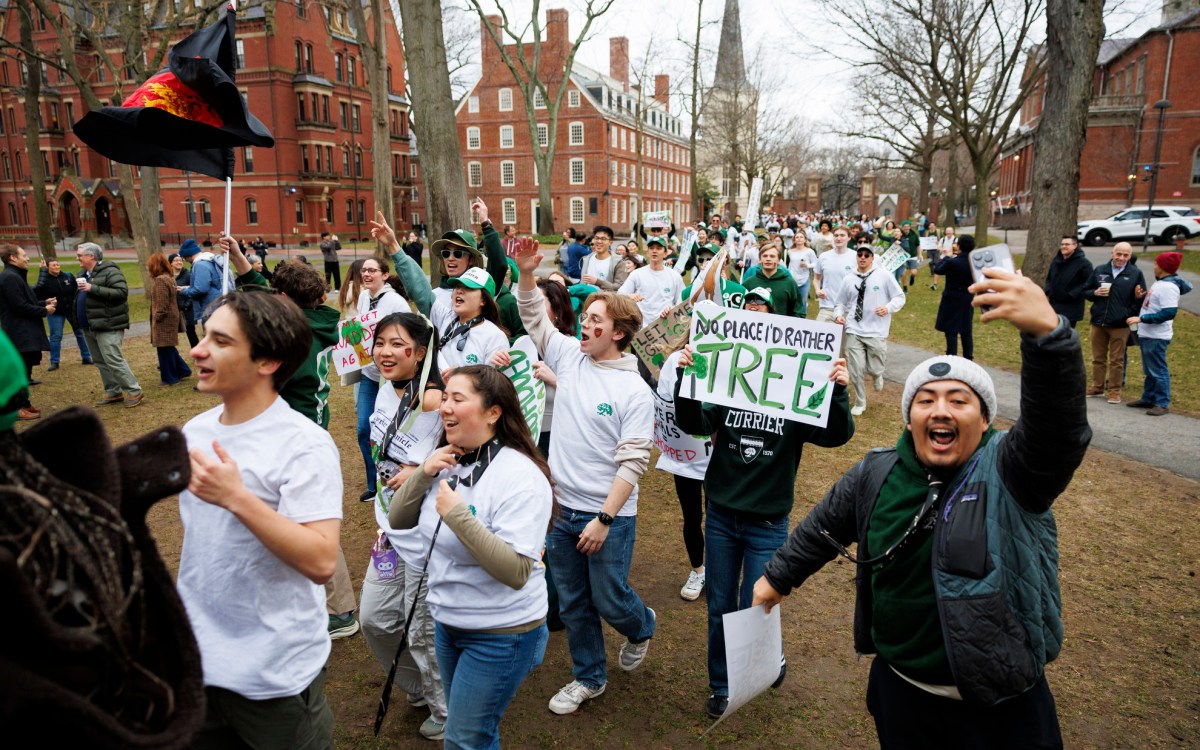
Hundreds of college students from around the Northeast descended on Harvard last weekend for the Northeast Climate Conference, an event designed to educate students and inspire them to action.

 Featured series


 Gallery