Featured series


Tag: Mutation
-
Nation & World
Staying ahead of virus mutations
EVEscape uses evolutionary and biological information to predict how a virus could change to escape the immune system.
-
Nation & World
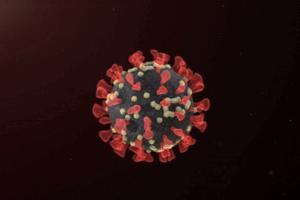
Breaking down boosters
A Harvard expert shares insight on the science and history of vaccine boosters and why we need them, speculating on a future that includes periodic COVID boosters.

-
Nation & World
Improved accuracy in genome editing
A team of scientists has engineered a form of the genome-editing protein Cas9 that can be controlled by a small molecule and offers improved DNA specificity.

-
Nation & World
Rules of evolution
For most people, rock-paper-scissors is a game used to settle disputes on the playground. For biologists, however, it is a powerful guide for understanding the key role mutation plays in…
-
Nation & World
Evolution in real time
After 26 years of workdays spent watching bacteria multiply, Richard Lenski has learned that evolution doesn’t always occur in steps so slow and steady that change can’t be observed.

-
Nation & World
New plan of attack in cancer fight
Harvard Professor Martin Nowak and Ivana Bozic, a postdoctoral fellow in mathematics, show that, under certain conditions, using two drugs in a “targeted therapy” — a treatment approach designed to interrupt cancer’s ability to grow and spread — could effectively cure nearly all cancers.
-
Nation & World
When timing is everything
In a new paper, Christopher Marx, associate professor of organismic and evolutionary biology, says that beneficial mutations may occur more often than first thought, but many never emerge as “winners” because they don’t fall within the narrow set of circumstances required for them to dominate a population.
-
Nation & World
One gene, many mutations
In a new paper, Harvard researchers show that changes in coat color in mice are the result not of a single mutation, but of many mutations, all in a single gene. The results start to answer one of the fundamental questions about evolution: Does it proceed by huge leaps — single mutations that result in…
-
Nation & World
One cell is all you need
Scientists at Harvard have pioneered a breakthrough technique that can reproduce an individual’s entire genome from a single cell. The development could revolutionize everything from cancer treatment, by allowing doctors to obtain a genetic fingerprint of a person’s cancer early in treatment, to prenatal testing.
-
Nation & World
Aspirin’s impact on colorectal cancer
Harvard researchers at Dana-Farber Cancer Institute find that aspirin therapy can extend the life of colorectal cancer patients whose tumors carry a mutation in a key gene, but it has no effect on patients who lack the mutation.

-
Nation & World
Transforming cancer treatment
Professor Martin Nowak is one of several co-authors of a paper, published in Nature on June 28,that outlines a new approach to cancer treatment that could make many cancers manageable, if not curable, by overcoming resistance to certain drug treatments.
-
Nation & World
The problem of pre-existing mutations
In a critical step that may lead to more-effective HIV treatments, Harvard scientists have found that, in a small number of HIV patients, pre-existing mutations in the virus can cause it to develop resistance to the drugs used to slow the progression of the disease.