
 Featured series

Tag: Lecture
-
Science & Tech
Lessons in learning
Study shows students in ‘active learning’ classrooms learn more than they think
-
Nation & World
Minding the gaps
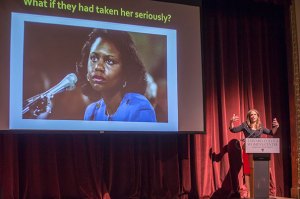
At the fourth annual Anita Hill Lecture on Gender Justice, Wake Forest University Professor Melissa Harris-Perry said that while more women have entered into today’s knowledge economy, they still make only 77 cents to every dollar men earn — and black and Latino women earn even less.
-
Campus & Community
Lepore to deliver Radcliffe lecture Sept. 10
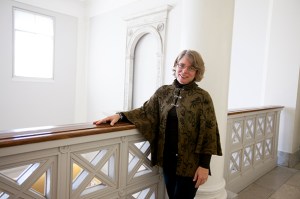
Award-winning author and Harvard Professor Jill Lepore will talk about her latest title, “Book of Ages: The Life and Opinions of Jane Franklin,” on Sept. 10 at the Radcliffe Institute.
-
Campus & Community
A look inside the lab
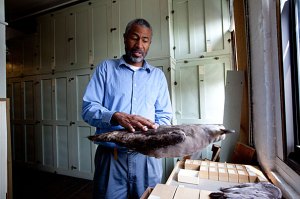
The Faculty of Arts and Sciences’ Division of Science recently relaunched its “Science Research Lecture Series,” aimed at introducing the broader local community to research conducted by Harvard faculty members. The talks will be held once a month in the Science Center, and will be open to the public.
-
Campus & Community
Gates receives honor, gives lecture
Henry Louis Gates Jr., the Alphonse Fletcher University Professor and the director of the W.E.B. Du Bois Institute for African and African American Research at Harvard University, was honored with the 2011 Media Bridge-Builder Award from the Tanenbaum Center for Interreligious Understanding.
-
Campus & Community
Faust named 40th Jefferson Lecturer
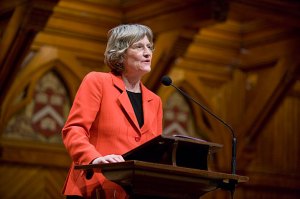
Drew Faust, eminent historian and president of Harvard University, will deliver the 2011 Jefferson Lecture in the Humanities on May 2.
-
Campus & Community
Harvard honors MLK
A celebration of the life and mission of Martin Luther King Jr. will be held on Feb. 7, from 7 to 8 p.m., in the Memorial Church in Harvard Yard.

-
Campus & Community
Paul Tillich Lecture speaker announced
Chief Justice Margaret H. Marshall of the Supreme Judicial Court, Commonwealth of Massachusetts, will deliver the fall 2010 Paul Tillich Lecture on Nov. 16 at 5:30 p.m. in the Memorial Church. The title of the lecture is to be announced.
-
Science & Tech
Turkle talks technology, intimacy
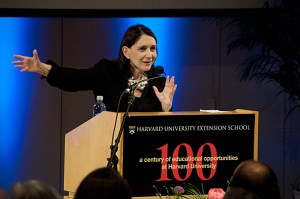
“Technology proposes itself an architect of our intimacies,” explained Massachusetts Institute of Technology Professor Sherry Turkle to an engrossed audience May 14 at the Harvard University Extension School.
-
Arts & Culture
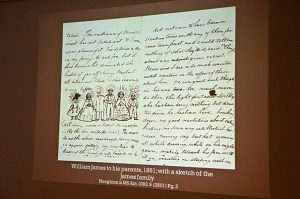
What makes a life significant?
A diverse Harvard panel marks the 1910 death of William James, celebrates his life, and revisits his famous question.
-
Campus & Community
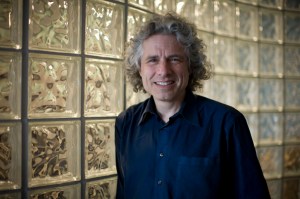
Steven Pinker wins George A. Miller Prize in Cognitive Neuroscience
Steven Pinker, the Johnstone Family Professor of Psychology in the Department of Psychology, was named this year’s winner of the George A. Miller Prize in Cognitive Neuroscience, presented by the James S. McDonnell Foundation.
-
Campus & Community
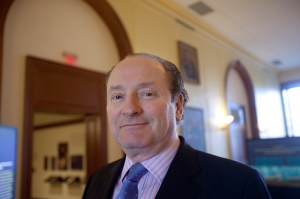
Robert C. Merton receives Kolmogorov Medal
Robert C. Merton, John and Natty McArthur University Professor at Harvard Business School and the 1997 co-winner of the Nobel Memorial Prize in the Economic Sciences, recently received the Kolmogorov Medal from the University of London.
-
Campus & Community
Distinguished Harvard Professor Celebrates Historic Intellectual Relationship
A Harvard University professor and one of the US’s most distinguished orators yesterday delivered a far-ranging lecture about the historic relationship between Cambridge and Harvard to commemorate Cambridge’s 800th anniversary.
-
Campus & Community
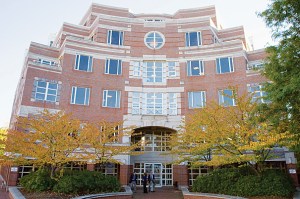
Around the Schools: Harvard Kennedy School
Political operative Terry McAuliffe, a visiting fellow this year at the Kennedy School, spoke last week at the John F. Kennedy Jr. Forum and regaled the audience with some of last year’s election bloopers.
-
Campus & Community
Glazer to give Lipset lecture, Nov. 4
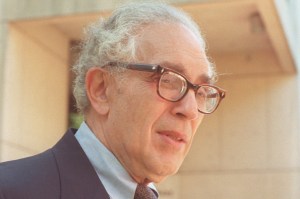
Nathan Glazer will give the Seymour Martin Lipset Memorial Lecture at the Canadian Embassy in Washington, D.C. on Nov. 4. Glazer’s talk is titled, “Democracy and Diversity: Dealing with Deep Divides.”
-
Campus & Community
O’Connor marks women’s progress in legal profession
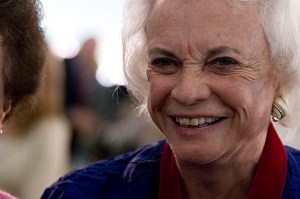
Sandra Day O’Connor, the first female justice of the U.S. Supreme Court, turns 80 years old next year. O’Connor — chipper, funny, and precise — spoke at a luncheon sponsored annually by the Radcliffe Institute for Advanced Study, which awarded the former justice its Radcliffe Medal.
-
Arts & Culture
Two views of disparate cultures
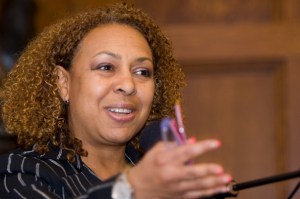
Art historian Kellie Jones, the child of two writers, grew up in the 1960s and 1970s on Manhattan’s Lower East Side. It was a place of cultural ferment, creation, and comparative racial freedom. Jones is exploring new visual and literary ways to convey her personal history. Legal scholar Stacy Leeds, an expert in tribal law,…
-
Arts & Culture
Sarah Messer’s surreal poetics
With long, sun-streaked tresses, Sarah Messer doesn’t strike one as a poetess whose work conjures American histories in bewitching, surrealist twists. But Messer’s poems navigate farther and farther from the familiar mainland into a world wholly her own.
-
Science & Tech
Looking at ‘spoiled’ Americans through an energy lens
In 1968, the United States was exporting oil. A decade later, given massive increases in domestic demand, it was importing half of this coveted fuel.
-
Campus & Community
Eck delivers Gifford Lectures
Diana Eck, Fredric Wertham Professor of Law and Psychiatry in Society and member of the faculty of divinity, recently traveled to Scotland to deliver a series of Gifford Lectures at the University of Edinburgh (April 27-May 7). The lecture series, which was established in 1888 through the endowment of Lord Gifford to four Scottish Universities…
-
Nation & World
Still ‘two cultures’ but who’s on top?
Fifty years ago a simple lecture sparked a global debate with lasting implications. On May 7, 1959, British physicist and novelist C.P. Snow declared that the gap between “two cultures,” that of the sciences and the humanities, was a destructive divide hampering the effort to find solutions to the problems of the world.
-
Nation & World
Religion key to foreign policy, says HKS speaker
As President Obama and his new administration seek to redirect U.S. foreign policy back toward more emphasis on diplomacy and less on the use of force, they should not overlook Orthodox Christianity as a resource.
-
Nation & World
Sandel to Deliver BBC’s prestigious Reith Lectures
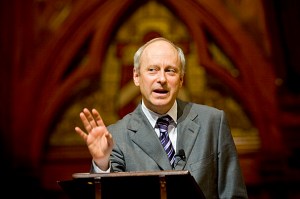
Michael Sandel, the Anne T. and Robert M. Bass Professor of Government, has been chosen by the BBC to deliver its Reith Lectures for 2009. Sandel’s lectures, titled “A New Citizenship,” will address the prospect for a new politics of the common good.
-
Nation & World
‘Paging God: Religion in the Halls of Medicine’
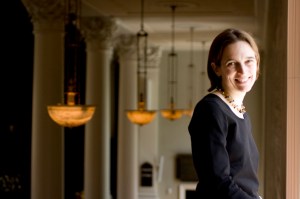
What happens when a Buddhist monk visiting the United States is hospitalized, terminally ill with liver cancer? Does religion interfere with his medical care? What about his Buddhist brethren, unable to join him bedside? Who will provide the appropriate services and ceremonies? Well, says Wendy Cadge, that’s where hospital chaplains come in.
-
Nation & World
Geneticist ‘who doesn’t believe in God’ offers new conception of divine
The Paul Tillich Lecture, offered annually at Harvard since 1990, commemorates the memory of a public intellectual who was once “the largest theological figure in our orbit,” said The Rev. Peter J. Gomes.
-
Nation & World
Obama and the art of the possible
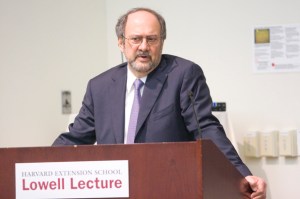
With the passing of Barack Obama’s 100th day in office, journalists and pundits are posing a simple but all-important question: How is the president doing? Robert Kuttner, author and political commentator, gave his own evaluation of the Obama presidency for the 2009 Lowell Lecture on April 30 in Emerson Hall.
-
Arts & Culture
Locke: More enlightened than we thought
English political philosopher John Locke died nearly a century before the American Revolution, and in his time parliamentary democracy was in its infancy. But his Enlightenment ideas — including the right to life, liberty, and property — went on to inspire American revolutionaries.
-
Health
Scholars take a look at decision making
Decisions, decisions. We all make them, starting with which side of the bed to get up on in the morning. But on a personal and public scale, many decisions have grave consequences for health, financial well-being, and — true enough — the fate of the planet.
-
Arts & Culture
Chance favored expedition leader in ‘missing link’ discovery
A graphic in an undergraduate geology textbook serendipitously led to the 2004 discovery of the missing link between fish and land animals far in the Canadian Arctic, one of the creature’s discoverers said during an April 16 lecture at Harvard.
-
Nation & World
Experts talk about reducing crime through a holistic approach
Los Angeles is a city that many equate with violent gangs and an ineffectual and troubled police force. Yet recent years have seen a decline in gang homicides and violent crime due to a new approach in policing.