Featured series
Campus & Community
Lampoon looks back at 150 years of laughs
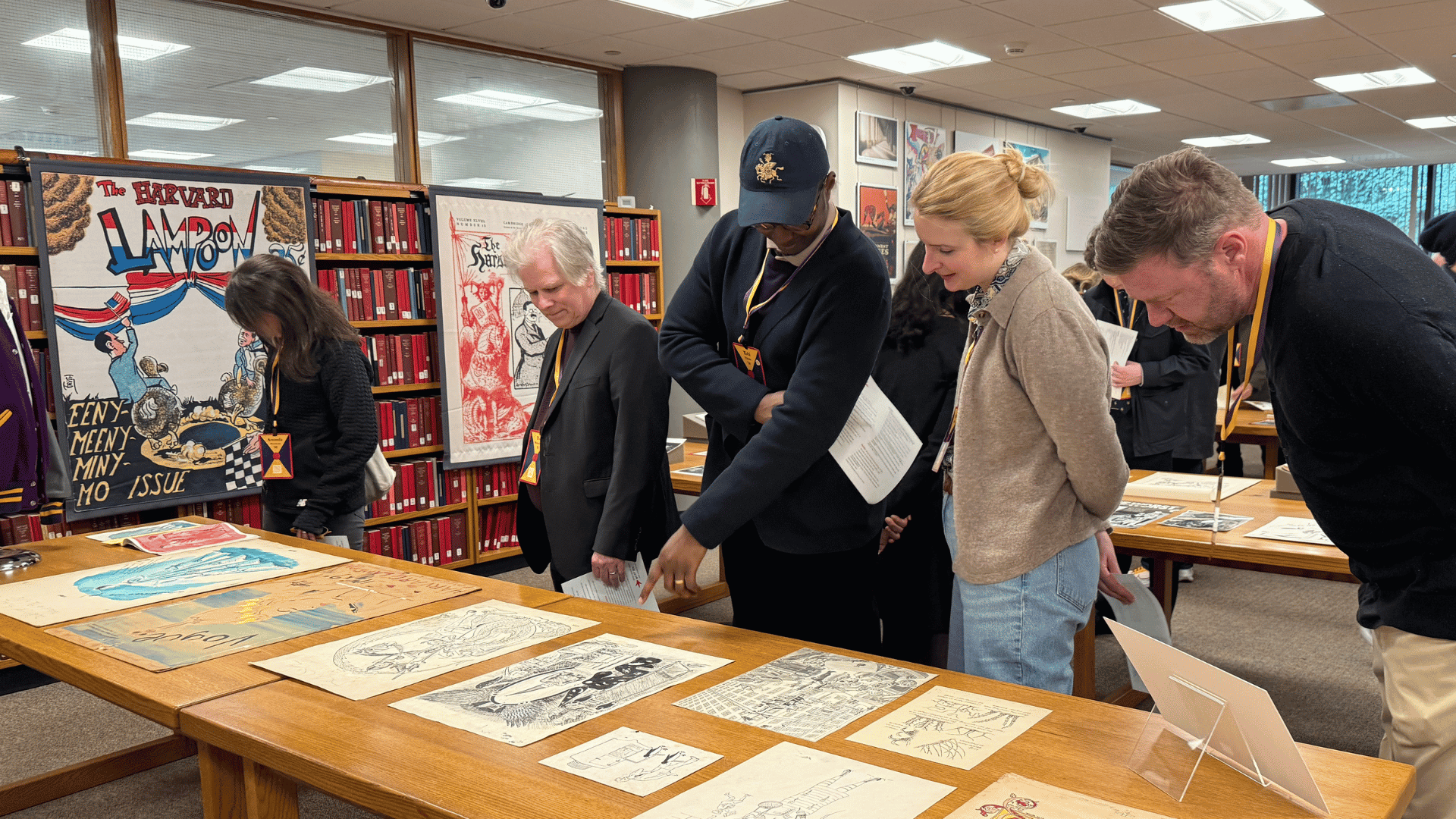
Lampoon alumni gathered at the pop-up exhibit.
Photos by Jacob Sweet
Alumni of humor magazine reunite for pop-up exhibit celebrating sesquicentennial
The first James Bond book that Thomas Beale read was not a Bond book at all. It was a fake — a parody titled “Alligator” written by members of The Harvard Lampoon. By the time he realized that, he’d already made significant headway into the text.
“That’s the art of a good parody,” he said. “You don’t quite realize you’re getting spoofed until halfway through.”
A high-schooler at the time, Beale was inspired. He started a humor column for his school newspaper, and when he arrived at Harvard, he joined the Lampoon itself. There, he met his people — a cohort with a “certain personality type,” who find their way to the 150-year-old humor publication.
More than 100 alumni of the magazine gathered in the Harvard University Archives on a recent Saturday morning for a pop-up exhibit highlighting the publication’s history, part of a multiday celebration of the group’s sesquicentennial.
“That’s the art of a good parody. You don’t quite realize you’re getting spoofed until halfway through.”
Thomas Beale
“The 250th of the U.S. is going to pale in comparison,” joked one alumnus.
In addition to the nearly 100 items displayed by University archivists, staff also displayed private collections from the alumni. It was in this section that Beale, a Cambridge resident and longtime treasurer of the group, showed off a parody issue of USA Today that featured a picture of his two young daughters (they’re now grown adults) and the family dog.
Archivists split the items into five categories: early history; rivalries; parodies; celebrations; and art of the Lampoon and ephemera.
Some pieces from the collection were easy to explain to outsiders, such as architectural drawings of the Harvard Lampoon Castle, which was designed by Edmund M. Wheelwright.
Others required some context. “Gripping a .50-caliber machine gun, John Wayne rode an armed personnel carrier into Harvard Square yesterday, in what was billed as an assault on the Eastern Liberal Establishment,” began coverage of a 1974 article. It was one of the many displayed publications covering Wayne’s attempt to defend his honor after Lampoon members had dubbed him the “biggest fraud in history.”
In the parodies section, visitors had the opportunity to read examples over three centuries — from an 1892 faux-Greek trilogy called “The Little Tin Gods-on-Wheels” to the group’s 2013 edition of “The Wobbit.” In between, the group took aim at publications both on campus and off.
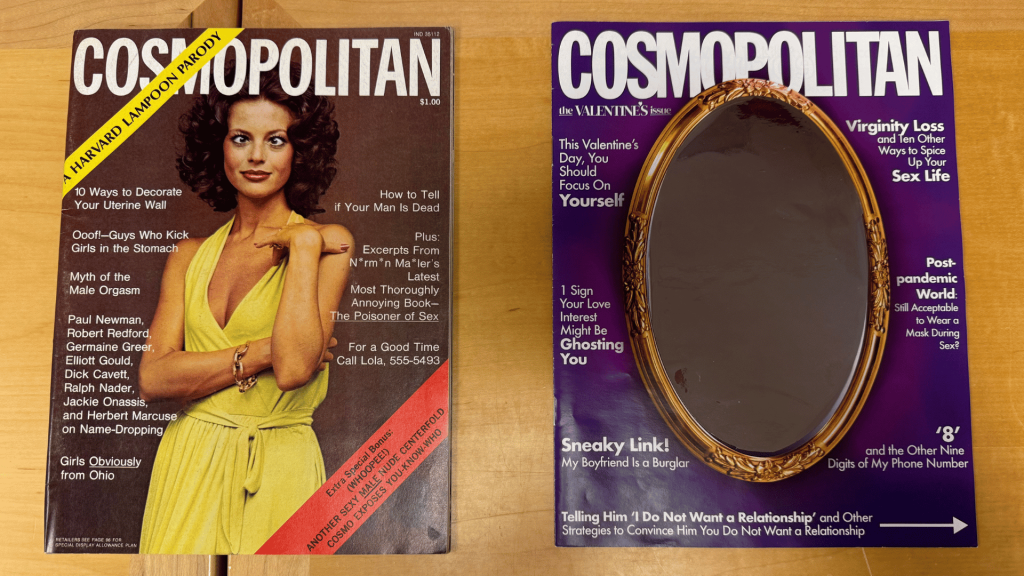
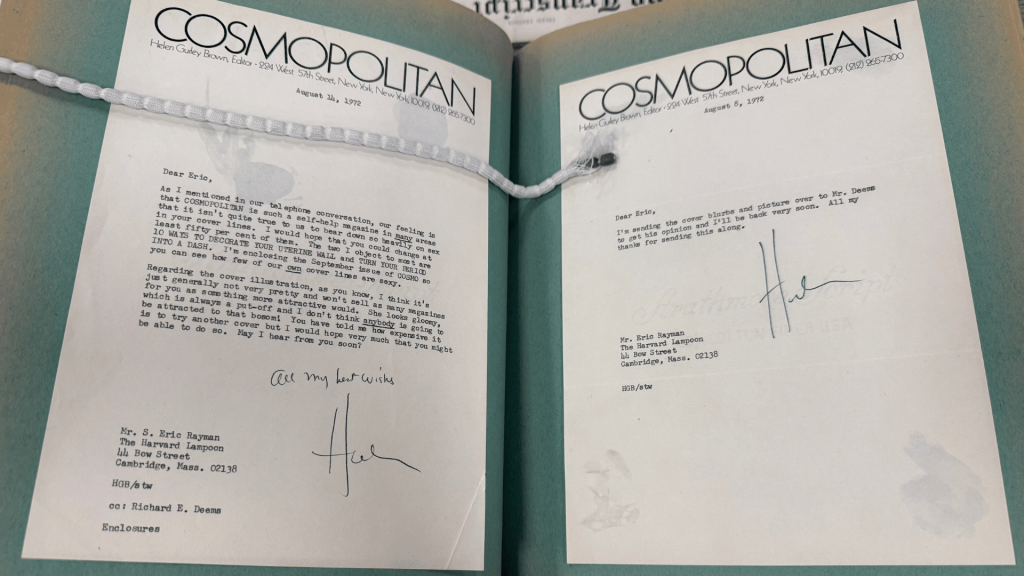
The table featured letters to the Lampoon from Cosmopolitan editor Helen Gurley Brown, who thought the group could find a better cover model for their mock issue and suggested some headline changes. “I’m enclosing the September issue of COSMO so you can see how few of our own cover lines are sexy,” she wrote.
The lampooning was not always one-sided. The Advocate, The Crimson, and the Spy Club of 1721 (the name is a long story) took turns parodying the Lampoon — and even took their rivalries off the page. Curators displayed a photograph of the 1946 Crimson/Lampoon annual baseball game and a 1910 postcard invitation to the same event. One scrapbook held an invitation to a 1907 inter-paper track meet between the Lampoon, Advocate, and Crimson. Surely human athleticism peaked that day.
While the Lampoon is perhaps best known today for its pipeline into TV writers’ rooms, the showcase revealed the relatively unsung work of the organization’s artists, whose hand-drawn and -painted work filled the pages of nearly every publication.
Curators acknowledged that some of the work had almost been lost to history. Collection development archivist Alexandra Dunn explained that the artwork by Henry Russell Wood, a 1927 College graduate, had been donated by his daughters, who found his art under a bed in a leather suitcase. The long-buried work included a pen-and-ink sketch from a Harvard football game and a colorful medieval-style folio featuring the Lampoon’s Ibis mascot.
Mac Whatley, a 1977 graduate of the College, was glad that so much of the Lampoon work had survived and that Archives is still looking to preserve more. He recalled classmates periodically cleaning out the castle and simply throwing old work out.
“There are things I rescued from the street because I couldn’t bear to throw them away,” he said. He’s held on to them until now, “but this is a much better place to look after stuff.”