
 Featured series


Tag: Origins of Life Initiative
-
Science & Tech
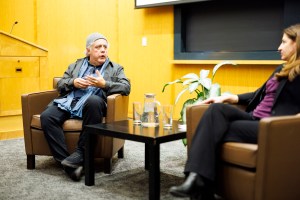
Why there might be life out there unlike any on Earth
Researchers create synthetic species without biochemistry, find they operate according to Darwinian evolutionary principles.
-
Science & Tech
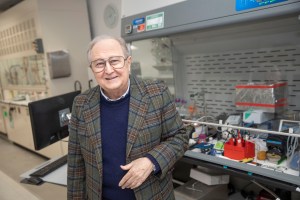
Harvard reflects on Apollo 11 and Neil Armstrong’s moon walk
A trio of Harvard astronomers reflect on the impact of Neil Armstrong’s first steps on the moon, then and now.
-
Science & Tech
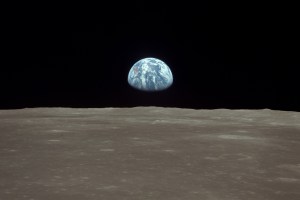
A role for cyanide in recipe for life
New Harvard findings show that a mixture of cyanide and copper, when irradiated with UV light, could have helped form the building blocks of life on early Earth.
-
Health
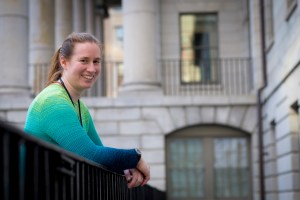
Understanding life, here, there, and everywhere
Harvard’s Origins of Life Initiative has grown along with the rise in interest in how life first arose on Earth and whether it exists on other planets.

-
Health
Mimicking life in a chemical soup
An Origins of Life researcher has created a chemical system that mimics early cell behavior.

-
Science & Tech
Earth’s sister in the crosshairs
A new book by Harvard astronomer Dimitar Sasselov explains the revolution in understanding the universe that views life as a natural part of planetary evolution and that has researchers on the brink of finding worlds that echo this one.

-
Health
Earthly extremes hint to life elsewhere
Scientists are examining single-celled organisms in extreme environments for clues to what life might look like on the myriad planets being discovered in the universe.

-
Science & Tech
‘It is within our grasp’
Answers to questions about life in the universe is “within our grasp,” astronomer Lisa Kaltenegger said at an Origins of Life Initiative forum.

-
Science & Tech
Bringing new meaning to the term scientific paper
An insight from the labs of Harvard chemist George M. Whitesides and cell biologist Donald Ingber is likely to make a fundamental shift in how biologists grow and study cells – and it’s as cheap and easy as reaching for a paper towel. Ratmir Derda, a postdoctoral student co-mentored by Whitesides and Ingber at Harvard’s…
-
Health
Microbes thrive in harsh, isolated water under Antarctic glacier
A reservoir of briny liquid buried deep beneath an Antarctic glacier supports hardy microbes that have lived in isolation for millions of years, researchers report this week in the journal Science. The discovery of life in a place where cold, darkness, and lack of oxygen would previously have led scientists to believe nothing could survive…
-
Health
Taking a stride toward synthetic life
Harvard scientists have cleared a key hurdle in the creation of synthetic life, assembling a cell’s critical protein-making machinery in an advance with both practical, industrial applications and that advances the basic understanding of life’s workings. George Church, a genetics professor at Harvard Medical School and member of Harvard’s Origins of Life Initiative, reported the…
-
Science & Tech
Charbonneau gets prestigious ‘young researcher’ award
David Charbonneau, the 34-year-old Thomas D. Cabot Associate Professor of Astronomy, has been named the recipient of the National Science Foundation’s 2009 Alan T. Waterman Award, and will receive $500,000 over a three-year period for scientific research or advanced study in his field. The annual Waterman Award recognizes an outstanding young researcher in any field…
-
Science & Tech
Transit search finds super-Neptune
Astronomers at the Harvard-Smithsonian Center for Astrophysics havediscovered a planet somewhat larger and more massive than Neptuneorbiting a star 120 light-years from Earth. While Neptune has a diameter3.8 times that of Earth and a mass 17 times Earth’s, the new world(named HAT-P-11b) is 4.7 times the size of Earth and has 25 Earthmasses. HAT-P-11b was…
-
Health
NYU chemist Robert Shapiro decries RNA-first possibility
Back in the depths of time, an event almost miraculously improbable happened, creating a long, unlikely molecule. And life arose on Earth. Or, if you prefer, back in the depths of time, in a soup of small, relatively common molecules, an unknown chemical reaction occurred, sustained itself, replicated … and life arose on Earth.
-
Science & Tech
A new era in search for ‘sister Earths’?
Research presented at a recent astronomical conference is being hailed as ushering in a new era in the search for Earth-like planets by showing that they are more numerous than previously thought and that scientists can now analyze their atmospheres for elements that might be conducive to life.
-
Science & Tech
Laser precision added to search for new Earths
Harvard scientists have unveiled a new laser-measuring device that they say will provide a critical advance in the resolution of current planet-finding techniques, making the discovery of Earth-sized planets possible. The discovery of planets outside of our solar system, called “exoplanets,” is one of the hottest fields in astronomy and holds great promise to increase…
-
Science & Tech
Interdisciplinary conference takes micro, macro look at origins of life
How did we get here? That’s not the first line in a hangover joke. It’s a question that has been asked for centuries about the origins of life on Earth. At Harvard last week, an A-list of astronomers, physicists, Earth scientists, and chemists met in the Radcliffe Gymnasium to look at this and other fundamental…
-
Health
Biologist Venter will be visiting scholar at Origins of Life Initiative
J. Craig Venter, the visionary biologist and intellectual entrepreneur who was a leading figure in the decoding of the human genome, will join Harvard University as a visiting scholar at the University’s Origins of Life Initiative.
-
Science & Tech
J. Craig Venter named visiting scholar
J. Craig Venter, the visionary biologist and intellectual entrepreneur who was a leading figure in the decoding of the human genome, will join Harvard University as a visiting scholar at the University’s Origins of Life Initiative. Venter, who left his last academic post in 1982, is founder and president of the J. Craig Venter Institute.…