Featured series
Nation & World
Bearing witness in war zones
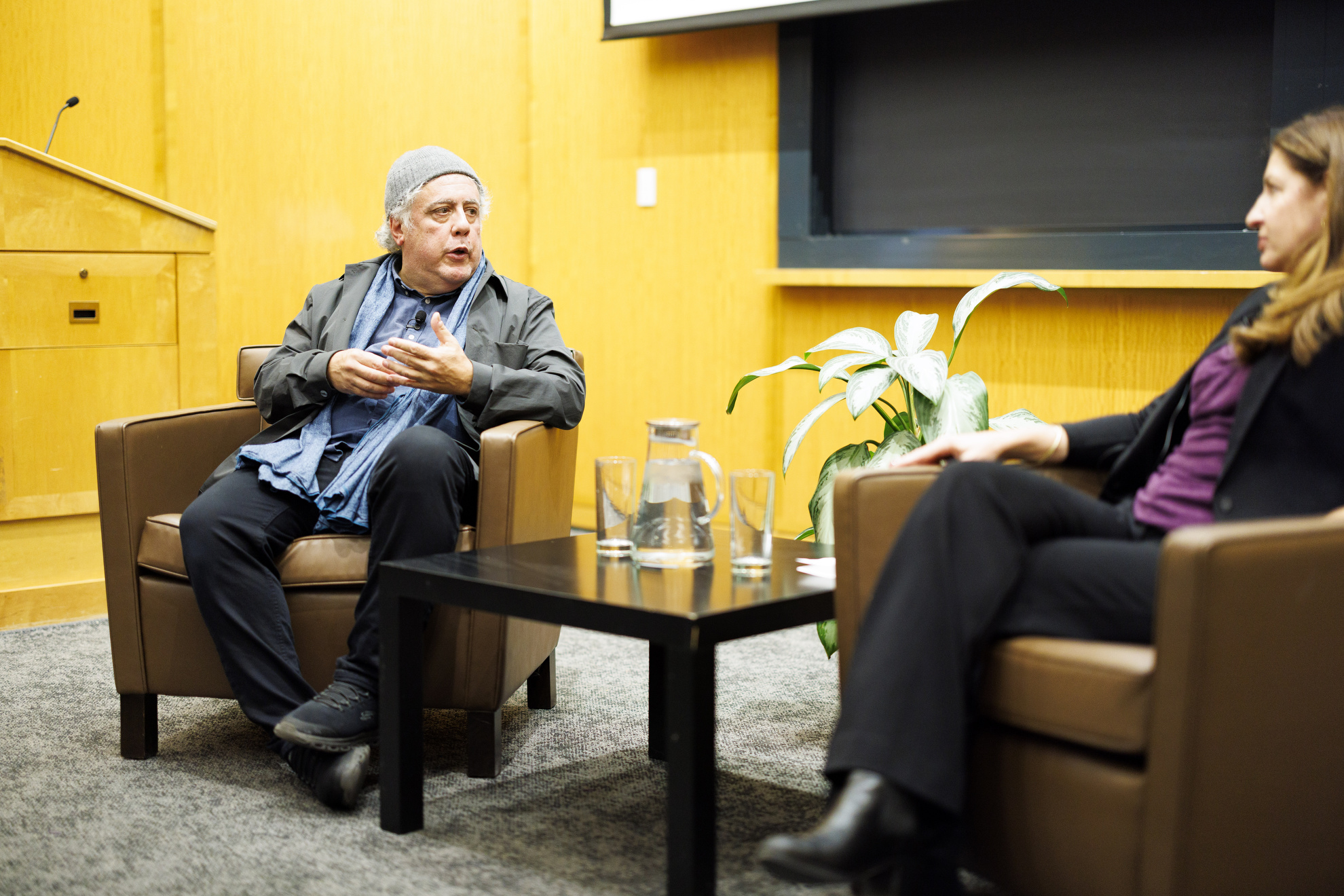
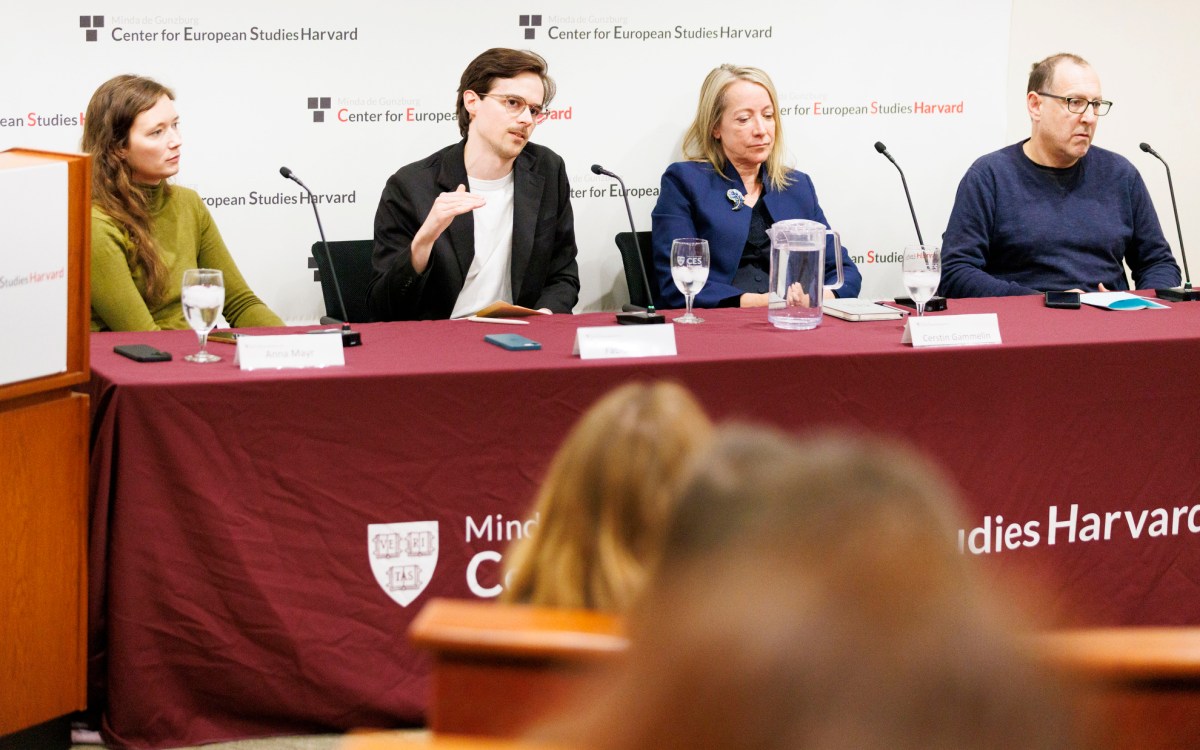
Ron Haviv (left) and Melani Cammett.
Photos by Veasey Conway/Harvard Staff Photographer
Award-winning filmmaker, photographer recounts three decades of trying to produce images that bring about positive change
Being a war photojournalist is a complex and dangerous undertaking. But the goal is simple: bear witness and, hopefully, inspire positive change.
That’s according to award-winning filmmaker and photographer Ron Haviv, who has been documenting the human faces of armed conflict for more than 30 years.
Last Thursday, Haviv, co-founder of the VII Foundation, which supports and educates photojournalists, spoke about his globe-covering career at the Weatherhead Center for International Affairs, giving the 2026 Samuel and Elizabeth Jodidi lecture, “Testimony 1989 to 2026.”
“My goal and the goal of contributing photographers to the VII Foundation and our colleagues around the world is for our work to rise above those images in order to be able to tell stories, in order to be able to have impact and be able to affect change,” he said.
Haviv’s quest began when he was a student at New York University in the late 1980s.
Intrigued by photojournalism, “I started working on the streets of New York and met these amazing men and women that were dedicated toward telling stories that would have impact,” he said.
Many of them, he recalled, would “put their arm around me and say, ‘You should do this or do that’ and so on. And at one point, a photographer who was going to cover an election being held by a dictator in the country of Panama had an extra plane ticket and said, ‘Here’s an extra plane ticket. Why don’t you come with me?’”
Haviv did, and a career was launched.
“There were bullets flying around, and it didn’t mean anything to me. I was just so intent on taking the photographs.” Haviv’s photo of the bloodied vice president-elect, Guillermo Ford, who had been physically beaten by supporters of the military ruler Manuel Noriega, ran on the covers of Newsweek, Time, and U.S. News and World Report.
It also caught the eye of then-President George H.W. Bush, who cited the image in a speech.
“Seven months later … the United States invaded Panama,” said Haviv, who accompanied the troops. “I’m not naive enough to think that the photographs were the only reason for the conflict, but they were part of the conversation.”
Soon after, he flew to China to cover the aftermath of the Tiananmen Square protests, to Africa as Nelson Mandela was released from jail, and to Kuwait City as it was liberated.
However, his belief that photographic evidence could bring political change was soon tested.
In 1991, he recalled, he was hearing rumors that Yugoslavia, a country in transition after the fall of the Soviet Union, “might break apart, and it might break apart violently,” he said. “So I went to Yugoslavia as it started to split apart, the first country being Slovenia.”
Over the next 10 years he documented the segmentation and civil wars that followed.
To illustrate, Haviv presented a short film summarizing what he saw, ending with the round-up of refugees in what was supposed to be a safe zone in Srebrenica but ended up being the site of a massacre.
“I documented what became known as ethnic cleansing … unarmed Muslim civilians being executed by well-armed Serbian paramilitaries,” he said. “This was the visual evidence to prove what everybody else was talking about.”
But this time, there was no immediate official corrective response.
“The photographs completely failed. They did nothing. Nobody cared,” said Haviv.
Eventually things both changed and didn’t.
“Part of Bosnia was declared a genocide, then Rwanda was declared a genocide. And now we have how many more genocides since then? And all of them are happening in front of us.
“We’re out there, myself and my colleagues, trying to bring you information and there’s a disconnect,” he said. “So it is this constant, constant fight to try to figure out what can we do,” he continued, to get people to “pay attention. This is very, very key to everything.”
Along with photos of both civilians and soldiers, atrocities and images of everyday life continuing, even in war zones, Haviv described a surprising commonality he discovered over time.
“In actuality, people are saying the same thing,” he noted. “They’re saying it’s always about the ‘other.’ It’s always about, ‘They’re coming to get me, so I’m going to fight.’
“On one hand, that is very depressing,” he continued. “But on the other hand, it shows also that we’re actually more alike than different. And if we can acknowledge that and try to move beyond that, then perhaps there might be some hope for us.”
The discussion that followed raised questions about the role of aesthetics in his work.
Haviv responded by explaining that he seeks to avoid what he called “war porn,” shocking images of death or poverty.
Looking at a dead body, for example, “You can photograph it like an autopsy picture, and I guarantee you …it will not even register,” he said. “There are ways to document and give value to whoever died and to be able to tell their story.
“I want you to be drawn into it, so into it that when you actually understand what you’re looking at and read the caption, you’re not going to forget it.”
Ron Haviv
“I want you to have an emotional connection to that photograph. And most of the time the initial interaction and value is going to come through the aesthetics,” he explained, listing such elements as color and framing of a shot. “I want you to be drawn into it, so into it that when you actually understand what you’re looking at and read the caption, you’re not going to forget it.”
Although there is a kind of truth in an image, Haviv took pains to note all that photography, whether taken with cameras or even cellphones, is not objective.
“By its very nature, it’s subjective,” said Haviv. “You move your phone this way or that way; you’re making a decision. What I try to do in my work is to ensure that I’m giving you a fair representation, a truthful representation of what I’m seeing.”
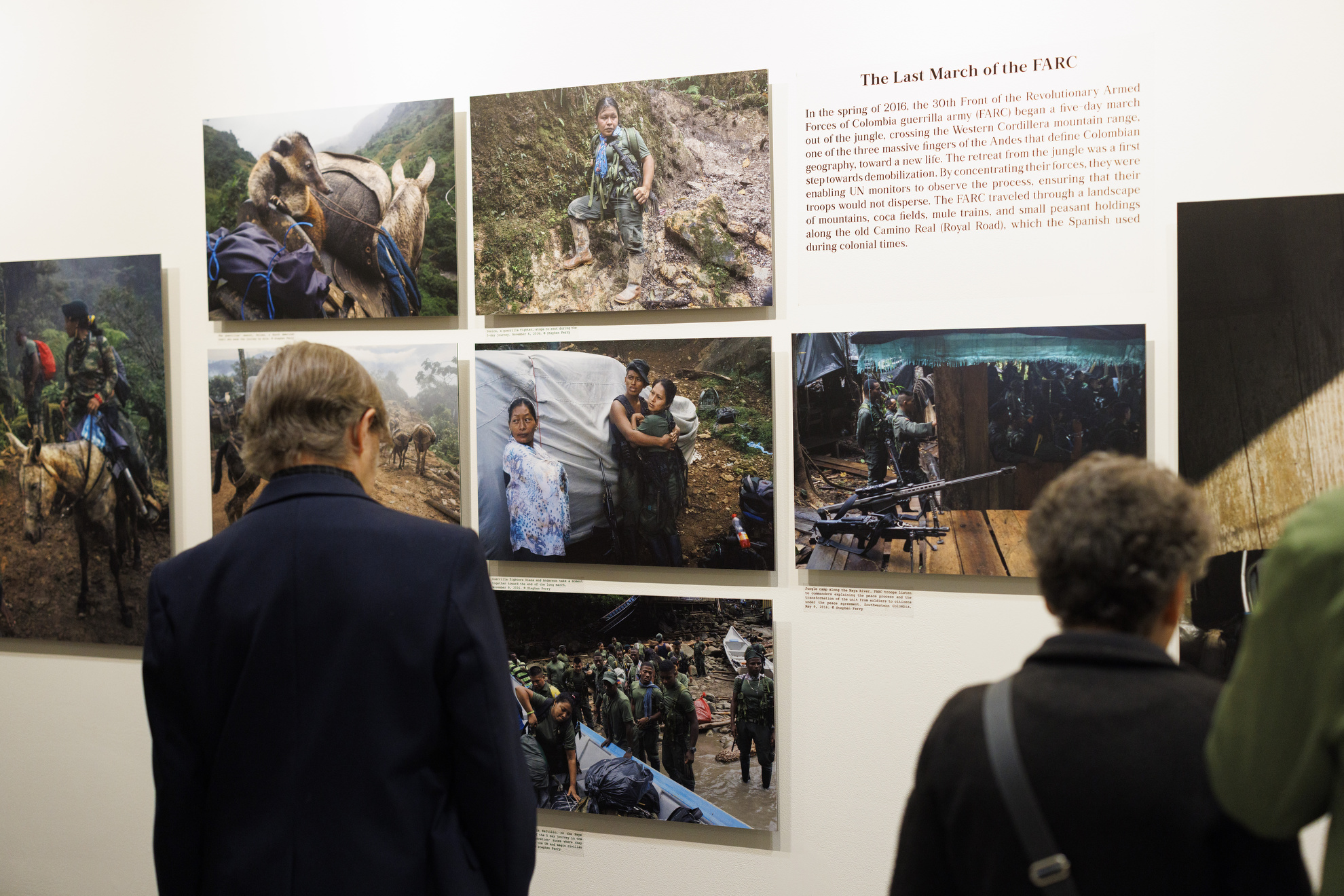
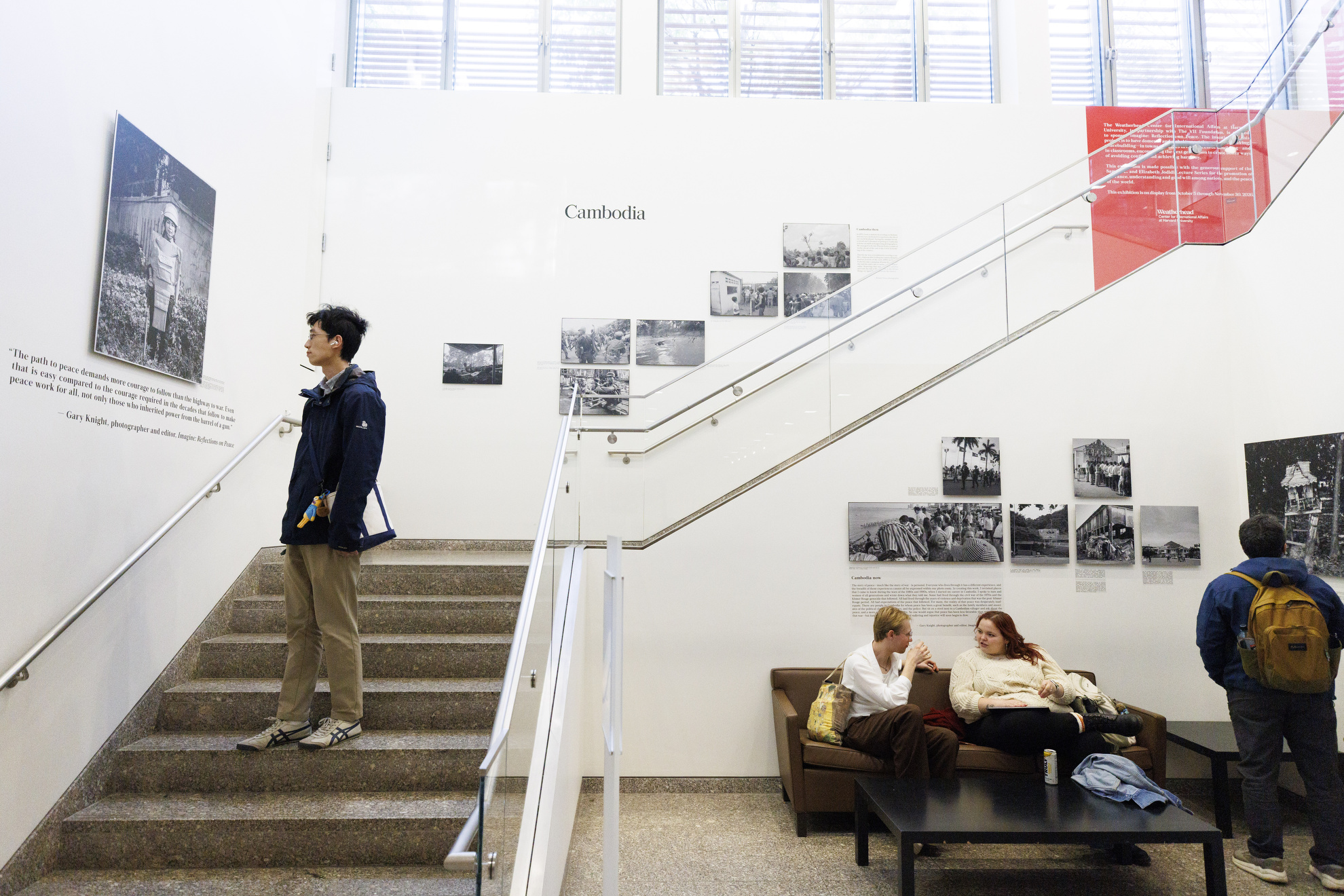
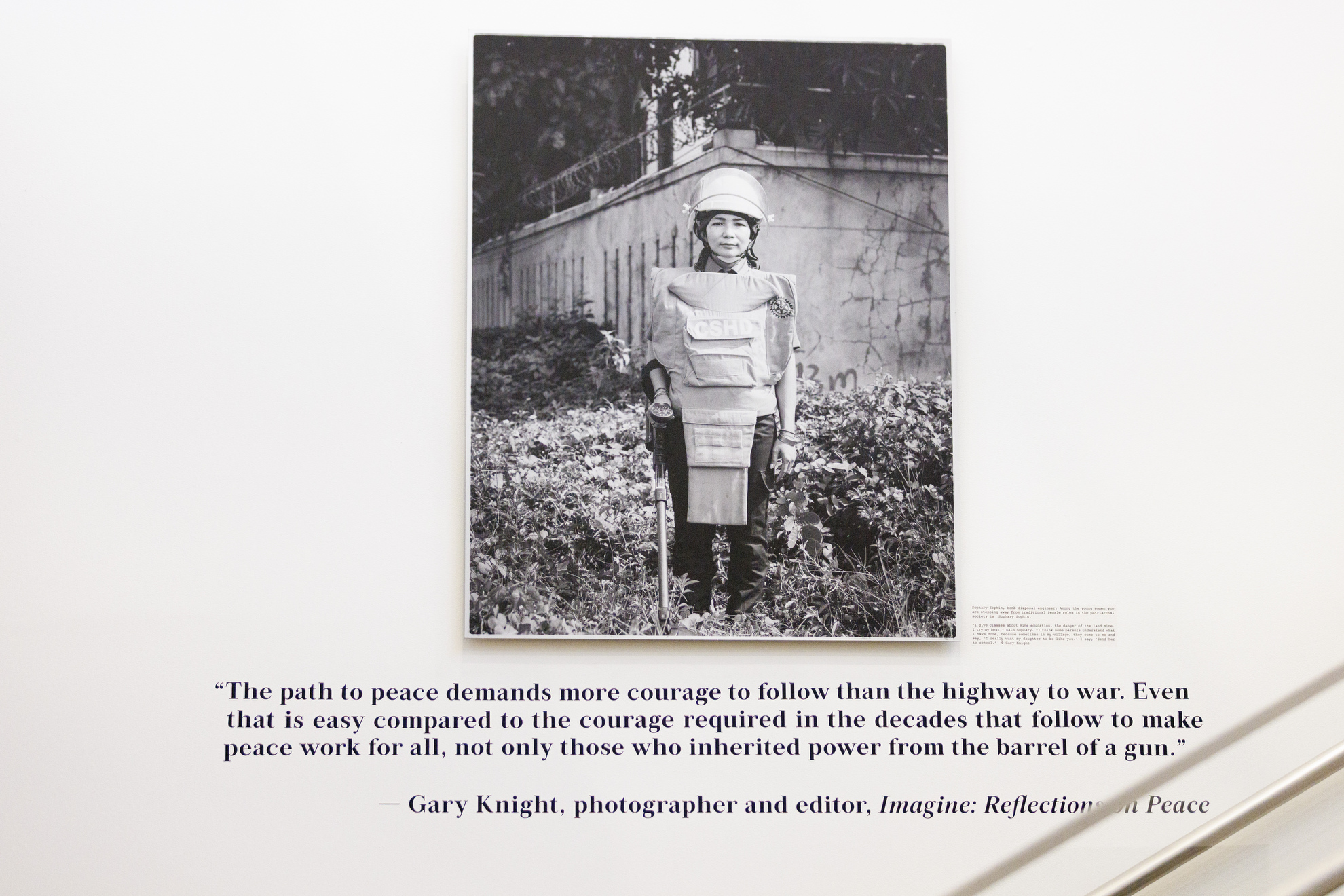
An accompanying photo exhibit, “Reflections on Peace,” is on view for Harvard ID holders on the Concourse Level of CGIS South, 1730 Cambridge St., through Jan. 4. The exhibit will be open to the public from noon to 4 p.m. November 7.
The exhibit was curated by the VII Foundation, which creates programs like “Reflections on Peace” and also educates aspiring visual journalists through the VII Academy.