
 Featured series


Tag: Department of Organismic and Evolutionary Biology
-
Science & Tech
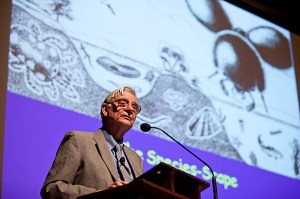
‘Settle down,’ warns E.O. Wilson
Esteemed biologist Edward O. Wilson called for renewed efforts to understand and conserve the planet’s biodiversity, in the first of three Prather Lectures being presented this week.
-
Health
Killer mushrooms!
It is thought to have been responsible for the deaths of emperors. In parts of California’s forests, it is everywhere. It is the deathcap mushroom, Amanita phalloides, so filled with toxins that a single cap can kill anyone who mistakenly eats it and does not get medical treatment. Because it looks like an edible mushroom,…
-
Science & Tech
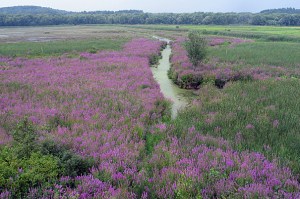
When success spells defeat
Invasive plants are beneficiaries of climate change in Thoreau’s woods.
-
Health
Sperm competition, cooperation
Some mouse sperm can discriminate between their brethren and the competing sperm from other males, showing an unusual behavioral complexity.

-
Health
Tracking genetic traits over time
Fossils may provide tantalizing clues to human history, but they also lack some vital information, such as revealing which pieces of human DNA have been favored by evolution because they confer beneficial traits — resistance to infection or the ability to digest milk, for example. These signs can only be revealed through genetic studies of…
-
Health
Orphan army ants join nearby colonies
Normal 0 0 1 415 2369 19 4 2909 11.1282 0 0 0 Colonies of army ants, whose long columns and marauding habits are the stuff of natural-history legend, are usually antagonistic to each other, attacking soldiers from rival colonies in border disputes that keep the colonies separate. But new work by a researcher at…
-
Science & Tech
Genetic sex determination let ancient species adapt to ocean life
A new analysis of extinct sea creatures suggests that the transition from egg-laying to live-born young opened up evolutionary pathways that allowed these ancient species to adapt to and thrive in open oceans. The evolutionary sleuthing is described today in a letter in the journal Nature by scientists at Harvard and the University of Reading…
-
Health
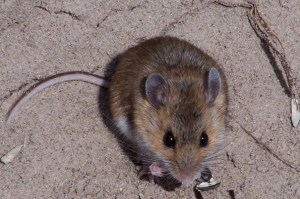
Mice living in Sandhills quickly evolved lighter coloration
A vivid illustration of natural selection at work: Harvard scientists have found that deer mice quickly evolved lighter coloration after glaciers deposited sand dunes atop what had been much darker soil.
-
Health
Freshwater fish at top of food chain evolve more slowly
Since evolving to eat other fish, freshwater fish at the top of the food chain have remained relatively unchanged compared with their insect- and snail-eating cousins, according to new research. Scientists report in the journal Evolution that once these fish, known as centrarchids, became top predators in aquatic ecosystems, natural selection put the brakes on…
-
Health
Maternal, paternal genes’ tug-of-war may last well into childhood
An analysis of rare genetic disorders in which children lack some genes from one parent suggests that maternal and paternal genes engage in a subtle tug-of-war well into childhood, and possibly as late as the onset of puberty. This striking new variety of intra-family conflict, described by Harvard researchers in today’s edition of the Proceedings…
-
Health
The way of the digital dodo
The National Science Foundation-funded, three-year effort aims to create 3-D digital models of each species represented in Harvard’s collection of 12,000 bird skeletons.
-
Science & Tech
The evolution of Darwin
In a fitting celebration of a man whose ideas revolutionized science, Harvard marked Charles Darwin’s 200th birthday in style.
-
Science & Tech
Exploring hidden life’s abundance
Two miles below the surface of the Sargasso Sea lies a depression in the Earth’s crust filled with sediment and, scientists believe, teeming with life — exotic, microscopic, and very likely never before seen by human eyes. Called the North Pond Basin, the site — researchers at Harvard and beyond believe — can provide a…
-
Science & Tech
Records dating back to Thoreau show some sharp shifts in plant flowering near Walden Pond
Drawing on records dating back to the journals of Henry David Thoreau, scientists at Harvard University have found that different plant families near Walden Pond in Concord, Mass., have borne the effects of climate change in strikingly different ways. Some of the plant families hit hardest by global warming have included beloved species like lilies,…
-
Health
Boning up on frogs’ defenses
Harvard biologists have determined that some African frogs carry concealed weapons: when threatened, these species puncture their own skin with sharp bones in their toes, using the bones as claws capable of wounding predators. The unusual defense mechanism is described by Harvard’s David C. Blackburn, James Hanken, and Farish A. Jenkins, Jr., in a forthcoming…
-
Science & Tech
Mars’ water appears to have been too salty to support life
A new analysis of the Martian rock that gave hints of water on the Red Planet — and, therefore, optimism about the prospect of life — now suggests the water was more likely a thick brine, far too salty to support life as we know it. The finding, by scientists at Harvard University and Stony…
-
Science & Tech
Hauser presents theory of “humaniqueness”
Shedding new light on the great cognitive rift between humans and animals, a Harvard University scientist has synthesized four key differences in human and animal cognition into a hypothesis on what exactly differentiates human and animal thought. In new work presented for the first time at the annual meeting of the American Association for the…
-
Science & Tech
Gonzalo Giribet
They had sifted through the forest floor’s leaves and dirt for days, looking for a tiny type of daddy longlegs native to New Zealand, but had little more than dirty hands to show for it. Gonzalo Giribet, a professor of organismic and evolutionary biology, managed to remain upbeat, but with each passing day the sick…
-
Health
Research highlights the muscle’s many motions
New research from Harvard’s Concord Field Station has shown that the common perception of a muscle as a single functional unit is incorrect and that different sections within an individual muscle actually do different work. The finding enriches a gradually emerging picture of a single muscle as a far more complex unit than traditionally believed.…
-
Science & Tech
Forests, reefs, mountaintop illuminate tropical biology
Morning came in the middle of the night in the hikers’ hut partway up the side of Borneo’s towering Mount Kinabalu. At 2 a.m., after just a few hours’ sleep, the Harvard Summer School students slowly roused themselves, creating a chorus of rustling sleeping bags, zippers, and boots on the wooden floor. They’d been on…
-
Campus & Community
Pressured by predators, lizards see rapid shift in natural selection
Countering the widespread view of evolution as a process played out over the course of eons, evolutionary biologists have shown that natural selection can turn on a dime – within months – as a population’s needs change. In a study of island lizards exposed to a new predator, the scientists found that natural selection dramatically…
-
Campus & Community
Students search for Thompson Island’s hoppers
Education met hands-on science on Boston Harbor’s Thompson Island on Oct. 9, 2006, as roughly 100 Harvard undergraduates fanned out from beach to beach collecting insects to be included in a new database of Harbor Island insect life. The students, part of biology professors Brian Farrell and Missy Holbrook’s OEB 10 class, “Foundations of Biological…
-
Campus & Community
Spring in your step helps avert disastrous stumbles
From graceful ballerinas to clumsy-looking birds, everyone occasionally loses their footing. New Harvard University research suggests that it could literally be the spring, or damper, in your step that helps you bounce back from a stumble. The work, published this week in the journal Proceedings of the National Academy of Sciences, sheds new light on…
-
Health
Beetles’ past tells volumes about tropical evolution
Experts seeking to explain the amazing diversity of the tropical rain forest have typically done so in two ways, viewing forests as either “evolutionary cradles” that encourage the rapid development of new species, or as “evolutionary museums” that allow species to accumulate over time. New work by Harvard researchers on tropical beetles indicates that both…
-
Campus & Community
Finding a fossilized needle in an Arctic haystack
The first season searching Arctic Canada for a fossil that would illuminate how our ancestors first crawled onto land proved Harvard Professor Farish Jenkins’ explorer’s maxim: Never go any place for the first time. A crew of six trudged through a barren landscape during the summer of 1999, finding the wrong sort of rocks scattered…
-
Campus & Community
Wakeley examines ancestral lines
John Wakeley is devising new ways to trace the evolutionary road taken by humans and the creatures with whom we share planet Earth by creating new models that examine how DNA has changed over time. A theoretical population geneticist, Wakeley’s research focuses on how our DNA changes as it is passed from generation to generation.…
-
Campus & Community
Evolution follows few possible paths to antibiotic resistance
Darwinian evolution follows very few of the available mutational pathways to attain fitter proteins, researchers at Harvard University have found in a study of a gene whose mutant form increases bacterial resistance to a widely prescribed antibiotic by a factor of roughly 100,000.
-
Science & Tech
Newly found species fills evolutionary gap between fish and land animals
Paleontologists have discovered fossils of a species that provides the missing evolutionary link between fish and the first animals that walked out of water onto land about 375 million years ago. The newly found species, Tiktaalik roseae, has a skull, a neck, ribs, and parts of the limbs that are similar to four- legged animals…
-
Campus & Community
A tale of a venomous dispute
Sea spiders as large as a foot across have been seen crawling along the deep ocean floor from the windows of submersible research vessels. Most of them, however, including those in a Harvard study, are a scant millimeter (.04 inch) in size. But big or small, they boast long snouts, on either side of which…
-
Campus & Community
Wing color not just for looks
Harvard and Russian researchers have documented natural selection’s role in the creation of new species through a process called reinforcement, where butterfly wing colors differ enough to avoid confusion with other species at mating time, helping the butterflies avoid creating less-fit hybrid offspring. Though more distantly related species tend to be more physically distinct, researchers…