Featured series


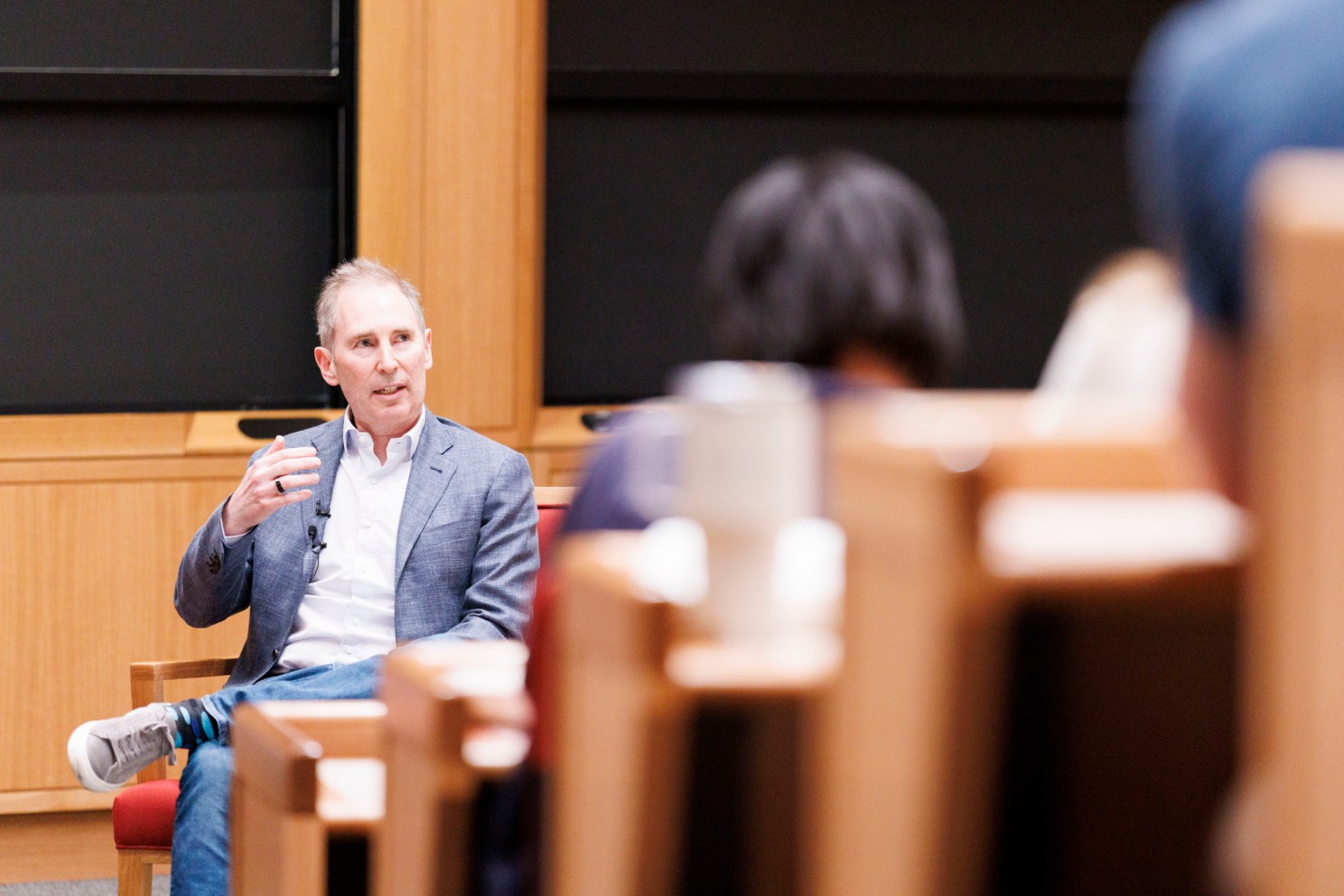
Andy Jassy.
Veasey Conway/Harvard Staff Photographer
Work & Economy
Dumbest question is the one you never ask, says Amazon CEO
AI competition – among companies and in the labor market – also on Jassy’s mind in HBS talk
Though it’s best known as an online retail and streaming giant, Amazon has also played a central role in the AI revolution.
In August, the company’s valuation hit $3 trillion. Much of that was driven by Amazon Web Services (AWS), the cloud computing operation that serves as a primary platform for both large-scale frontier model AI builders like Anthropic and OpenAI and for smaller firms developing simpler, more cost-effective AI tools for business applications.
During a talk Thursday at Harvard Business School, Amazon CEO Andy Jassy offered his view of where AI is going and rejected the idea of a winner-takes-all race from which one model emerges to set industry standards and control the marketplace.
“There is not one tool to rule the world — it never works out that way,” Jassy told Andy Wu, the Arjan and Minoo Melwani Family Associate Professor of Business Administration. “Customers always want choice, and in fact, most of the sophisticated generative AI applications today use multiple models.”
“There is not one tool to rule the world — it never works out that way.”
Andy Jassy
Ultimately, there will be six to eight AI models that compete with one another, Jassy said. Some may be a little better in one area than another, but they’ll all be useful and offer the level of intelligence, cost, access control, and safety customers want, he predicted.
One major obstacle AI still faces is the high cost of inference, the process of training models to make decisions and predictions. Though the number has come down significantly in the last few years, it’s “still too high,” Jassy said, largely because of the price of computer processing chips, a problem Amazon is seeking to address with its own line of budget AI-accelerator chips.
Jassy began working at Amazon three days after graduating from Harvard Business School in 1997. He was part of the team that founded and launched AWS in 2002. Those first few years were “by far the hardest, most difficult years of my career,” he recalled.
“None of us were sure it was going to work. I felt like every day my best people would come to my office and say, ‘What are we doing? Why are we doing this?’”
Jassy marveled at how significantly Amazon’s cloud computing business has grown recently thanks to AI.
“When Amazon launched AWS, its revenue run rate was $58 million in its first three years,” he said.
“People said, ‘Oh my God, I can’t believe how fast the business is growing.’ In the first three years of this AI wave, our AI revenue run rate is over $25 billion. It’s unbelievable how fast it’s growing and how much AI is being done on top of our platform.”
When it comes to the workforce impact of AI, Jassy was blunt: “In almost every way you can imagine, you’re going to have agents doing a lot of jobs that humans are doing today.”
Still, he sees more reason for optimism than panic.
“It doesn’t mean there’s going to be no jobs for humans,” he said. “You’re still going to have lots of people who are doing critical reasoning and thinking about how to connect the dots and what experiences to build, and there are going to be all sorts of new jobs that we haven’t thought about yet that will arise. But it’s going to be different.”
For M.B.A. students preparing to head out into the business world, Jassy advised hard work and humility.
“Just because you went to HBS doesn’t mean that you get an advanced role in companies,” he said. “Most people don’t start in their dream jobs.”
Recounting his earliest days as head of AWS, Jassy said he avoided asking questions because he worried it would undermine his credibility as a leader, especially with those who knew a lot more about the technical side of the business.
“I was afraid to ask dumb questions because I thought they’d all say, ‘See, he doesn’t know enough about technology.’ And then I’d get into a meeting with the team and with Jeff [Amazon founder Jeff Bezos] and he’d ask the exact same question I was going to ask,” he said.
By keeping quiet, Jassy said, he was not doing his job.
“You have to be comfortable that you’re going to make mistakes,” he said. “You have to be comfortable asking dumb questions. It’s the best way to learn.”