Featured series
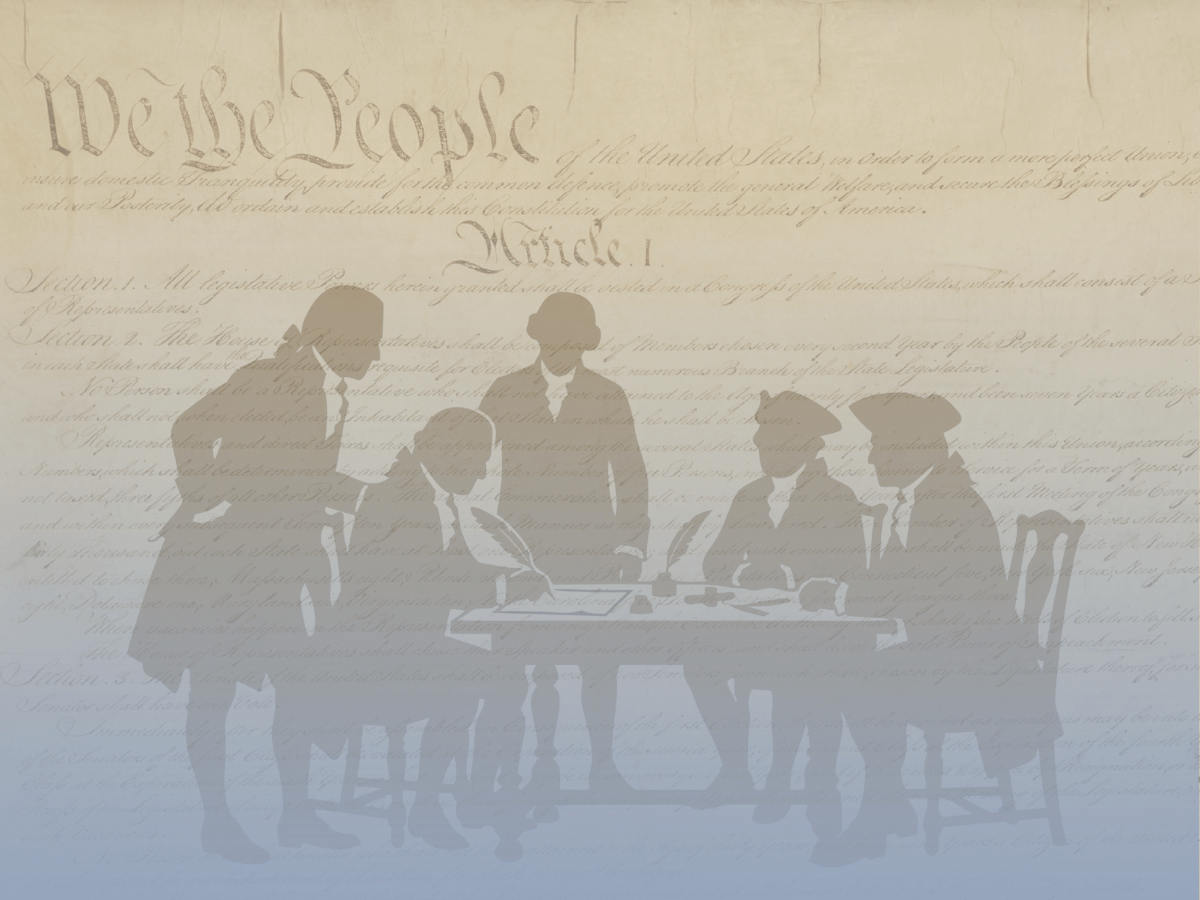
Illustration by Liz Zonarich/Harvard Staff
Nation & World
Democracy? Some founders were skeptical.
Historians detail how, why Constitution became (and remains) work in progress
Part of a series of occasional features marking the nation’s semiquincentennial.
Creating a democracy was not really at the forefront of the founders’ minds when the American colonies first declared independence from Britain in 1776.
The independence movement began as a struggle between the colonies and the crown to gain more rights within the empire, not to break away from it, said Alex Keyssar, Matthew W. Stirling Jr. Professor of History and Social Policy at Harvard Kennedy School.
Once they had, the question was: How to create something from scratch that was not a monarchy but could hold the 13 colonies together?
“The idea of having a government without a king or a hereditary source of executive authority was pretty radical,” Keyssar said. “They had no models. They were well-read and were familiar with the ancient models of Athens in Greece and the Roman republic, but they also had assemblies and some experience with local self-government in the colonies. Their instincts veered toward something that looked like elected self-government.”
“They had no models. They were well-read and were familiar with the ancient models of Athens in Greece and the Roman republic, but they also had assemblies and some experience with local self-government in the colonies.”
Alex Keyssar
They eventually fashioned a new republic with a constrained executive, elected representatives, and basic civil liberties, creating the world’s first representative democracy, in which citizens elected representatives to govern on their behalf. It was a brand-new and far-reaching development, with worldwide repercussions, said Keyssar.
But it wasn’t planned that way from the start.
“They set in motion forces that were unintended and had unintended consequences,” said Michael Klarman, Charles Warren Professor of American Legal History at Harvard Law School, and author of “The Framers’ Coup: The Making of the United States Constitution.” “Some of the forces that were set in motion by the revolution had to do with the idea that if ordinary people are going to fight for independence, they should also have a role in making political decisions.”
In fact, at the outset of the American Revolution, many of the framers had a negative view of participatory democracy, which they associated with mob rule.
They believed in a government with the consent of the governed but didn’t trust the masses to have a direct role in ruling or to choose a president. What they created was indirect democracy, in which people elect representatives to rule.
“They didn’t want people participating directly in government,” said Klarman. “They didn’t believe that the blacksmith and the shipwright should be in the legislature; they didn’t believe that those people ought to be running government and that they should be deferring to their betters.”
In addition, the framers had to strike a series of compromises over the two main divisions among the young republic: the free states versus slave states, and the big states versus small states.
As a result, they created a system of government with certain features that amounted to an “incomplete democracy,” said Daniel Ziblatt, Eaton Professor of the Science of Government.
“Using our modern criteria and looking back, which is something a political scientist would do, there were violations of what we would today call democracy,” said Ziblatt. “The endurance of slavery as an institution is an obvious violation of civil liberties.”
Other undemocratic features left by the framers were omitting a guarantee of the right to vote in the Constitution, and leaving the states to regulate who could vote, who in most cases happened to be white, male, property owners. There was also the so-called three-fifths clause, which counted an enslaved person as three-fifths of a person for the purposes of determining congressional and Electoral College representation and federal taxes.
The clause was a compromise between the North and the South, whose states had bigger enslaved populations and wanted all residents counted (whether they were allowed to vote or not) to give southern states greater political power.
“There was a kind of broken system of representation,” said Ziblatt. “It wasn’t fully fleshed out as a democratic system of representation.”
Keyssar, the historian, agreed.
“In terms of democratic values and principles, the institutions they left were very imperfect,” he said, “and many of those have been modified over time.”
The conception of democracy has changed and expanded since the framers crafted the early foundations of representative democracy, with major breakthroughs such as the abolition of slavery in 1865, the 14th Amendment in 1868, which guaranteed political equality, the right of African Americans to vote in 1870, and the right of women to vote in 1920.
But a lot of those amendments took place as a result of violent changes, said Ziblatt.
“We have a constitution that has evolved over time, but it did require a Civil War,” said Ziblatt. “Many of the things that we love about our Constitution came through constitutional changes that happened later.”
Making those changes was not easy.
Since it was ratified in 1789, the U.S. Constitution has been amended only 27 times. Some see that level of stability as a reflection of the strength of the system. Others view it as a flaw that slows adaptation to rapidly changing times. It may be up to later generations to test the system, said Ziblatt.
Being one of the hardest constitutions in the world to change in some ways hinders the nation’s ability to democratize further, said Ziblatt.
“In many ways, I think we’re now in this situation today where it feels like constitutional changes seem impossible. Can the system within the formal channels of the institutions become more democratic? It’s kind of an open question,” he said.