
 Featured series

Tag: Atul Gawande
-
Campus & Community
The double life of Truelian Lee
Concentrating in chemistry and English, Truelian Lee blended art with scientific problem-solving to bring chemistry to wider audiences.

-
Health
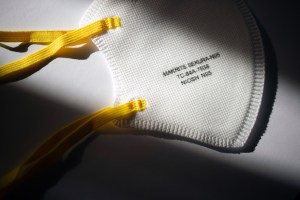
Upgrade your mask as more-transmissible COVID strain surges
With new coronavirus variants on the U.S. pandemic scene, experts say brace yourself for another surge — and mask up.
-
Health
Gawande confronts the inevitable
Death, imperfection, and rock ’n’ roll were all part of surgeon-author Atul Gawande’s conversation with Dean David Hempton at HDS convocation.

-
Health
Vexing health problems can be solved, Gawande believes
Tackling complex issues such as opioid addiction, gun violence, and uneven access to medical care seems daunting, but surgeon and author Atul Gawande says history shows that over time, the nation can solve its public health challenges.

-
Health
Checklists are boring, but death is worse
Systems aren’t sexy, but they save lives, says Harvard Medical School Professor and author Atul Gawande during HUBweek events in Boston.
-
Nation & World
Ingenuity in public health
Inaugural winner Chelsea Clinton was on hand as the Harvard T.H. Chan School of Public Health recognized Blake Mycoskie of TOMS Shoes with this year’s Next Generation Award.

-
Health
Preoccupied with life
Harvard-affiliated surgeon and writer Atul Gawande explores big questions around end-of-life care in “Being Mortal.”
-
Campus & Community
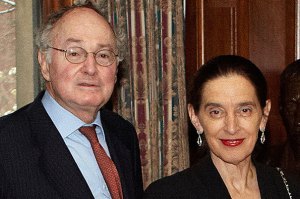
$12.5M to support innovation in education at HSPH
A major effort under way at Harvard School of Public Health to redesign its educational strategy has received significant new support of $12.5 million from the Charina Endowment Fund and Richard L. (M.B.A.’59) and Ronay Menschel.
-
Campus & Community
A year of change, month by month
2012-13 was a year of inventions and ascensions, elections and projections, digitizing and prioritizing. The University also launched HarvardX, the wildly popular web learning platform.

-
Nation & World
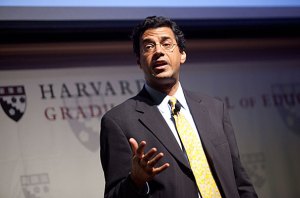
Coaching tips from Gawande
“The biggest factor in determining how much students learn isn’t class size or standardized testing, but the quality of their teachers,” said Atul Gawande in a Harvard Graduate School of Education talk on ways teaching can be improved through coaching.
-
Campus & Community
Garber, Gawande elected into APS
Marjorie Garber and Atul Gawande have been elected members of the American Philosophical Society.
-
Health
The battle for medicine’s soul
Author and surgeon Atul Gawande says effective medicine requires high-quality care and solid research. But it also requires a willingness to adapt.

-
Health
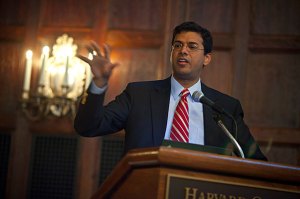
HSPH receives $14.1M grant
Harvard School of Public Health (HSPH) has been awarded a $14.1 million, four-year grant from the Bill & Melinda Gates Foundation to test the effectiveness of an innovative checklist-based childbirth safety program in reducing deaths and improving outcomes of mothers and infants in 120 hospitals in India.
-
Health
Where surgery is lacking
Authorities on global health and surgery gathered Nov. 5 to discuss how to address the lack of trained surgeons and adequate operating rooms in developing nations.

-
Campus & Community
Medical Liability Costs Make Up 2.4% of U.S. Health Spending
Medical malpractice and guarding against suits cost the U.S. about $55.6 billion annually, or 2.4 percent of the total health-care bill, according to Harvard University’s Atul Gawande and co-authors.
-
Nation & World
Doctor examines torture
Author and Harvard doctor Atul Gawande explored the practice of solitary confinement in a lecture at Harvard Law School.

-
Campus & Community
Top surgeon Atul Gawande urges doctors to use ‘The Checklist’
But surgeon Atul Gawande, who teaches at Harvard Medical School, says medicine today is so complex that even the sharpest doctors can no longer keep everything they need to know in their heads.
-
Campus & Community
Atul Gawande’s ‘Checklist’ For Surgery Success
Speaking about dealing with unexpected challenges in medicine, Atul Gawande — a surgeon who writes for the New Yorker when he’s not at his day job at Harvard Medical School — relates a story about a man who came into an emergency room with a stab wound…
-
Campus & Community
Uninsured trauma mortality higher
CHICAGO – Uninsured patients with traumatic injuries, from car crashes, falls and gunshot wounds, were almost twice as likely to die in the hospital as similarly injured patients with health insurance, according to a troubling new Harvard University study.
-
Health
Surgical safety checklist drops deaths and complications by more than one-third
A group of hospitals in eight cities around the globe has successfully demonstrated that the use of a simple surgical checklist during major operations can lower the incidence of deaths and complications by more than one-third. The rate of major complications in the study operating rooms fell from 11 percent in the baseline period to…
-
Campus & Community
Ninety percent of U.S. wounded survive
For an article in the Dec. 9, 2004 issue of the New England Journal of Medicine, Atul Gawande, an assistant professor at Harvard Medical School and a surgeon at Brigham and Women’s Hospital in Boston, gathered data on casualties and talked with surgical teams that served near the front lines in Iraq. He concludes that…
-
Health
Study identifies risk factors for retained objects after surgery
A study found that errors involving leaving surgical sponges or instruments inside patients are more likely to happen during emergency procedures, or in operations where there is a sudden change in plan. Additionally the research revealed that the higher a patient’s weight, the more statistically likely it is that an object will be inadvertently left…