Featured series


Nation & World
What the framers were really thinking
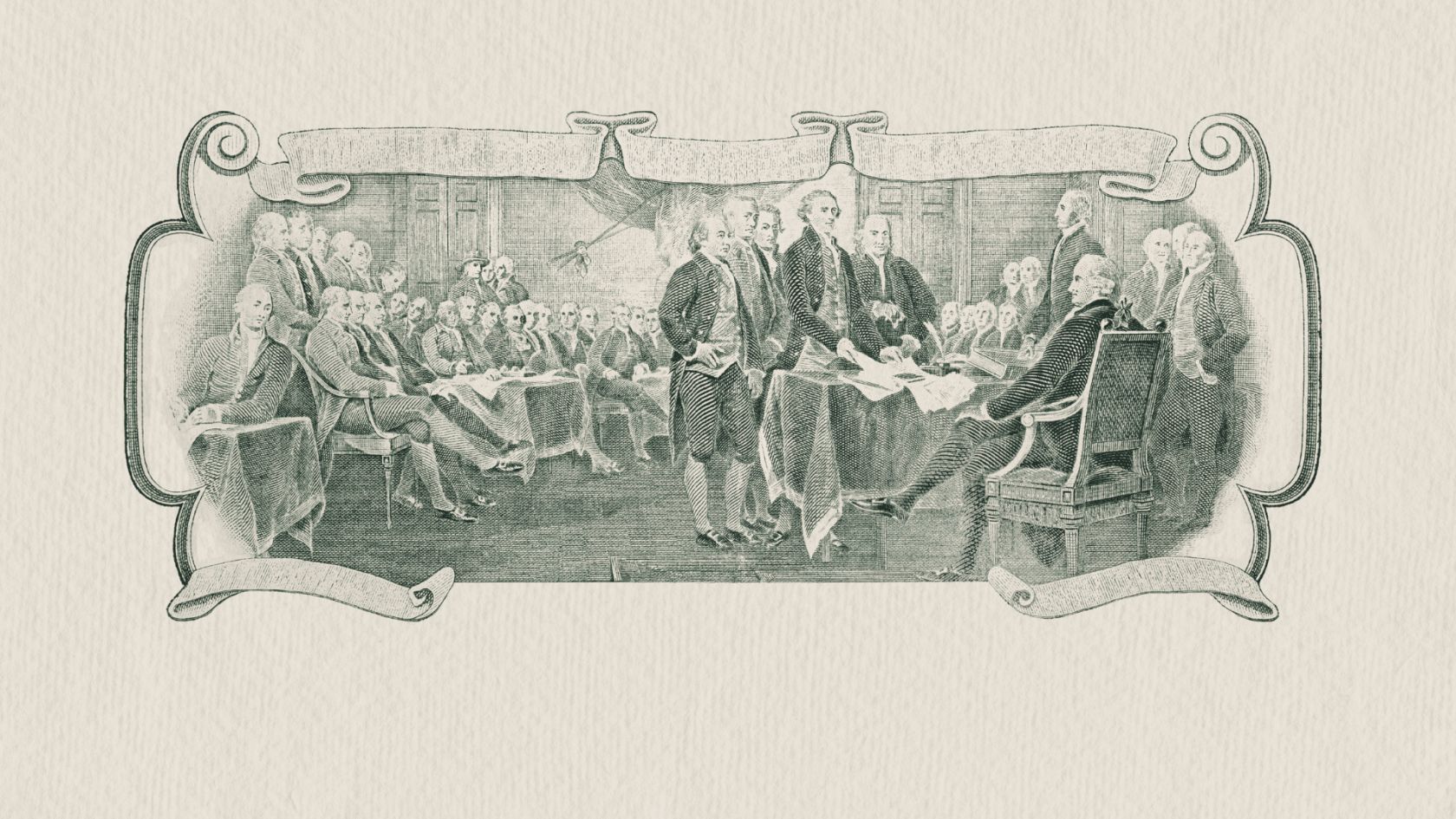
Origin story of Declaration of Independence involves more than just embrace of Enlightenment ideas, scholars say
Part of a series of occasional features marking the 250th anniversary of the Declaration of Independence
Celebrations of the 250th anniversary of the Declaration of Independence have called attention once again to the oft-repeated origin tale of how the revolutionary document sprang from Enlightenment ideas — natural rights, the social contract, and separation of powers.
But other parts of the story often get less attention. That is how the founders’ thinking was affected by existing social and political conditions on the ground, as well as their familiarity with the evolution of English constitutional history.
The independence movement really took hold when political leaders grew angry over the imposition of Parliament’s tax laws, such as the 1764 Sugar Act, the 1765 Stamp Act, and the 1767 Townshend Acts that imposed tariffs on British goods. And their efforts to oppose British rule were bolstered by early forms of self-government that had emerged in the American colonies.
“Town meetings and colonial assemblies made the Revolution happen,” said Robert Allison, Ph.D. ’92, a Suffolk University historian who studies early American colonial history. “Parliament declared that it had the power to govern the colonies ‘in all cases whatsoever,’ but each colony already had an elected assembly which made laws for it. And in New England each town had a meeting — at least once a year, but in many cases when any 10 tax-paying adult men signed a warrant for one — that made laws and elected all officials in the town.”
As the movement took shape, the framers of the Declaration were heavily influenced by 17th century political philosophy, specifically John Locke’s ideas of natural rights and government by consent and Montesquieu’s doctrine of separation of powers.
But they had to adapt some those ideas, many of which had never been tried in practice, according to Michael Klarman, Charles Warren Professor of American Legal History at Harvard Law School.
One example is the way they took Locke’s foundational formula of universal natural rights, “life, liberty, and property,” and substituted the right to property with “the pursuit of happiness” in the Declaration of Independence.
The antecedents to the phrase “the pursuit of happiness” can be traced to James Wilson, a signer of the Declaration and the Constitution, said Danielle Allen, James Bryant Conant University Professor.
Wilson is one of the least-known founders, but a recent book, “The Lost Founder: James Wilson and The Forgotten Fight for a People’s Constitution” by journalist Jesse Wegman, sheds more light on his role in the country’s founding, Allen said.
Essentially, Wilson advanced the idea that one of the central purposes of government should be something broader and higher than the preservation of individual property.
“Wilson drew on the Scottish Enlightenment for a common-sense approach to human morality that put happiness at the center, as a concept of human flourishing and well-being.”
Danielle Allen
“Wilson drew on the Scottish Enlightenment for a common-sense approach to human morality that put happiness at the center, as a concept of human flourishing and well-being,” according to political philosopher Allen. “And then John Adams picked up that line of argument and used the vocabulary of happiness to make the case for what kinds of government should be formed throughout the fall of 1775 and the spring of 1776.”
Also by the spring of 1776, the right to property had been connected to a defense of enslavement and had become a contested term, she said. “The Lockean triad was life, liberty, and property. So, life, liberty and the pursuit of happiness was keeping the issue of slavery out of that important preamble.”
As well-educated people, and as British subjects themselves, the founders were well-versed in 17th and early 18th century English history, a turbulent period during which England became a constitutional monarchy, in which the king could no longer act without Parliament’s support.
“This was part of the cultural formation of the people who made the revolution,” said Eric Nelson, Robert M. Beren Professor of Government. “These were people who considered themselves as Englishmen, and they were familiar with the entire tradition of English constitutional history, including the fearsome debates over liberty, sovereignty, monarchy, and property going back at that point nearly 600 years.”
The founders drew upon many Enlightenment intellectuals, including Locke and his influential “Two Treatises of Government” (1690). But Locke was only one of many thinkers who influenced the founders, said Nelson.
“Locke was a major figure within the traditional of political thought and constitutional refection that the founders were familiar with,” said Nelson. “He was a very important source, but it’s wrong to say that it was ‘The John Locke Show.’”
Among other political theorists of the era was James Harrington, who wrote “The Commonwealth of Oceana” (1656) on what makes an ideal republic and what makes a government stable.
Also influential were Algernon Sidney, author of “Discourses Concerning Government” (1698), a critique of royal absolutism and a defense of republicanism and popular government and the natural equality of all men; John Trenchard and Thomas Gordon, who wrote “Cato’s Letters” (1720-1723) on the importance of liberty, government limits, and the rule of law; and David Hume, who penned “A Treatise of Human Nature” (1739-1740) on liberty and checks on powers.
In addition, the 1215 Magna Carta, which set limits on royal power, and the English Bill of Rights of 1689, which limited the powers of the monarchy and established Parliament’s rule over the British Crown, were part of the intellectual origins of the founders’ vision for the new republic.
“The most important intellectual source they had was an understanding of 17th and early 18th century England, when there had been a big fight over the role of Parliament versus the role of the Crown, and they were really versed in that whole political world as though it was yesterday,” said Allison.
Even as the ideas of liberty and self-governance drew popular support to the independence movement in the colonies and abroad, there was considerable disagreement among the founders about the new kind of political system they were building.
“We spend a lot of time in our political culture asking, ‘What did the founders think about X?’” said Nelson, the government professor. “The founders were a very heterogeneous group of people who thought very different things and had very different political and constitutional preferences and ideas. So, the question ‘What did the founders think about X?’ is almost always badly posed.”
The result was a lot of compromise, improvisation, and much experimentation.
For that reason, Klarman, who wrote “The Framers’ Coup: The Making of the United States Constitution,” warns of the dangers of treating the nation’s foundational documents as “divinely inspired” and its framers as “demigods.”
“I think the framers were pretty virtuous, and they were trying to do what was good for the country, but they had interests, just like everybody has interests, and among them was to protect property rights.”
Michael Klarman
“I think the framers were pretty virtuous, and they were trying to do what was good for the country, but they had interests, just like everybody has interests, and among them was to protect property rights,” said Klarman. “But we turn the founders into God-like creatures, who were ultra-virtuous statesmen who had no interests or prejudices, but simply were divining the best form of government.”
It’s an argument that prevents necessary changes in the Constitution, he said, to make institutions more responsive to these modern times and the union more perfect.
“Throughout American history, there has always been this tendency, usually a conservative-leaning tendency, to say, ‘How dare you touch the Constitution? How dare you criticize how the Senate is constructed? How dare you criticize the Electoral College?’ and that we ought to be reluctant to change any of these things because the framers were so extraordinary, so selfless, so divinely inspired … We should decide these questions on their merits, not with a heavy thumb on the scales in favor of what the founding generation believed.”
More like this
-
Hot off the presses: The Declaration of Independence
A flawed first copy — dashed off in all-nighter — endures as template for democracy in action
-
America the beautiful
Celebrating nation’s natural wonders through art on 250th anniversary
-
One of first to receive University honorary degree? George Washington.
Archivist says it’s an early example of ‘long tradition of honoring national leaders’
-
How did Ben Franklin’s barber keep up with news on war for independence?
Houghton exhibit showcases newspapers, pamphlets, other media, offering on-the-ground view of what regular citizens knew, and when they knew it
-
Helping to give birth to nation — and Harvard Med
School founder John Warren numbered among alumni who were part of revolutionary generation
-
Walking in Harvard’s ‘Revolutionary footsteps’
Exhibit traces University’s role in America’s birth — from campus barracks to Founding Father alumni
-

Did the British unleash biological warfare against Washington’s troops?
Historians trace role of physicians, medicine, disease during war in articles marking 250th anniversary of Declaration of Independence
-

High-tech for the 1700s
Exhibit showcases tools that powered Revolutionary America