Featured series


Arts & Culture
America the beautiful
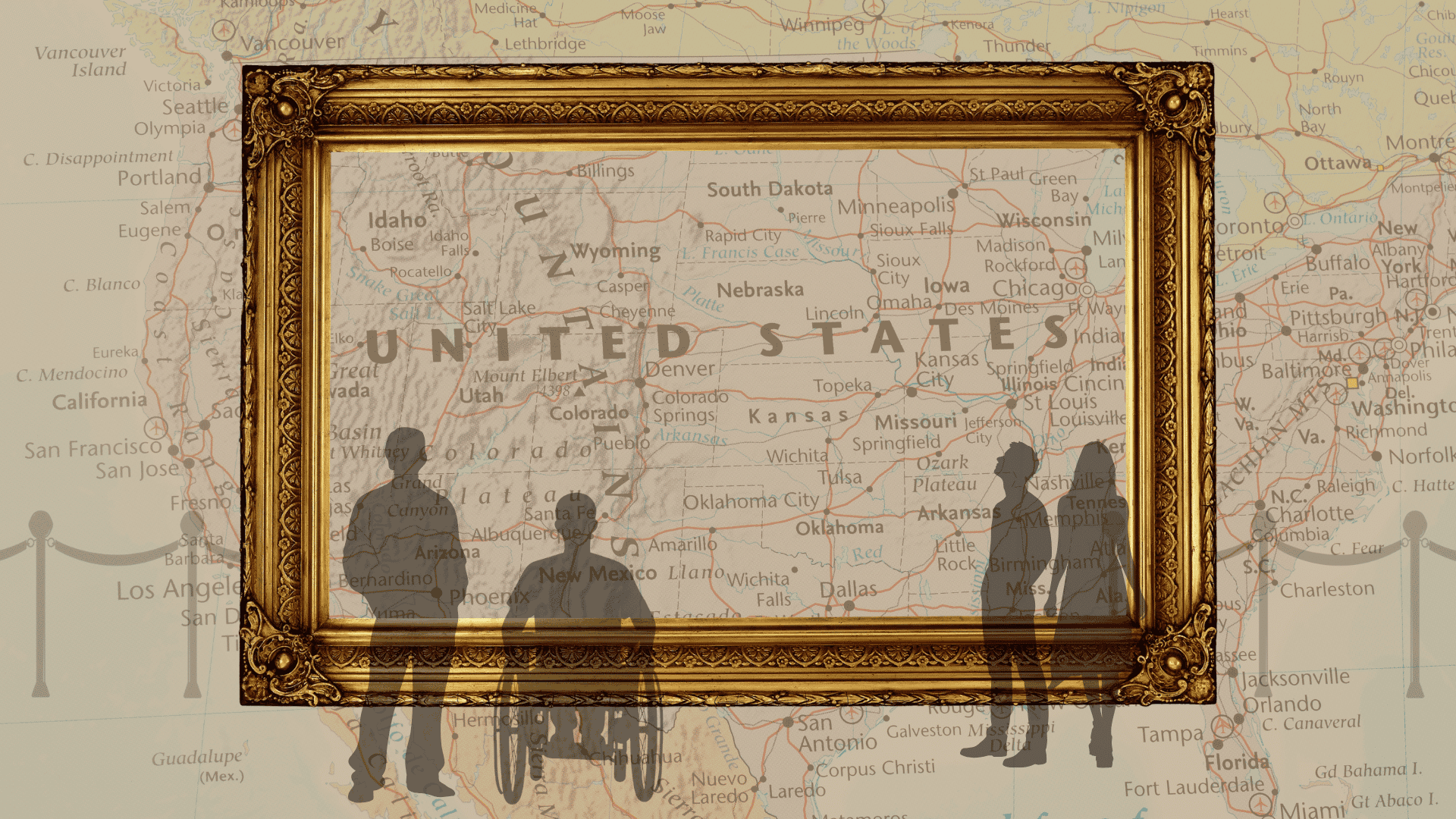
Illustration by Liz Zonarich/Harvard Staff
Celebrating nation’s natural wonders through art on 250th anniversary
Part of a series of occasional features marking the 250th anniversary of the Declaration of Independence.
The U.S. boasts a diverse array of stunning natural landscapes, from the dense Louisiana bayous to the peaks of the Rockies.
“Nature is our commonwealth — our common wealth,” said Horace D. Ballard, Theodore E. Stebbens Jr. Curator of American Art at the Harvard Art Museums.
Early European colonists in the Americas, Ballard explained, sent friends and colleagues plants, seeds, and the bones of mastodons, as evidence of the marvelous landscapes that produced them. Later, in the 1850s and ’60s, Americans with little ability to travel would pay to crowd into tight rooms for a chance to view a single painting of Niagara Falls.
“When it comes to the United States, with all of its thousands of microclimates and ecosystems, it’s dizzying,” Ballard said. “One of the most profound and simple — but not naive — pronouncements we can make and hold onto on the country’s 250th anniversary is this incredible, dizzying diversity we’re all so proud of, and we all benefit from, socially and environmentally. E pluribus unum — out of many, one — defines the way the world has always seen the U.S.”
You can find many examples of artwork documenting the nation’s natural beauty at Harvard Art Museums. Ballard and other experts walk us through a selection below.
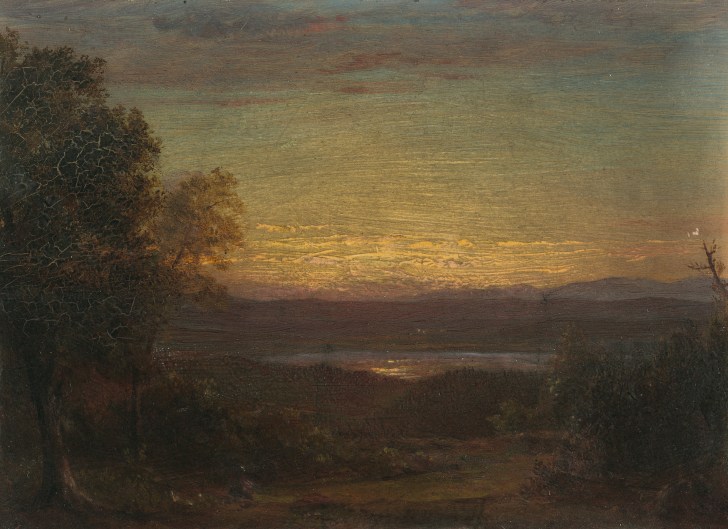
The tradition of American landscape painting traces back to the Hudson River School, founded by British-born painter Thomas Cole in the mid-19th century. Troubled by the nation’s rapid industrialization, Cole and his pupils portrayed America as a “wild, sparsely inhabited Eden, which it was not,” Ballard said.
Frederic Edwin Church (1826-1990) was one of Cole’s star pupils. Church bought a hillside farm in New York State, which he named Olana, across the Hudson River from his old mentor’s home. In the last years of his life, struggling with painful arthritis, Church completed a sequence of small landscape paintings of the views from Olana.
“This is Frederic Church at his most abstract and expressive; this is him at his most nostalgic,” Ballard said. “I think he’s contemplating the fulfillment and joy of being completely unified with the natural world, but also what it means to grow older. A sunset gives him the space to be fully alive to his humanity.”
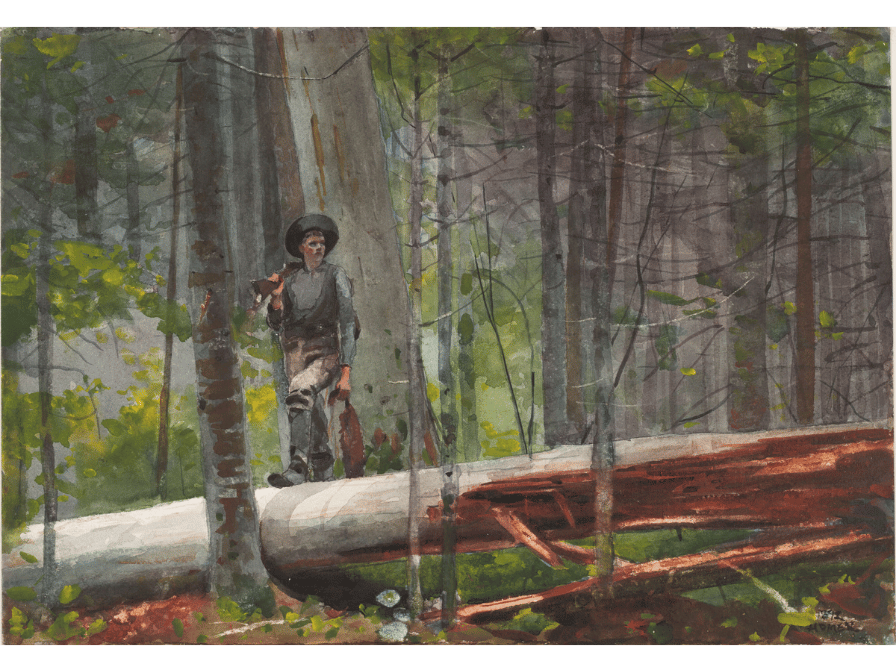
Around the turn of the 20th century, New York State’s Adirondack region saw an influx of urbanites — wealthy New Yorkers with summer homes as well as lower-income and immigrant communities — looking to reconnect with nature.
A prodigious painter of maritime scenes, war dispatches, and landscapes, Winslow Homer (1836-1910) often turned to nature to evoke nostalgia for a simpler, less politicized ideal of America. His 1892 painting, “Hunter in the Adirondacks,” shows a lone figure carrying a shotgun and some sort of animal or pelt, in the moment of stepping over a fallen tree.
“It’s a sweet moment, an everyday moment of profundity for both the subject and the viewer, as the senses of touch, smell, and sight are activated,” Ballard said.
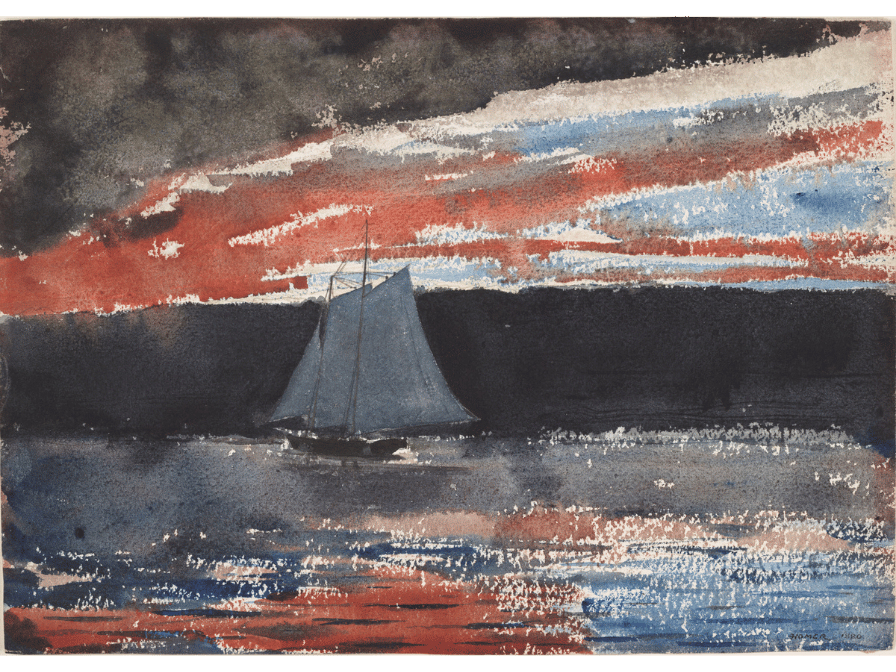
Ships have a long legacy in painting as metaphors for the freedom of the individual and the nation, Ballard said.
“For those of us in New England, we know that kind of vessel,” he went on about the painting from Winslow Homer’s period in Gloucester, Massachusetts. “There’s commerce here, as well as joy. There’s a sense of craft here, a sense of home.”
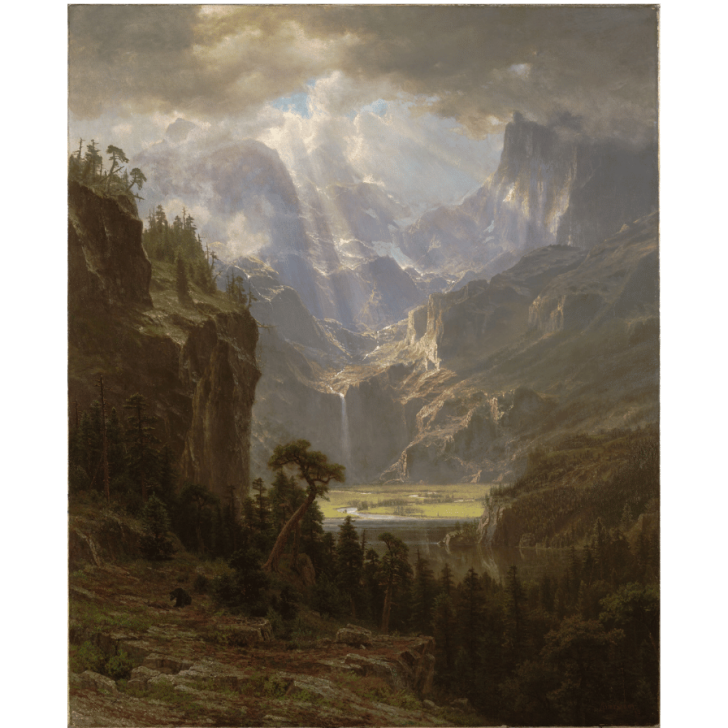
An artist with U.S. government survey expeditions, Albert Bierstadt (1830-1902) painted “Lander’s Peak” not based on any specific location but as a composite of various views in the Rocky Mountains. Though Bierstadt met with and sketched Shoshone tribe members during his travels, he omitted them from the landscape.
“There will always be a question of what exactly he was looking at, what he did not paint, what he did paint that wasn’t there,” Ballard said.
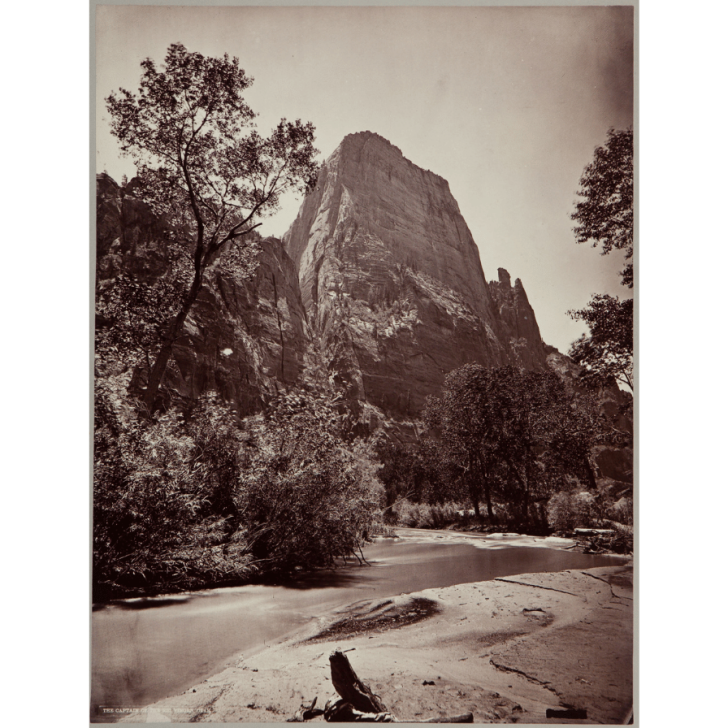
Photography was invented in the early 19th century, after the Revolutionary War and on the eve of the Civil War — a time of claiming land through westward expansion as well as an effort to learn the land. Many early American landscape photographs were made on behalf of railroad companies as they cleared the way for tracks across the continent.
“The camera, paired with this moment of study and discovery and claiming, all wrapped into the aesthetics of the raw landscape discovered in its pristineness — quite ironically, it was the beginning of the land being claimed for this American project that would become great development and great ecological devastation,” said Audrey Sands, Richard L. Menschel Associate Curator of Photography at the Harvard Art Museums.
John Hillers (1843-1925) was a photographer for U.S. government survey efforts at a time when, to most people living on the East Coast, the American West was seen as an unmapped and dangerous place.
Though his photos were taken to help the government better understand the land, they were often reprinted for purchase by ordinary Americans. “These images were revelations for many people living on the East Coast or in the eastern half of the United States,” said Sands.
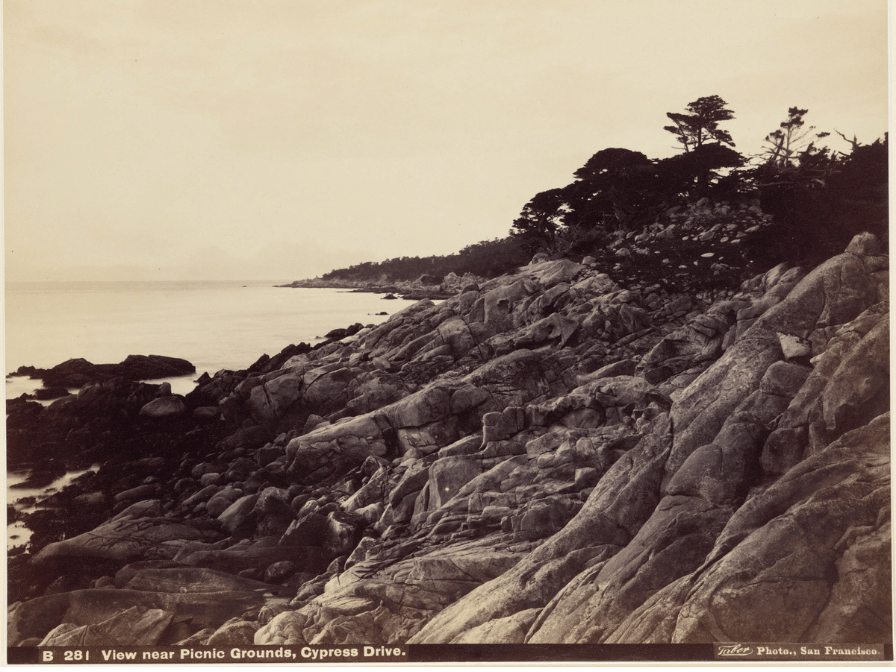
Photographer Carleton Emmons Watkins (1829-1916) was commissioned by the Pacific Improvement Company, a real estate division of a railroad company, to promote the luxury resort complex the Hotel Del Monte.
He captured a series of images along California’s now-famous 17-mile drive along the Monterey coast. The project was a part of the creation of the idea of California, Sands said, as a place of “a different kind of raw nature.”
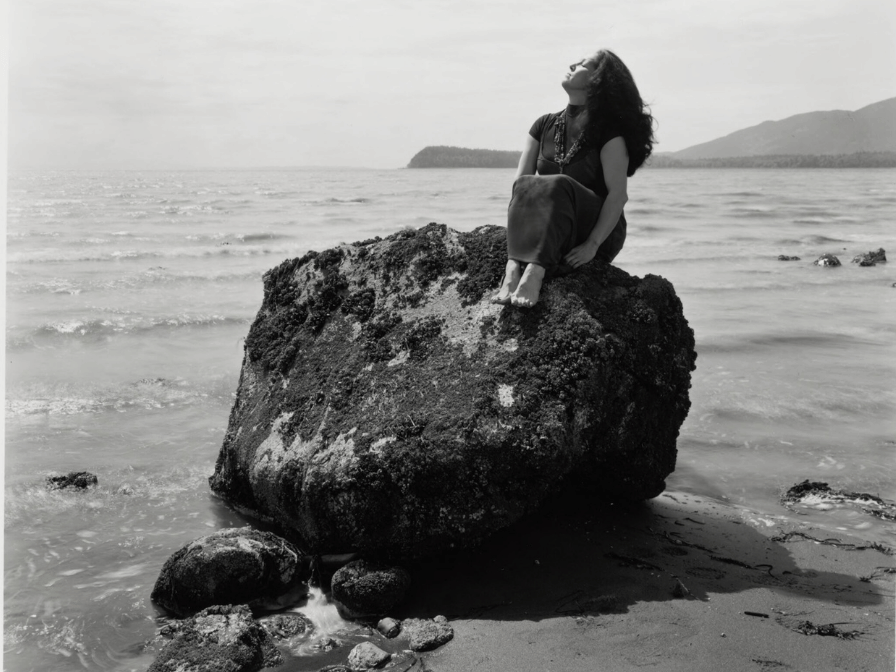
This photo is part of Andrea Modica’s book “Real Indians: Portraits of Contemporary Native Americans and America’s Tribal Colleges.”
Named in response to Christopher Columbus’ belief that he had found a sea route to India and encountered “real Indians,” the book sought to highlight the true diversity of America’s Native peoples, Sands said.
Vernell Lane was a site coordinator for the Lummi Cedar Project, a community group that helped reintroduce the sport of canoe-pulling to Native young people.
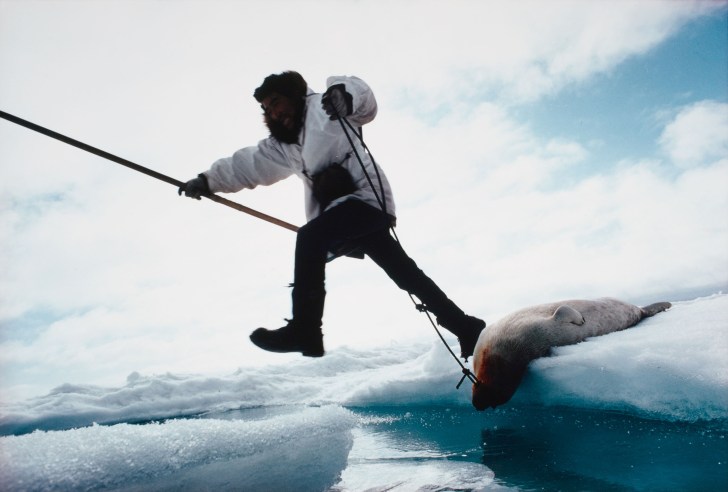
Untitled (a native hunter from Point Hope, Chukchi Sea, Alaska)
Gordon W. Gahan, 1971
National Geographic photographer Gordon Gahan (1945-1984), an outsider to the region and to Inuit culture, captured this image of a native hunter in Alaska.
“The photo really makes you think about the lengths different peoples have had to go to preserve certain practices,” Sands said.
Decades after the photo was taken, “It’s hard not to see these icy formations and think about climate change, and how little may be left in another 30 or 50 years of what was already a rare and special cultural phenomenon,” she added.
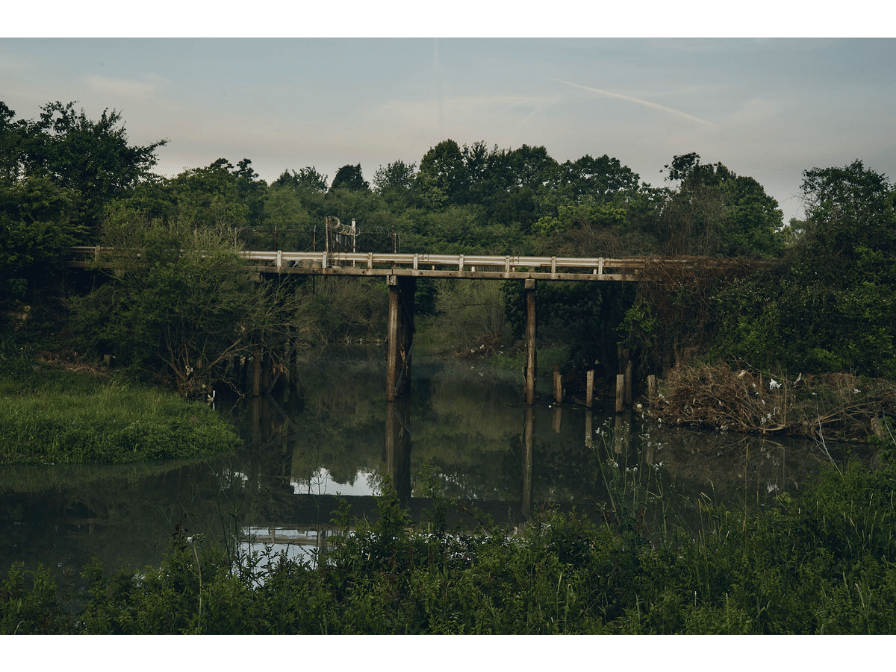
For 90 years, the Mante Sano Bayou outside Baton Rouge was used as a dumping site for the petrochemical industry, says Pulitzer Prize-winning photographer Stacy Kranitz.
And yet, something of the ecosystem’s beauty and resilience remains. In her series “Fulcrum of Malice,” Kranitz invites us to shift from passive appreciation to active reckoning with our own way of life.
“The photograph’s composition relies on an act of exclusion,” said Kranitz, who is also a 2026-2027 fellow at the Nieman Foundation for Journalism at Harvard University. “By omitting that the stream is wedged between an ExxonMobil chemical plant and a Copolymer Rubber facility, the framing offers a deceptive pastoral pleasure.”
More like this
-
What the framers were really thinking
Origin story of Declaration of Independence involves more than just embrace of Enlightenment ideas, scholars say
-
Hot off the presses: The Declaration of Independence
A flawed first copy — dashed off in all-nighter — endures as template for democracy in action
-
How did Ben Franklin’s barber keep up with news on war for independence?
Houghton exhibit showcases newspapers, pamphlets, other media, offering on-the-ground view of what regular citizens knew, and when they knew it
-
One of first to receive University honorary degree? George Washington.
Archivist says it’s an early example of ‘long tradition of honoring national leaders’
-
Walking in Harvard’s ‘Revolutionary footsteps’
Exhibit traces University’s role in America’s birth — from campus barracks to Founding Father alumni
-
Moved by what’s missing in Homer’s ‘Harrow’
Curator launches series steeped in U.S. history
-
High-tech for the 1700s
Exhibit showcases tools that powered Revolutionary America
-

Did the British unleash biological warfare against Washington’s troops?
Historians trace role of physicians, medicine, disease during war in articles marking 250th anniversary of Declaration of Independence