Featured series
Nation & World
One of first to receive University honorary degree? George Washington.
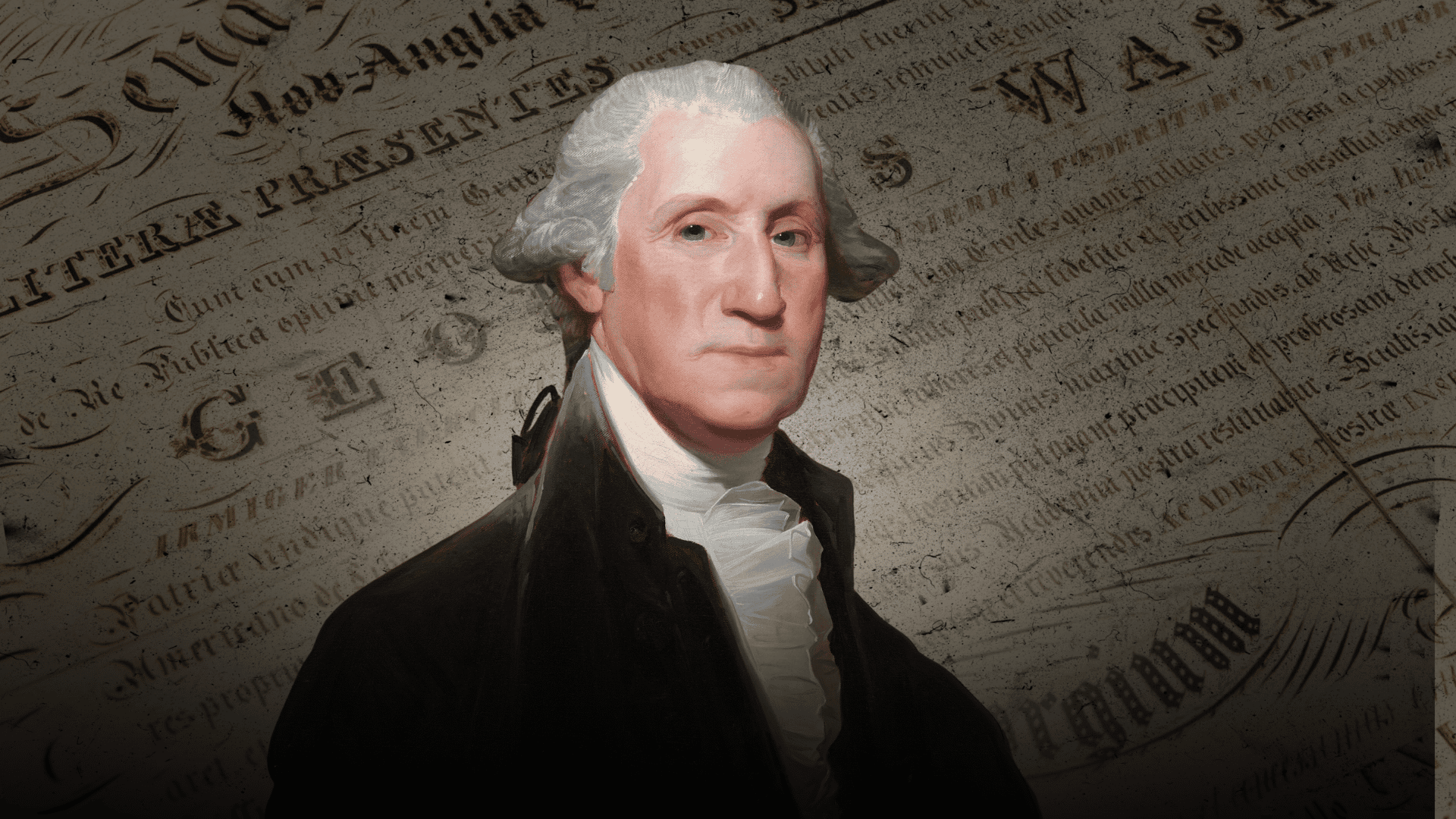
Portrait by Gilbert Stuart in Harvard Art Museums collection.
Photo © President and Fellows of Harvard College; Photo illustration by Liz Zonarich/Harvard Staff
Archivist says it’s an early example of ‘long tradition of honoring national leaders’
Part of the Commencement 2026 series
A collection of features and graduate profiles covering Harvard’s 375th Commencement.
Part of a series of occasional features marking the 250th anniversary of the Declaration of Independence.
It was a historic thank you.
Harvard President Samuel Langdon and the fellows of the College held an assembly and voted to award Gen. George Washington an honorary doctoral degree on April 3, 1776, about two weeks after the Continental Army forced the British out of Boston, a turning point in the War for Independence.
“Harvard awarded Washington this degree partially to recognize the success of the work that he did as a general, driving the British forces from Boston and freeing the city and Harvard from occupation,” said University Archivist Virginia Hunt. “We conferred the degree as an expression of the gratitude of the College for his eminent service to his country and to society.”
Washington was neither the first, nor would he be the last, major figure of the Revolution to be honored by the University. But the degree reflected the close ties between the history of the institution, which holds its 375th commencement this year, and that of the nation’s founding 250 years ago.
The English translation of the degree, originally printed in Latin, lauds Washington “for his distinguished Virtues, both Civil and Military … through all the Fatigues and Dangers of a Camp, without accepting any Reward, he might deliver New-England from the unjust and cruel Arms of Britain, and defend the other Colonies.”
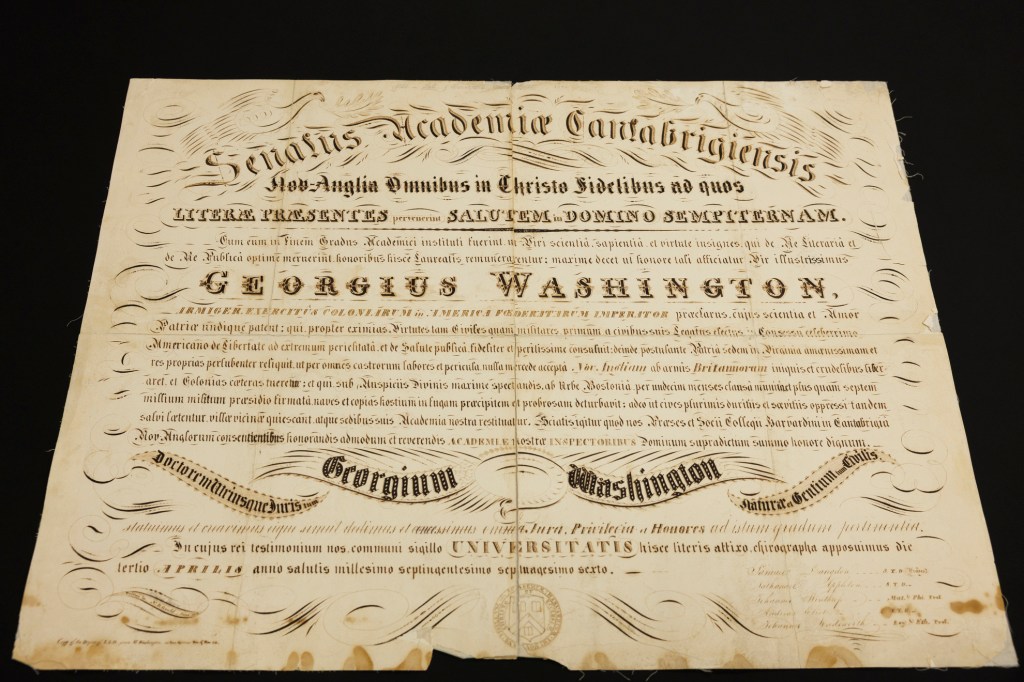
Replica of the honorary degree awarded to George Washington in 1781.
Niles Singer/Harvard Staff Photographer
President Alan Garber recites honorary degree given to George Washington
transcript
Transcript:
WHEREAS Academical Degrees were originally instituted for this Purpose, That Men, eminent for Knowledge, Wisdom and Virtue, who have highly merited of the Republick of Letters and the Common Wealth, should be rewarded with the Honor of these Laurels; there is the greatest Propriety in conferring such Honor on that very illustrious Gentleman, GEORGE WASHINGTON, Esq; the accomplished General of the confederated Colonies in America; whose Knowledge and patriotic Ardor are manifest to all:
Who, for his distinguished Virtues, both Civil and Military, in the first Place being elected by the Suffrages of the Virginians, one of their Delegates, exerted himself with Fidelity and singular Wisdom in the celebrated Congress of America, for the Defence of Liberty, when in the utmost Danger of being for ever lost, and for the Salvation of his Country; and then, at the earnest Request of that Grand Council of Patriots, without Hesitation, left all the Pleasures of his delightful Seat in Virginia, and the Affairs of his own Estate, that through all the Fatigues and Dangers of a Camp, without accepting any Reward, he might deliver New-England from the unjust and cruel Arms of Britain, and defend the other Colonies;
and Who, by the most signal Smiles of Divine Providence on his Military Operations, drove the Fleet and Troops of the Enemy with disgraceful Precipitation from the Town of Boston, which for eleven Months had been shut up, fortified, and defended by a Garrison of above seven Thousand Regulars; so that the Inhabitants, who suffered a great Variety of hardships and Cruelties while under the Power of their Oppressors, now rejoice in their Deliverance, the neighbouring Towns are freed from the Tumults of Arms, and our University has the agreeable Prospect of being restored to its ancient Seat.
Know ye therefore, that We, the President and Fellows of Harvard-College in Cambridge, (with the Consent of the Honored and Reverend Overseers of our Academy) have constituted and created the aforesaid Gentleman, GEORGE WASHINGTON, who merits the highest Honor, Doctor of Laws, the Law of Nature and Nations, and the Civil Law; and have given and granted him at the same Time all Rights, Privileges, and Honors to the said Degree pertaining.
In Testimony whereof, We have affixed the Common Seal of our University to these Letters, and subscribed them with our Hand writing this Third Day of April in the Year of our Lord one Thousand seven Hundred Seventy-six.
Hunt said at this time it was unusual for colleges and universities to award such an honor. At the time, Harvard had granted only a few honorary degrees of any kind.
In fact, his was the first doctor of laws degree to be granted to a non-alumnus and even predated the founding of Harvard Law School. Washington was also the first veteran to receive an honorary degree from the University.
“It wasn’t routine to award honorary degrees at the time, as it is now,” Hunt explained. “These special awards were usually granted when an individual did something for society or the larger community that was significant or had a profound impact.”
In 1775, Washington arrived in Cambridge to lead the Continental Army as the conflict between the British monarchy and Colonial settlers grew from political unrest to revolution.
The entire Harvard campus was turned over to wartime use, resulting in the student body’s temporary relocation to Concord for a year.
Washington moved first into Wadsworth House and later into Longfellow House, where he set up headquarters.
“Harvard didn’t exist in a bubble,” Hunt said. “A good number of Harvard graduates at this time became key revolutionary leaders, and they fostered a lot of new ideas in the intellectual and academic debate and [in] how the new country was conceived and understood.”
The diploma given to Washington was signed by Langdon and five fellows of the College. Notably, the diploma was missing the signature of College Treasurer John Hancock, who was in Philadelphia preparing to sign the Declaration of Independence.
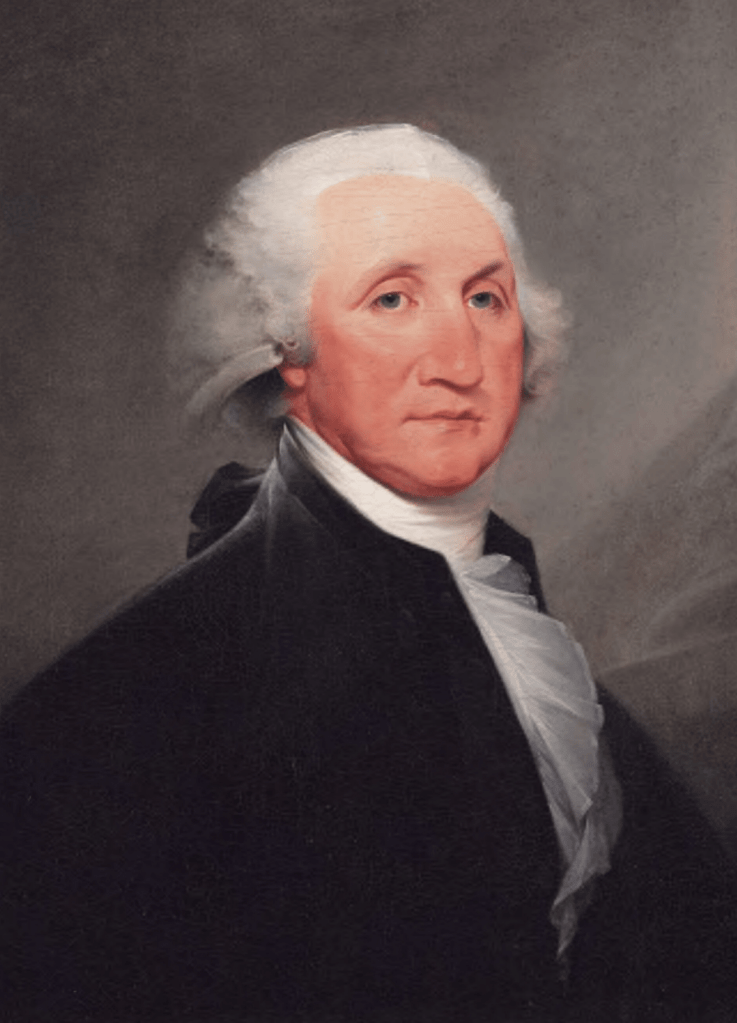
Portrait by John Trumbull (A.B. 1773) in the Cabot Room at Loeb House.
Photo © President and Fellows of Harvard College
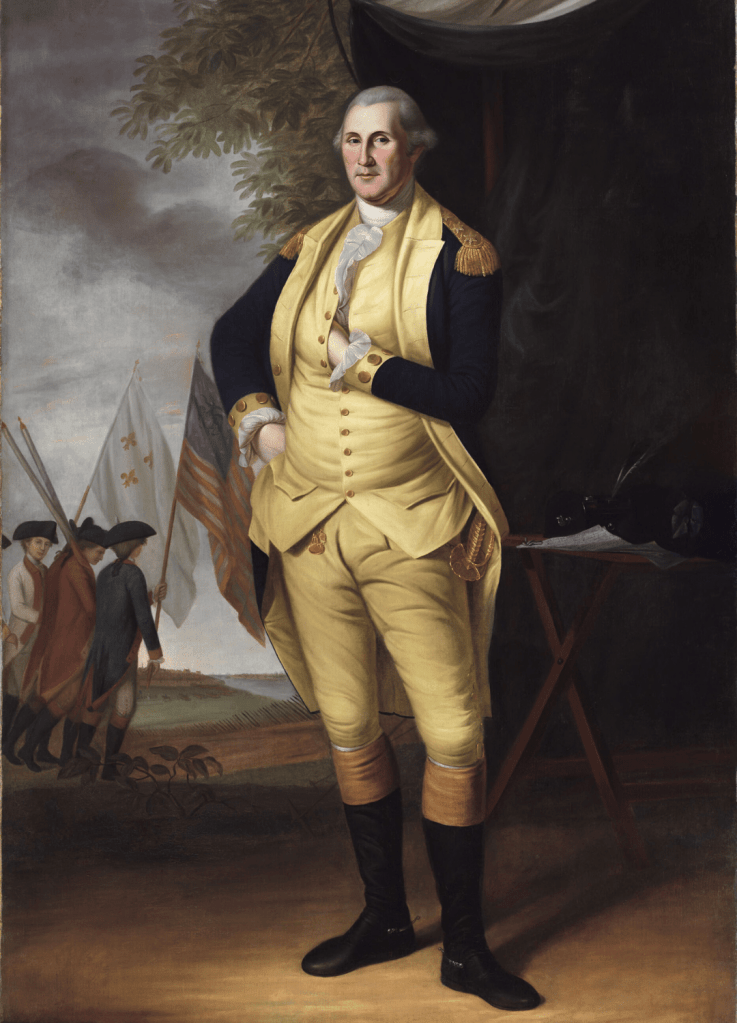
Portrait by Charles Willson Peale at Harvard Art Museums.
Photo © President and Fellows of Harvard College
Washington would go on to become the first president of the U.S. in 1788. He was not the only founder to receive an honorary degree before, during, or immediately following the establishment of the new nation. A long list of others — including Ben Franklin, Horatio Gates, John Warren, Samuel Adams, John Adams, and Thomas Jefferson — were also honored.
And of the 56 signatures on the Declaration of Independence, eight were Harvard graduates.
“All of these leaders who came through Harvard were leaders in the American Revolution,” said Hunt. “Their experience at Harvard, their education and their being together while [the war was] happening shaped how we as a newly forming nation started to think about what we wanted the country to be.”
Washington’s diploma currently is in the Library of Congress, but a reproduction of the original, created by N.D. Gould, is part of the Harvard University Archives’ collections and included in the Harvard and the American Revolution exhibition that is open to the public through 2027 in Pusey Library and online.
Another reproduction is located in Wadsworth House, the current Office of the University Marshal.
Hunt said the awarding of the degree highlights the value the University has placed over the course of history in celebrating the ways individuals courageously step up to lead.
“So many leaders in American history have come through Harvard in one way or another,” Hunt said. “I like to think that [this degree] helped inaugurate what we think of now as the beginning of a long tradition of honoring national leaders in all areas of society who have achieved great things — or made profound and positive impacts on our world.”
More like this
-
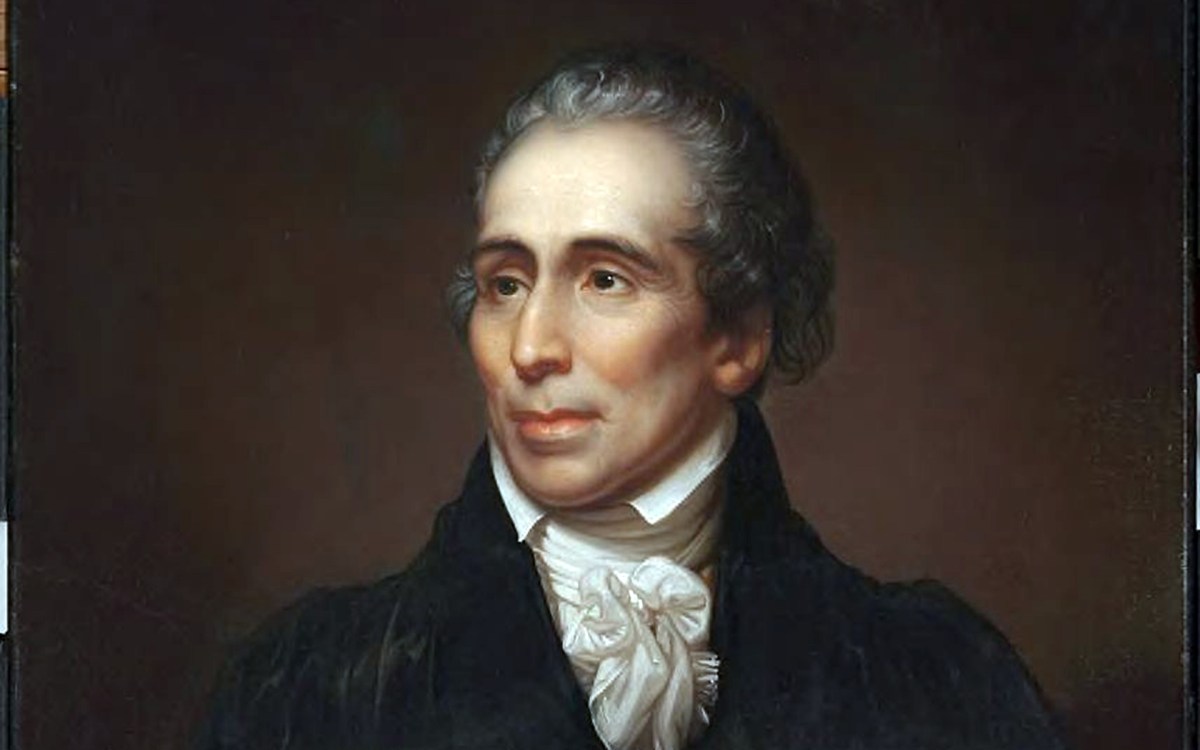
Helping to give birth to nation — and Harvard Med
School founder John Warren numbered among alumni who were part of revolutionary generation
-
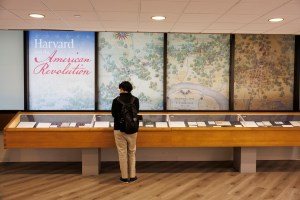
Walking in Harvard’s ‘Revolutionary footsteps’
Exhibit traces University’s role in America’s birth — from campus barracks to Founding Father alumni
-
Did the British unleash biological warfare against Washington’s troops?
Historians trace role of physicians, medicine, disease during war in articles marking 250th anniversary of Declaration of Independence