Featured series

Arts & Culture
Power sees much to admire in ‘Diplomat’ — except that deodorant thing
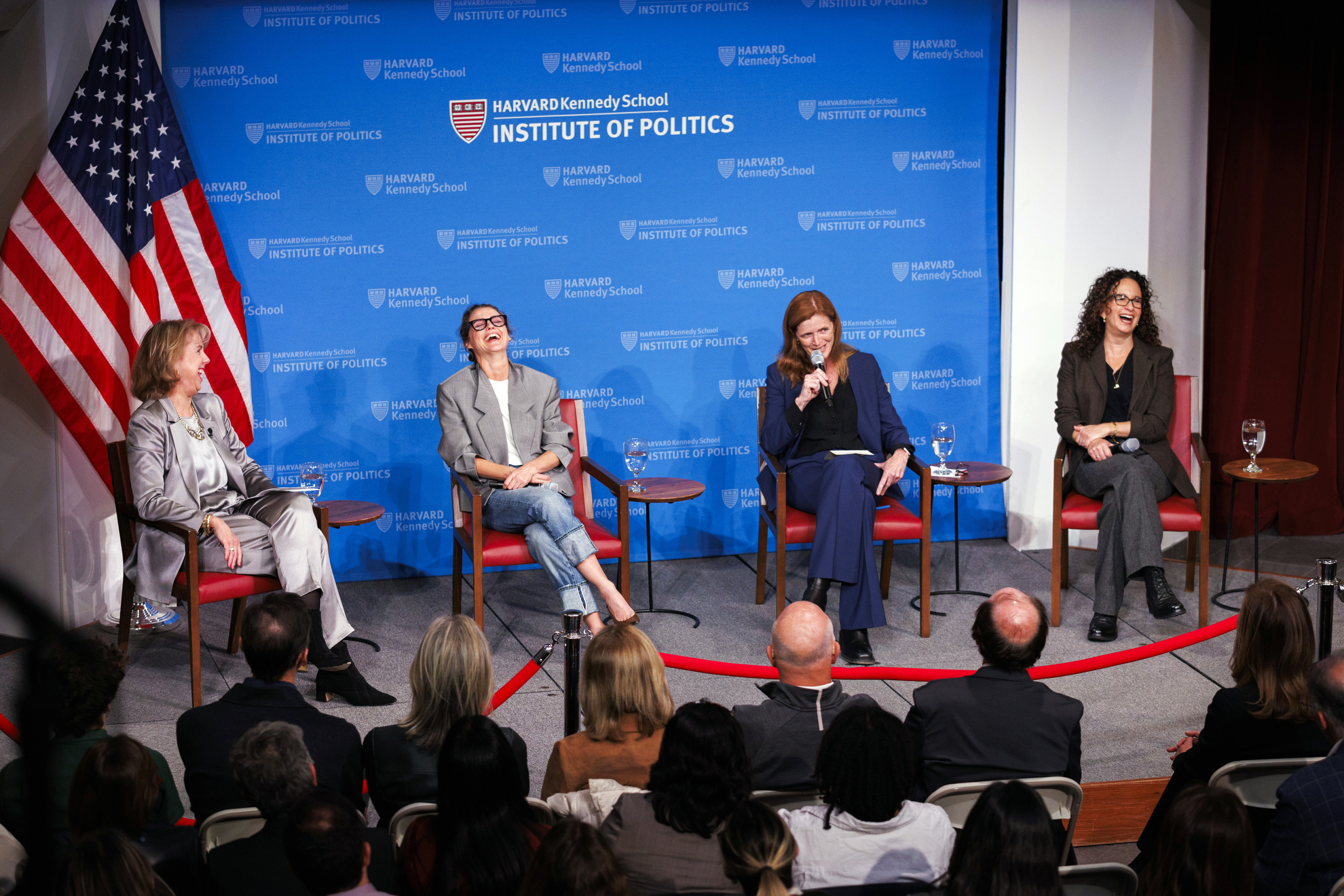
Nancy Gibbs (from left), Keri Russell, Samantha Power, and Debora Cahn are pictured on the stage.
Photos by Stephanie Mitchell/Harvard Staff Photographer
Former ambassador sits down with star, showrunner to separate fact, fiction in hit series about foreign service officers
The dazzling depiction of foreign service officers in “The Diplomat,” Netflix’s action-packed, hit series, is Hollywood fiction. But it also includes more truth than viewers might think.
During a discussion at Harvard Kennedy School on Monday evening, actress Keri Russell, creator and showrunner Debora Cahn, and Ambassador Samantha Power spoke about how the award-winning show shines a light on the lives and difficult, unsung work of the country’s real-life public servants overseas.
While the three never settled on a detailed assessment of the show’s veracity, Cahn, at least, likes to say the series is “not realistic, but authentic.” Much of the discussion revolved around how the show balances foreign service realities with dramatic storytelling.
Now in Season 4, Russell stars as a career diplomat plucked from the global hotspots where she thrives and assigned to serve as U.S. ambassador to the Court of St. James in London.
It’s a posh, largely ceremonial post that Russell’s serious-minded character, Kate Wyler (inspired in part by Power), recoils from and yet soon transforms into a consequential position of international power and influence.
While “The Diplomat” is most definitely fiction, the show’s writers regularly get inspiration, as well as fact checks, from former diplomats and others in this world to ensure the show’s thrilling portrayal is grounded in reality.
“Whenever we can be accurate, we are,” said Cahn, who hinted that fans may see more of “The Diplomat,” although Netflix has not yet confirmed there will be a Season 5.
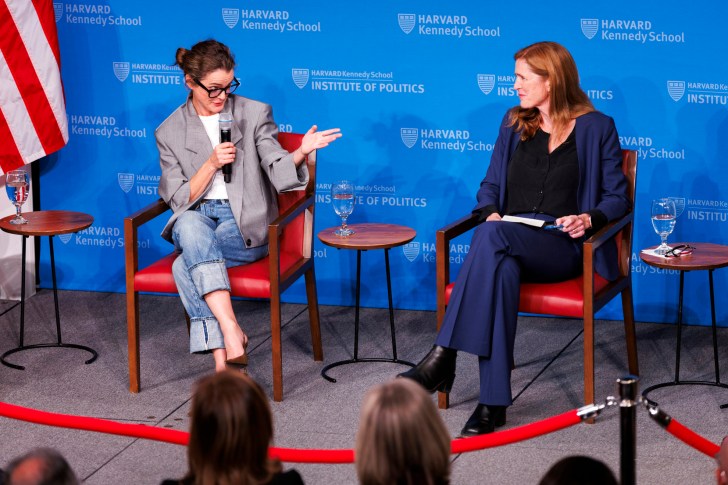
If fans noticed more than a passing resemblance between Wyler and Power, who served as U.S. ambassador to the United Nations and administrator of USAID during the Obama and Biden administrations and who organized the event, that’s no accident.
Cahn said the Wyler character is a composite of many different people, but confessed Power’s 2019 memoir, “The Education of an Idealist,” was a rich source she mined for show dialogue and story ideas, including the time Power absent-mindedly followed President Barack Obama into the men’s room while robustly pressing him on recognition of the Armenian Genocide.
“It’s funny because it’s a bathroom, but it’s emblematic of something that we see in you and in other people who do this work: the relentlessness, the willing to continue forward no matter how many times you hear no,” Cahn told Power. “It’s not always clear that that’s the right thing to do, but the commitment to never stopping the solving of a problem is something that I think was really appealing.”
Power, now the Anna Lindh Professor of Practice of Global Leadership and Public Policy at Harvard Kennedy School and a professor of the practice at Harvard Law School, admits that Wyler, whose messy hair and rumpled attire belie a fierce intellect and strong opinions that sometimes get her into trouble, felt familiar.
“When I see Kate Wyler, particularly how she moves and the pace at which she moves, I’m forever told by anyone I’ve ever worked with, ‘Can’t you please slow down? Do you have to be two steps in front of everyone?’” she said.
“I’m not paying attention to who is beside me. I’m just trying to get to the place we have to get to. And the sort of hair-brushing neglect and other elements. There is a scene I think in the first season where I felt I probably should issue some kind of press release saying I do wear deodorant,” Power joked.
Power said the show’s frequent policy and ethical disputes among the main characters, often instigated by Wyler, present viewers with a good example of the importance of coalition-building and the value of encouraging dissent within organizations.
Though stressful in the moment, ultimately disagreement tends to lead to good decisions.
“It comes from the top as to whether a leader believes that, in the end, they and the country will be better off with more guardrails. It’s the true fork in the road philosophically about what government is at its best and what produces the best outcomes,” Power said.
“The Diplomat” is often compared to the Emmy- and Golden Globe-winning mega-hit “The West Wing” for its quick-paced, high-stakes political repartee, focus on the inner lives of characters, and deep interest in the process of government.
Cahn, who previously worked on both “West Wing” and “Homeland,” has described “The Diplomat” as “a love letter” to the men and women in the foreign service and USAID and all they do on behalf of the country, often without recognition and certainly without the show’s glamour and intrigue.
It’s a view that Russell shares.
“This is a show about everyone who makes everything happen and how it affects their lives and the relationships they form, and that’s what was important to me. It’s a peek behind the curtain of this world that you don’t get to see.”
Keri Russell
“This is a show about everyone who makes everything happen and how it affects their lives and the relationships they form, and that’s what was important to me. It’s a peek behind the curtain of this world that you don’t get to see,” she told moderator Nancy Gibbs, the Lombard Director of the Shorenstein Center on Media, Politics, and Public Policy, and the Edward R. Murrow Professor of the Practice at HKS.
Russell’s no stranger to fast-paced, high-stakes political dramas involving difficult personal choices with global implications.
She starred in “The Americans,” the critically acclaimed, 2013-2018 series about Russian spies who posed for decades under deep cover as ordinary suburban Americans, a story inspired by a real married couple who were part of a Russian spy ring.
The pair lived in Cambridge, Massachusetts, under fake identities while the husband, who went by Donald Heathfield, graduated from HKS in 2000. The FBI broke up the ring in 2010.
Cahn has been encouraged by the vibe shift toward optimism that she sensed earlier this year when she met with some of the current and former public servants who assist with the show’s research.
She voiced admiration for those who are still committed to the idea of America and to spreading the gospel of democracy around the world amid all the major shifts in the nation’s foreign policy.
“To see people who are like, ‘Stop worrying! That’s so last year; move on. There are things that we can do, and there are things that we will do.’ It’s good,” Cahn said.