Featured series

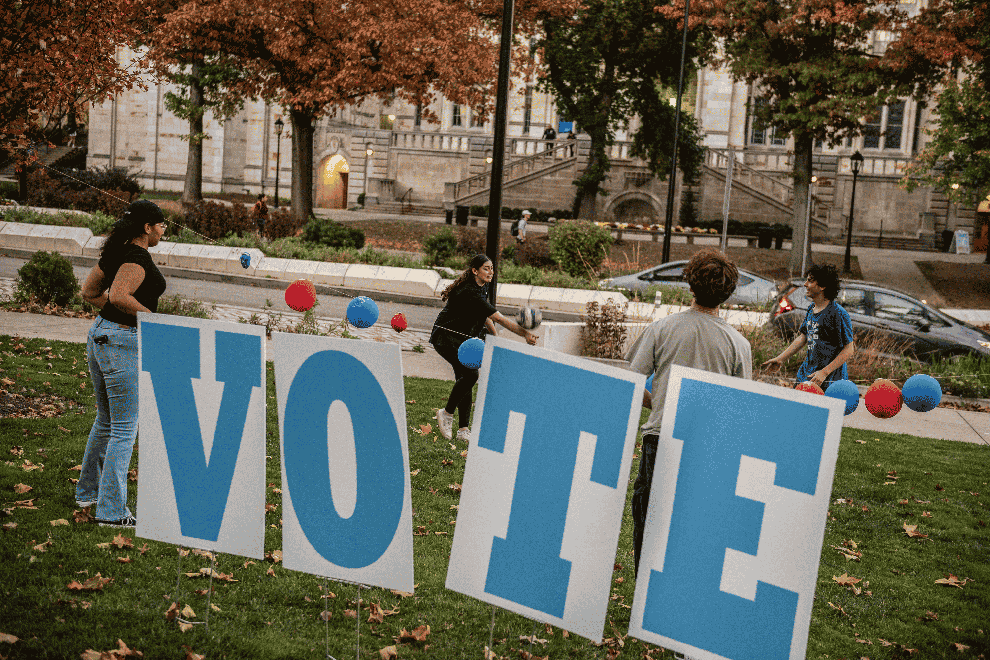
Students at University of Pittsburgh in 2024.
Aaron Jackendoff/Sipa via AP Images
Nation & World
Disillusion runs deep among young Americans
IOP leaders say that extends to health of nation’s democracy, and key is persuading young adults that involvement can yield change
The kids are not all right on the future.
For the first time in the 26-year history of the Harvard Youth Poll, more respondents expect to be worse off financially than their parents (27 percent) than better off (25 percent).
In addition, 49 percent of the young adults say their personal finances are worse off than when the current presidential administration took office, according to the latest biannual poll of Americans aged 18-29 by the Institute of Politics at the Harvard Kennedy School.
Betsy Fischer Martin, director of the IOP, and John Della Volpe, its director of polling, say the survey results may figure into the upcoming midterm elections, widely being viewed as a referendum on the president’s policies and the nation’s economy.
But they say the pessimism among young people extends beyond those concerns to doubts about the future of American democracy and their place in it.
This interview has been edited for length and clarity.
Gazette: Your poll found that just 9 percent of young Americans say the country is headed in the right direction, one of the lowest numbers in recent years. Did that surprise you?
John Della Volpe: I wouldn’t say it came as a total shock.
We saw in the spring of ’24 that only 9 percent of young Americans saw the country headed in the right direction. Then there were two surveys in a row where that number was 13 percent. We know what’s driving those numbers: a deep level of economic concern and a sense that their voice wasn’t reflected in politics, and those factors have not improved as we’ve moved closer to this election.
So no, I wouldn’t say it was a surprise.
Betsy Fischer Martin: Back in 2003, when we asked College students whether they expected to be financially better off than their parents, 74 percent said yes. But today, that number was just 28 percent.
Think about that change.
For generations, we’ve told kids, if you get a good education, work hard, find a job, and buy a home, you’re going to have a chance to build that better life, that American dream.
But that path looks harder and harder for young people. These young people are wondering, “How am I going to raise a family or build that financial security?” It’s a profound change in what’s attainable.
We’re speaking amid historic protests across Europe that are essentially about the same issues — affordability and quality of life for young people. Are you surprised we’re not seeing more organized action here?
Fischer Martin: You have to remember that this generation of 18 to 29 came of age during an extreme period of polarization and conflict and distrust in institutions, to say nothing of COVID-19. This hasn’t hit them all of a sudden. This is all they’ve known.
“This hasn’t hit them all of a sudden. This is all they’ve known.”
Betsy Fischer Martin
Della Volpe: I think what connects these Gen Z-led movements, whether it’s in Nepal, Bangladesh, India, or throughout Europe, is that younger people around the globe are deeply concerned about corruption, concentrated power, and whether their voices matter.
In our poll, 91 percent identified cost of living as an important priority, but 88 percent identified corruption as important to their vote. Few are confident that the upcoming elections will be fair and accurate in this country.
So one question that I have is: Do people in other parts of the world believe their institutions will respond?
A key outcome of this election will be: Will the young people who show up to vote feel that their voices have been heard? Will whoever they vote for make an effort to listen to them and speak to their agenda and concerns?
That’s quite a concerning portrait of the nation, the notion that young people feel so disaffected on the prospects for positive change.
Della Volpe: I mean, listen: We still have, relative to previous generations, a higher-than-average share of young people saying they’re going to participate. But yes, this generation doesn’t have very many examples of youth movements leading to real change.
Of course, we had the George Floyd protests in 2020, and in qualitative research sessions, that’s one of the few times I hear people say they felt proud to be American … but that didn’t lead to any significant national reform.
And student activism after the gun violence at Parkland led to record turnout in 2018 and resulted in the first bipartisan gun violence prevention legislation in two generations … but much of that has been watered down over the last couple of years.
So unfortunately there’s a track record of young people working hard and putting themselves out there and not seeing the progress that they expected.
But despite all that, this continues to be a generation that votes at higher levels today than Baby Boomers, Gen Xers, and Millennials did when they were the same age. There is still a committed group who is engaging despite all the pessimism.
Your poll found that among likely voters, 63 percent describe their vote as opposition to the president and his policies as opposed to an affirmative vote for a preferred candidate. Is that what you’d expect to see in a midterm?
Della Volpe: The relevant trend year is really 2018, and as much of a whiplash as it was between eight years of “no-drama Obama” and then Trump, we still saw that roughly three out of five voters said they were voting for the Democrat, not against Trump. Now that’s close to 50-50.
It’s a notable decline that I think correlates with a lower level of approval for the Democratic party as a whole. But there’s nuance here: Although fewer Republicans are likely to vote, those who are choosing to vote are saying it’s to support Republicans, not oppose Democrats.
But yes, that’s really a statement about midterm elections, right? There’s almost always more energy and more votes cast from the coalition that’s out of power.
Fischer Martin: But there also are a handful of candidates, people like Michigan U.S. Senate candidate Abdul El-Sayed, who are capitalizing on this emerging economic populism we’re seeing among young people.
Two-thirds of young Americans see the power of large corporations as a serious threat to their financial security, and 64 percent see AI replacing jobs as a serious threat.
These candidates are running on solutions that are normally considered socially progressive — a wealth tax, Medicare for All, banning stock trading among members of Congress — even if they’re not identifying with that Democratic Socialist label. They see the problems and they’re speaking to them.
Of course we’re speaking in the context of the midterm elections, but do you get the sense from young people that their pessimism goes beyond politics to a more existential disaffection?
Della Volpe: It’s bigger than politics.
Last fall, we asked a series of open-ended questions about the two political parties, and a plurality were negative on both. It was a sense that neither party on a national level has their back.
But compare that to New York City, where well over half of New Yorkers believe that their city is headed in the right direction. It was a 180 between former Mayor Eric Adams and current Mayor Zohran Mamdani. Housing is still expensive; the cost of living hasn’t changed. But New Yorkers feel that Mamdani understands their challenges and is addressing them.
Fischer Martin: One of the big challenges that we have is helping young people understand that political participation can make a meaningful difference in their lives. It’s just not something they’ve seen a ton of.