
 Featured series


Tag: Department of Nutrition
-
Health
Five healthy habits to live by
A new Harvard study has found that by following five healthy lifestyle habits during adulthood, your life expectancy may increase by a decade or more.

-
Health
‘Best diet in America,’ but who knew?
The Harvard Chan School welcomed Lawrence Appel of Johns Hopkins to discuss his work testing the DASH diet.

-
Health
To age better, eat better
Much of life is beyond our control, but dining smartly can help us live healthier, longer

-
Health
Butter’s benefits melt away
Harvard researchers take a 2014 paper to task and find that butter isn’t one of the good guys. Get your fats from nuts and vegetable oils instead.

-
Health
An end to trans fats?
A proposal issued today by the U.S. Food and Drug Administration, if finalized, would effectively make trans fat in the food supply a thing of the past. The Gazette asked Professor Walter Willett, chair of the Department of Nutrition at the School of Public Health, to discuss the potential impact of the ruling, in policy…

-
Health
Skip the juice, go for whole fruit
Harvard researchers have found that people who ate at least two servings each week of certain whole fruits — particularly blueberries, grapes, and apples — reduced their risk for type 2 diabetes by as much as 23 percent in comparison to those who ate less than one serving per month.

-
Health
‘Whole grain’ not always healthy
U.S. Department of Agriculture’s 2010 Dietary Guidelines recommend that Americans consume at least three servings of whole-grain products daily, and the new U.S. national school lunch standards require that at least half of all grains be whole-grain rich. However, no single standard exists for defining any product as a “whole grain,” according to a Harvard…

-
Health
Kids are what they eat
Sugary cereals, oversized soft drinks, and quarter-pound cheeseburgers are among the unhealthy food choices kids face daily. Junk food, most of it highly processed, and sugar-sweetened beverages are major contributors to the childhood obesity epidemic.

-
Health
Muffin makeover
Nutrition experts at HSPH and chefs and dietitians at the Culinary Institute of America have developed five muffin recipes that incorporate healthy fats and whole grains, and use a lighter hand on the salt and sugar.

-
Health
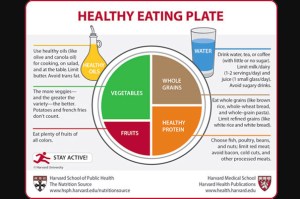
Harvard serves up its own ‘Plate’
The Healthy Eating Plate, a visual guide that provides a blueprint for eating a healthy meal, was unveiled today by Harvard nutrition experts.
-
Health
Get the salt out
Responding to the health threat posed by Americans’ over-consumption of sodium, experts in the department of nutrition at Harvard School of Public Health (HSPH) and The Culinary Institute of America (CIA) called today for sodium reduction strategies that are strong and effective—and that maximize the enjoyment people derive from food. “There is now overwhelming evidence…
-
Health
Epstein-Barr Virus implicated as a cause of MS
Researchers from the Harvard School of Public Health, Walter Reed Army Institute of Research, and a team of collaborators have observed for the first time that the risk of multiple sclerosis (MS) increases by many folds following infection with the Epstein-Barr virus (EBV). This finding implicates EBV as a contributory cause to multiple sclerosis. The…
-
Health
D. Mark Hegsted, national force in science of human nutrition, dies
D. Mark Hegsted, who was instrumental in the development of the federal “Dietary Guidelines for Americans,” died Tuesday, June 16, 2009, at the age of 95 at a nursing center in Westwood, Mass. Hegsted was a founding member of the Department of Nutrition at the Harvard School of Public Health (HSPH), among the first such…
-
Health
Weight loss bottom line: Fewer calories
A new study by Harvard researchers and colleagues shows that eating fewer calories leads to weight loss, regardless of where those calories come from. Many popular diets emphasize either carbohydrate, protein, or fat as the best way to lose weight. Yet there have been few studies lasting more than a year that evaluate the effect…
-
Health
Changes in diet and lifestyle may help prevent infertility
Women who followed a combination of five or more lifestyle factors, including changing specific aspects of their diets, experienced more than 80 percent less relative risk of infertility due to ovulatory disorders compared to women who engaged in none of the factors.
-
Health
Study shows benefits of eating fish greatly outweigh risks
Many studies have shown the nutritional benefits of eating fish (finfish or shellfish). Fish is high in protein and omega-3 fatty acids. But concerns have been raised in recent years about chemicals found in fish from environmental pollution, including mercury, PCBs and dioxins. That has led to confusion among the public – do the risks…
-
Health
High intake of vitamin D linked to reduced risk of multiple sclerosis
More than 185,000 women from the Brigham and Women’s-based Nurses’ Health Study and Nurses’ Health Study II, who were free of multiple sclerosis (MS), were selected for a research study. The participants filled out dietary questionnaires every four years between 1980 and 1999 that assessed their vitamin D intake along with other dietary information. During…
-
Health
Coffee cuts diabetes risk
More than 125,000 study participants who were free of diabetes, cancer, and cardiovascular disease at the start of a study were selected from the on-going Health Professionals Follow-up Study and the Brigham and Women’s Hospital-based Nurses Health Study. Some 41,934 men were tracked from 1986 to 1998 and 84,276 women from1980 to 1998 via food…
-
Campus & Community
Low-carb more effective than low-fat
A study put three groups of dieters on different regimens. They included a low-fat group, a low-carbohydrate group that ate the same number of calories, and a third group on a similar low-carbohydrate plan that included 300 extra calories a day. The low-carbohydrate dieters lost more weight than low-fat dieters despite eating 25,000 extra calories…
-
Health
Anti-inflammatory drugs may reduce Parkinson’s disease risk
In the first study to investigate the potential benefit in humans of the use of non-steroidal anti-inflammatory drugs (NSAIDs) in reducing the risk of Parkinson’s disease, Harvard School of Public Health researchers found that regular users of these drugs had a lower risk for Parkinson’s disease than non-users. More than 44,000 men and nearly 99,000…
-
Health
Generous portions of TV make women fat
The first study to compare the effects of inactivity on obesity and diabetes concludes that being a couch potato significantly raises the risk of both diseases. “Our data provide strong evidence that sedentary behaviors, especially prolonged TV watching, are directly related to the risk of obesity and type 2 diabetes,” reports Frank Hu, leader of…
-
Health
Study finds frequent consumption of alcohol linked to lower risk of heart attack in men
Men who drank moderate amounts of alcoholic beverages three or more times a week had a risk of myocardial infarction 30 to 35 percent lower than nondrinkers. The observational study, which tracked the drinking habits of nearly 40,000 men over a 12-year period, provides an important clue as to how alcohol helps guard against coronary…
-
Health
Men can reduce stroke risk by eating fish
Researchers tracked the diet and health outcomes of more than 43,000 male participants for 12 years. Using detailed food frequency questionnaires, participants were asked how often they ate fish, ranging from never or less than once per month to six or more times per week. The men in the study were also asked about four…
-
Health
Nuts lower diabetes risk
Women in a study who reported eating nuts at least five times per week reduced their risk of type 2 diabetes by almost 30 percent compared to those who rarely or never ate nuts. The researchers also found that women in the study who frequently ate peanut butter reduced their risk for type 2 diabetes…
-
Health
New alternative to USDA dietary guidelines nearly twice as effective in reducing risk for major chronic disease
Researchers at the Harvard School of Public Health rigorously assessed the diets of more than 100,000 men and women and found that the reduction in risk was nearly twice as great for those whose diet met the new guidelines when compared to those whose eating patterns reflected the current USDA dietary guidelines. The findings appeared…
-
Health
Key gene discovered for obesity and diabetes
Obesity is closely associated with insulin resistance and is one of the leading risk factors for type 2 diabetes. Both affect more than 50 percent of the U.S. population. Little has been known about the molecular mechanisms linking these two metabolic diseases. Both are associated with a wide range of inflammatory molecular activity in fatty…
-
Health
HIV-1 positive mothers taking vitamin A increase risk of transmitting HIV to newborns
In many regions of Africa, between 15 and 30 percent of women attending prenatal care clinics are HIV-1 positive. And 20 to 45 percent of children born to HIV-1 positive mothers become infected through breastfeeding or during intrauterine or labor and delivery periods. Mother-to-child transmission of HIV-1 has been attributed in part to poor maternal…
-
Health
Medical student engineers protein to dissolve blood clots
Heart attacks and strokes are caused by blood clots called thrombi that block blood flow in the arteries of the heart and of the brain. Body tissues become deprived of needed oxygen and nutrients, eventually dying. Cardiovascular disease is the number one killer of Americans each year — and has been since 1900 with the…
-
Health
Study links Western dietary pattern with greater risk for type 2 diabetes in men
About 16 million Americans have type 2 diabetes, which can cause blindness, kidney failure, and heart disease. Now researchers from the Harvard School of Public Health have linked a diet high in consumption of red meat, processed meat, high-fat dairy products and refined grains, combined with obesity and inactivity, with a high risk for type…
-
Health
Nutrition book author Willett rebuilds USDA food pyramid
For more than 20 years researchers at Harvard and elsewhere have been looking at the long-term health effects of eating certain types of foods. These researchers now have a good idea what’s good for you and what’s not, and in what quantities. However, that information is not reflected in the “food pyramid” produced by the…