Featured series

Campus & Community
‘A sea of happy faces’
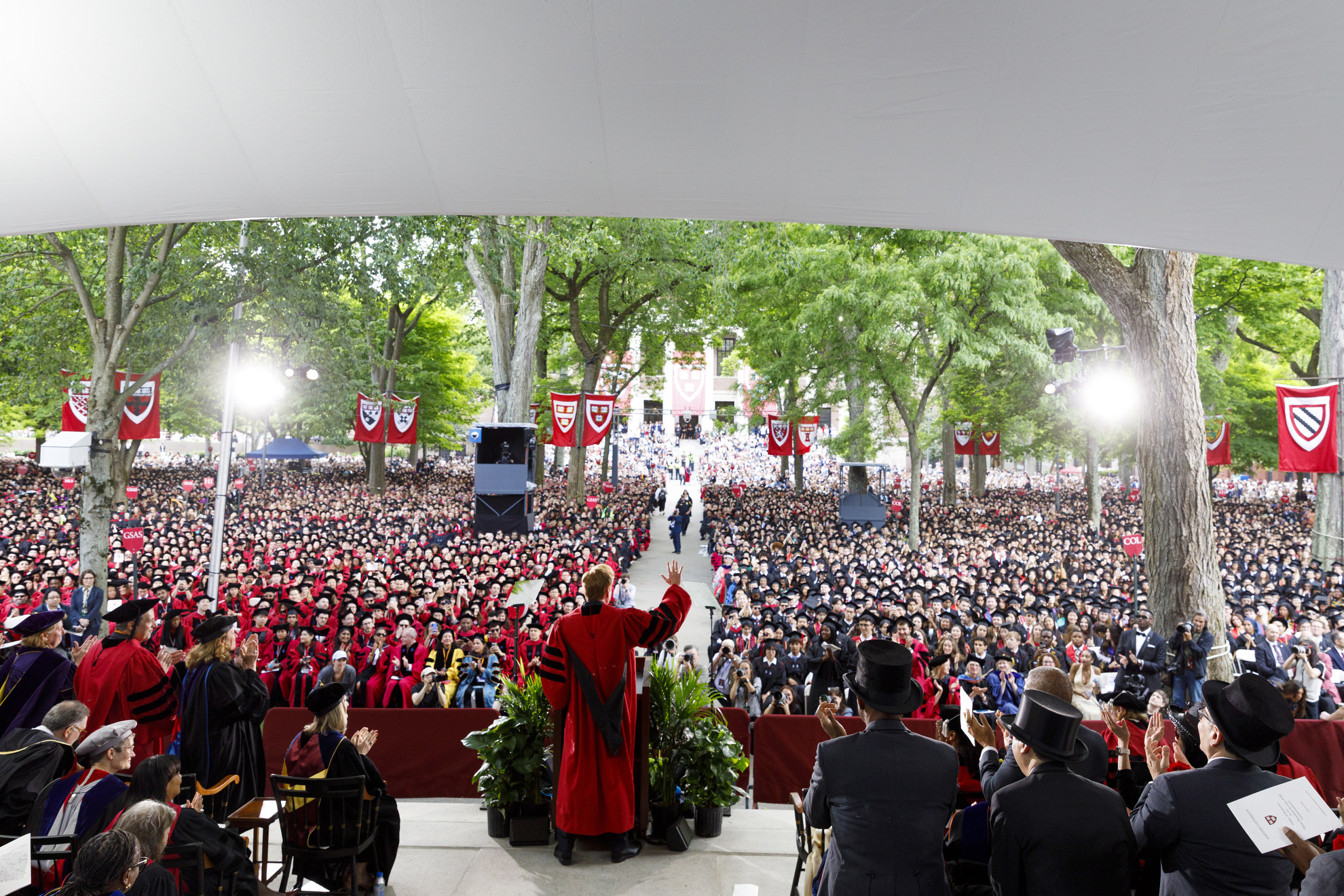
Conan O’Brien ’85 greets the graduates who fill Tercentenary Theatre.
Veasey Conway/Harvard Staff Photographer
For students and their families, a day filled with joy, pride, appreciation
Part of the Commencement 2026 series
A collection of features and graduate profiles covering Harvard’s 375th Commencement.
Commencement, of course, comes with a pretty strict dress code: Robes, badges, and caps are all imbued with centuries of tradition and institutional significance.
But many newly minted graduates find ways to accessorize around the margins — most notably, around their necks.
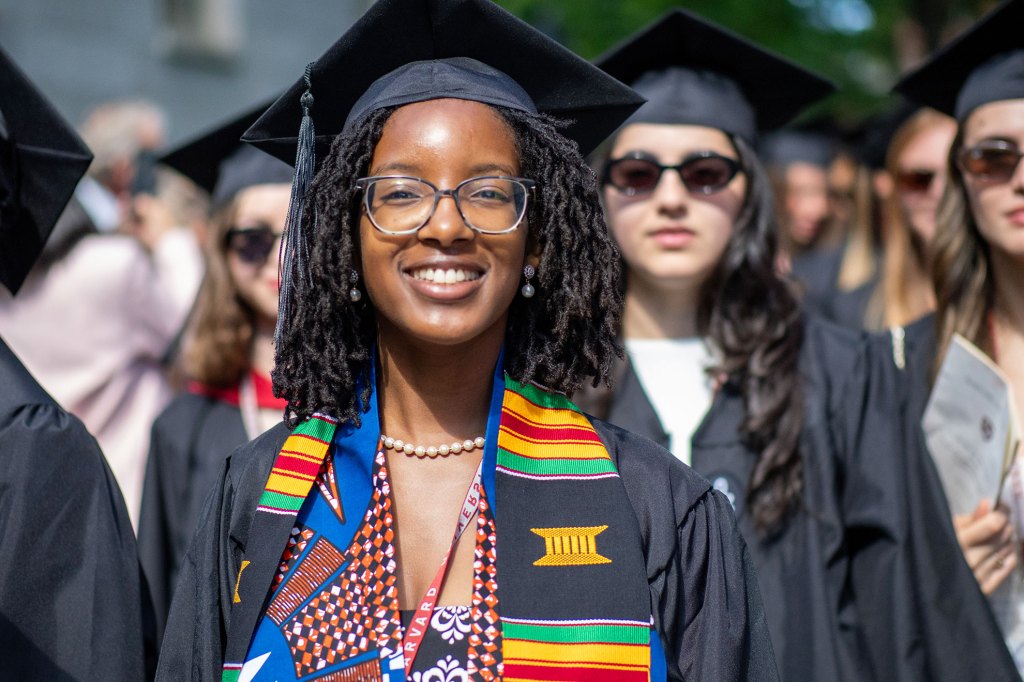
Everywhere were ribbons and stoles of significance draped over robes.
Many were distributed by student groups to represent pride and affinity: first-generation status, countries of origin, or membership in, say, the Harvard Law Review.
Others were more personal.
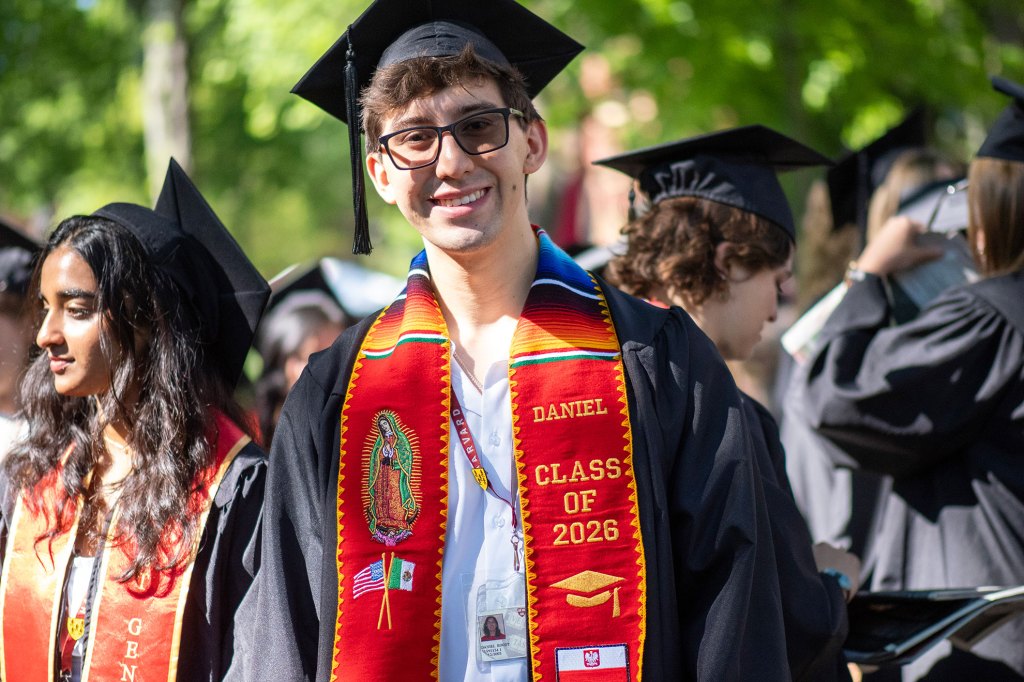
On one end of Daniel Kocot’s stole was Our Lady of Guadalupe, the patron saint of Mexico, on the other, the Polish flag, representing both halves of his family tree.
“My parents surprised me with it,” said Kocot, who is from Chicago and is graduating with a B.S. in electrical engineering. He particularly liked the colorful serape gradient woven in: “It’s traditional in blankets in Mexico, but it’s integrated into the stole itself.”
The best stoles caught the eye from 50 feet out, suggesting that undergraduate black goes with everything.
Christian Liu, leaving Currier House with a degree in computer science, wore a batik pattern to represent his native Singapore: a looping network of vibrant floral imagery against a navy background, like an electric paisley.
Sarah Adegbite’s featured a scale icon, rather than the other option, a star — even though she’s a Divinity School graduate, not a lawyer.
“I studied the history of slavery in Christianity, how enslaved people encountered ritual and sacramental practice,” Adegbite said. “So, thinking about justice and liberation has been a big part of my time at the Divinity School.”
Adegbite, who is Nigerian and was raised in London, made a point of giving thanks to the classmate who sourced stoles that speak to her family’s West African roots. (“Made in Ghana,” says its sticker.)
Lulu August’s parents came to the U.S. from Tanzania for education, and Lulu spent time there with her grandparents, “when I was very young,” while her mother was attending medical school.
By now, in trips back and forth, August’s mom has assembled a whole library of kitenges, colorful cotton patterns widely used in East Africa. “We looked through what she had: My favorite color is blue; her favorite color is orange; so we chose one that had both.”
While most of these markers lie flat, a few explode into three dimensions.
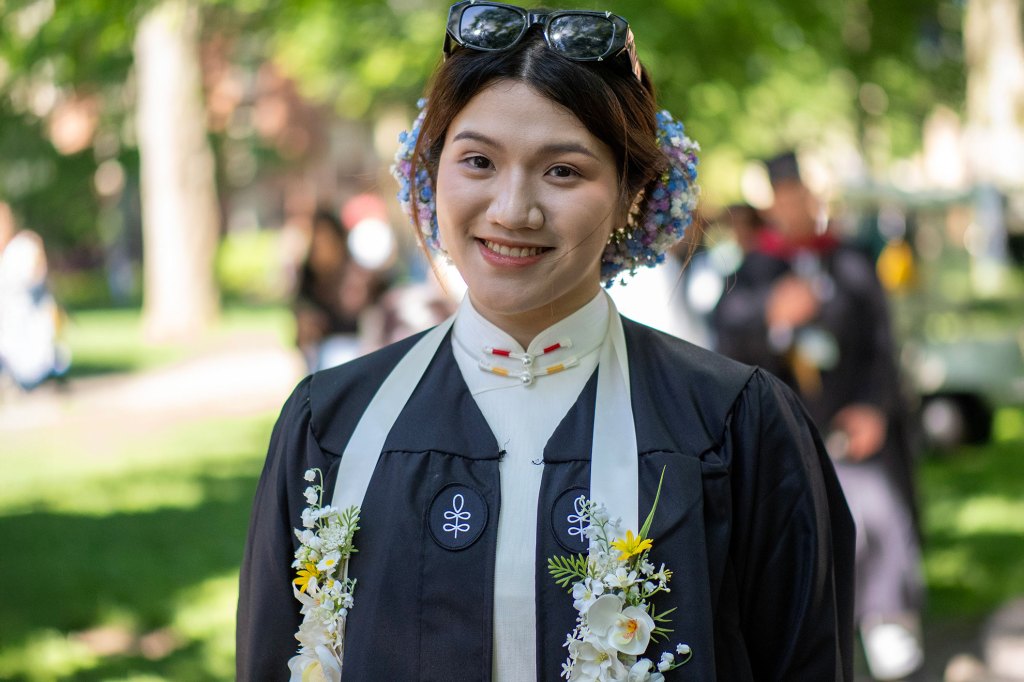
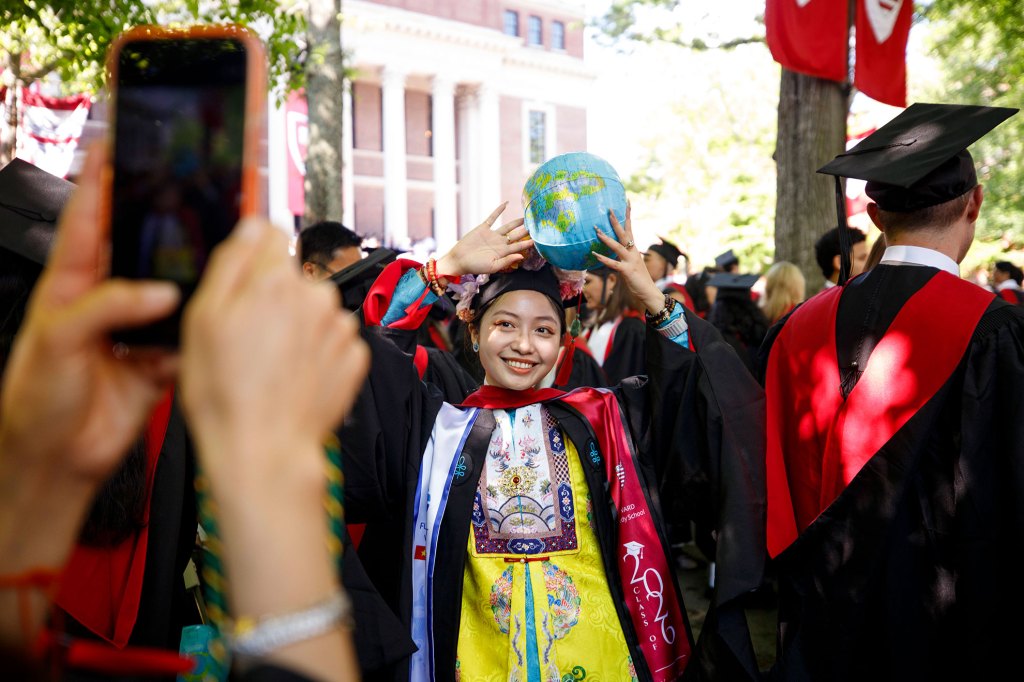
Lucy Zheng, who is from Shanghai, wore an intricate floral wreath and a stole to match, dotted with what look from afar to be living orchids and other flowers. “They’re not real,” Zheng noted. “I had it shipped from China.”
Zheng’s undergraduate studies centered on East Asian art, and her floral adornments pay tribute to similar crowns, called zanhua, made famous by the women of the fishing village of Xunpu, in southern China.
Some of the accessories, while not unique, capture the almost-unthinkable distances that students travel.
Twin sisters Cielo and Isa Long grew up on Tinian (population about 2,000) in the Northern Mariana Islands. They feel certain they’re the first Tinianese to get degrees from Harvard.
In such a remote community, pride runs deep: Marianas grads all wear stoles depicting the Northern Marianan flag — featuring traditional images from the island’s native populations, and a white star symbolizing its status as a U.S. territory.
Isa said: “It’s a way of instilling pride in our people.”
All these students were pleased to say that their families hadn’t just sent stoles but had come to Cambridge themselves for Commencement — even if, for the Longs, that meant 33 hours of travel.
“Here to Newark, Newark to Japan, Japan to Guam, Guam to Saipan, overnight layover, next morning to Tinian,” Cielo said.
A touch of Revolution
Leading the procession into Tercentenary Theatre were musicians participating in Commencement for the first time who nonetheless brought a bit of tradition to the event.
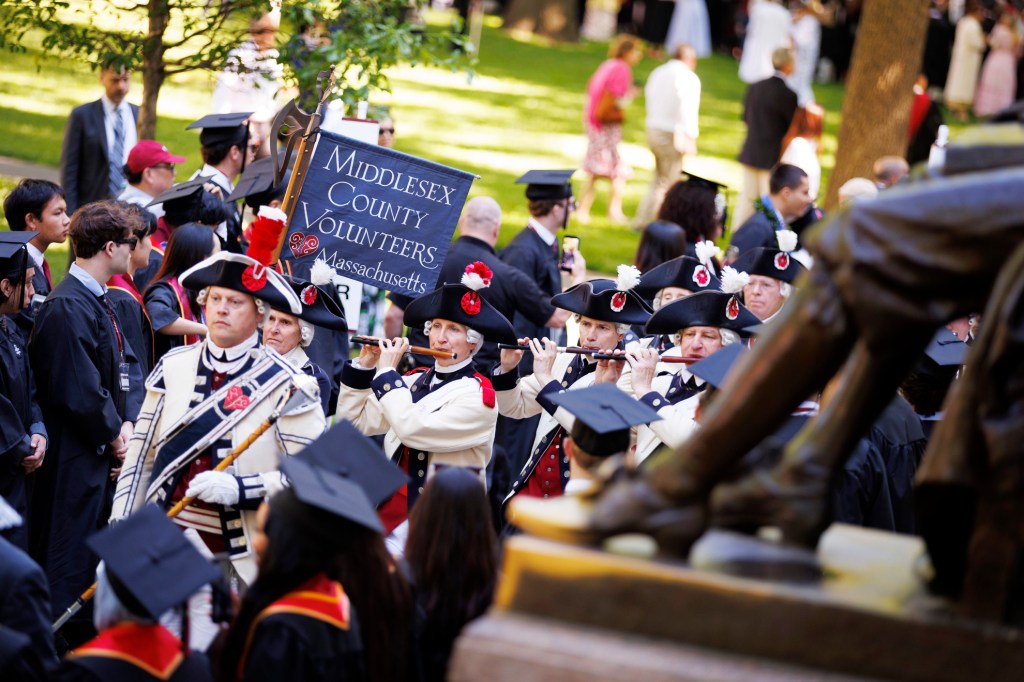
In honor of the nation’s 250th anniversary this July 4, Commencement organizers asked the Middlesex County Volunteers Fifes and Drums, a musical corps established in 1982, to participate.
The 11 MCV participants were attired in the garb of Colonial military musicians: long white coats with blue facings, white pants, and tricorn hats. At their head was drum major John Nichols, a Harvard environmental officer with Environmental Health and Safety and the organization’s director.
Nichols, a drummer, said he began playing with a youth fife and drum corps while growing up in the Boston area. He joined the Middlesex County Volunteers Fifes and Drums about 10 years ago because it sat at the intersection of two longstanding interests: music and history.
“I was a history major from Boston College so for me it scratches that itch, continually diving into Colonial America,” Nichols said. “I also love the pageantry of the martial music, with our tattoos and our performances.”
He rose to lead the nonprofit, which is dedicated to educating the public and performing fife and drum music from the 16th through 19th centuries, including “Yankee Doodle” and other Revolutionary War period pieces.
Though there were volunteer militias in Middlesex County during the Revolutionary War, Nichols described MCV as a “historically inspired” group, rather than a recreation of any particular troop of the era.
For Nichols himself, the experience put a new spin on Commencement, for which he and other environmental safety officers are usually in the Yard as safety ambassadors, assisting visitors and being on hand for emergencies.
Not only was he in a procession that he typically watches, but some of the organizing meetings were at Wadsworth House, where the Commencement and University Marshal’s offices are located.
Wadsworth House is the campus’ second-oldest building, after Massachusetts Hall, and was built in 1726-27 for then-President Benjamin Wadsworth.
George Washington stayed there in 1775 while making plans for the early stages of the war and taking command of the Continental Army.
“To take a meeting where we’re talking about celebrating the 250th at the Commencement, in a room where Washington was writing papers and reports during the Siege of Boston, it was pretty remarkable,” Nichols said. “As a history nerd, it was awe-inspiring.”
Their job: Spreading happiness
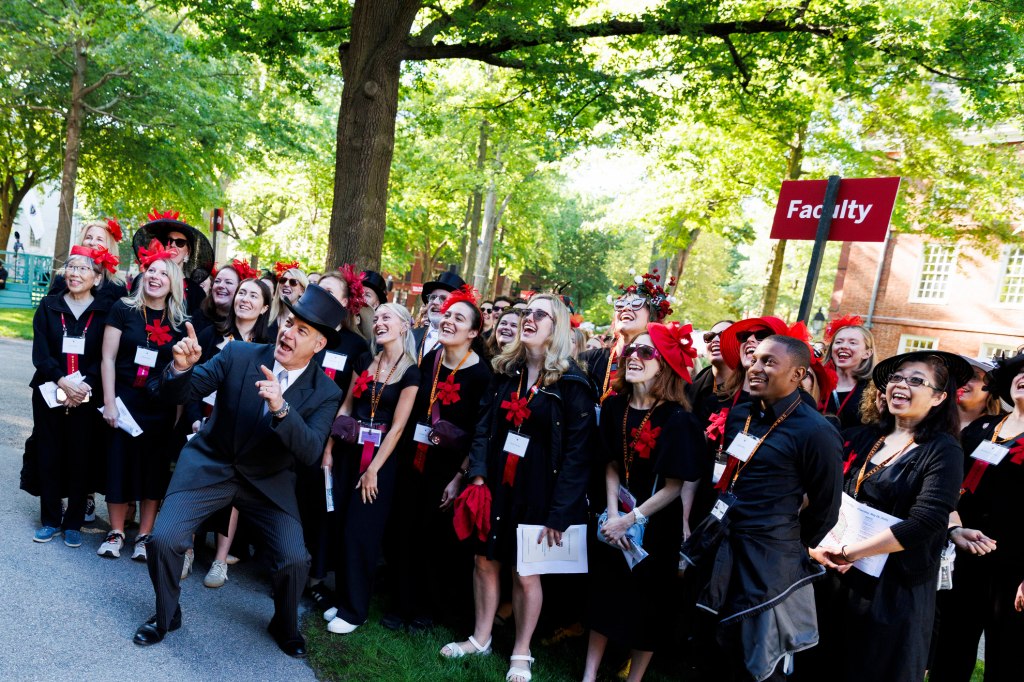
Donna Gibson Stone ’66 of Topsfield, Mass., and Bob Phifer ’69 of Wellesley, Mass., met each other while volunteering for the alumni Committee for the Happy Observance of Commencement, also known as the Happy Committee. The two friends have volunteered for decades as volunteers during Commencement festivities — and find it to be one of the most joyous days of the year.
“It’s a sea of happy faces. Everybody is in a good mood,” Stone said. “The mood is usually quite upbeat, and I find it a joyful experience.”
Phifer said that he appreciates the sense of tradition and ceremony that comes with being part of such a historic institution, which is particularly striking this year, the 375th anniversary.
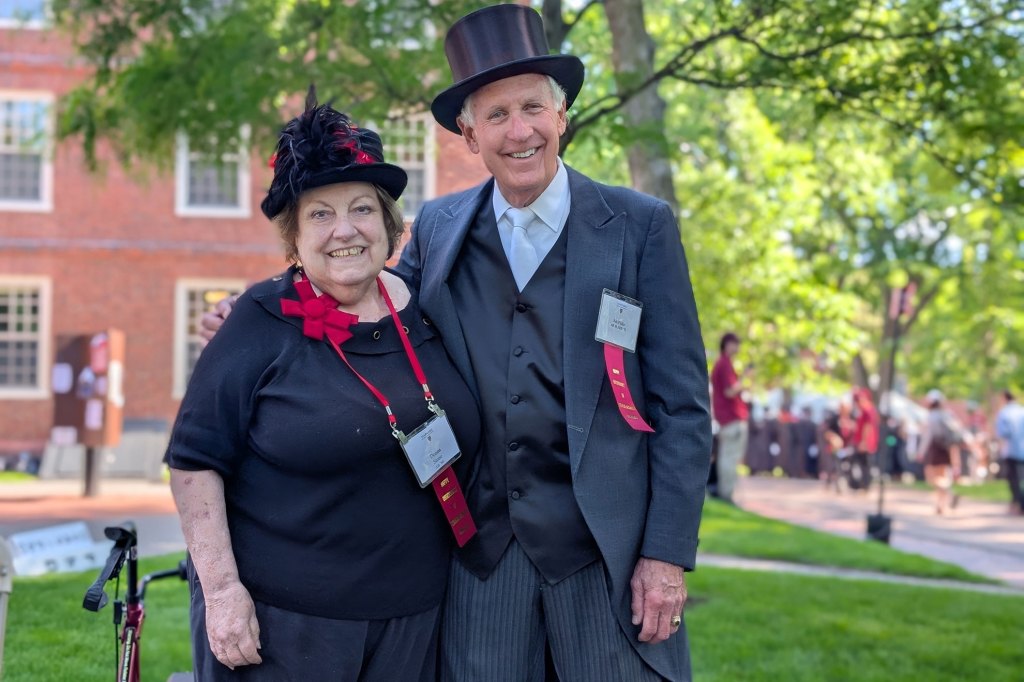
“There’s nothing like this in the rest of the United States,” he said. “It appeals to my sense of tradition, stability, continuity, and depth … but it’s also a festival. It’s just fun.”
As part of their marshal duties, Stone and Phifer lend their institutional knowledge and celebratory spirit to help ensure the event runs smoothly.
When asked about the traditional marshal uniform — a suit and top hat for men and black clothing with an extravagant hat of black or red for women — Stone and Phifer chuckled, saying it’s a nice occasion to wear “the same costume every year.” Plus, the eye-catching pieces make it easy for attendees to find help if they need it. Stone pointed to her own hat and said it was one from the first batches of hats ever given for Commencement, created in Jamaica Plain by local haberdashery Salmagundi.
More than just a festive day, Phifer said Commencement provides a moment to pause and remember that there is a rhythm to our lives, one that can be grounding. It’s a call to keep doing our part to make the world a better place.
“It’s nice to go to something which has been predictable for three centuries,” he said. “It kind of gives you a center, a meaning, a compass for the way in which we should go forward. Commencement is a beginning, a chance to go forward again, to amend our lives and move forward. So let’s hope these graduates will do that.”
‘My family is amazing’
There are small children everywhere at Commencement, but they may be in highest concentration at the party for graduates of the Division of Continuing Education.
Gathered for a quick lunch at the quadrangle in front of the Harvard Museum of Natural History, some mothers wearing mortarboards and holding toddlers looked almost stunned to have made it to this day.
“There were times when I wasn’t sure if I could do this, but I did,” said Kelsea Binns, as her husband, Mustafa, wrangled their 2-year-old behind her. She corrected herself: “We did.”
After years working as a consultant in Seattle, Binns decided to pursue a master’s degree in sustainability offered remotely through the Extension School. It was an enormous commitment for a young parent with a full-time job.
“I was working at my consulting firm, like 60 hours a week. And then every Saturday I went to a coffee shop, for at least eight hours, and worked on homework,” Binns said. Pointing at her son, she said, “I saw him, maybe, one hour a day sometimes.”
Binns quickly found she was not alone.
During remote classes, “Plenty of babies would pop in the screen to say goodnight,” said Ashley Rutkowski, who is graduating from the same master’s program. (Her own son, nearly 2, was lounging in a stroller on the lawn.)
Rutkowski, too, thanked her support system.
“He’s the one with the baby, my parents on the weekend,” she said of her partner.
She was moved by Conan O’Brien’s Commencement message that all success comes backed by a team. “My family is amazing,” she said.
The spouses were celebrating, too. Mustafa Binns said that Kelsea had been there for him during his own spot of mid-career “upskilling.” “It feels like a joint accomplishment,” he said.
In an ideal world, sustainable practices would be quickly woven into the fabric of corporate America. But in Binns and Rutkowski’s experience, it made sense to dive in intensively, though it made for tiring weeks.
They took courses on how to incorporate climate resilience, planning for weather events and eliminating waste in their everyday work.
Binns hopes to focus on “nature-based solutions,” using green space and the built environment to mitigate the effects of disasters.
“The goal is to save the planet,” Binns said. And in a fit of parental practicality, she added, “and also to make money somehow.”
Company — and a company — for a grad
Astra and Lori Wagman were sitting on folding chairs in the shade in front of Lamont Library, surveying the scene, which felt kind of expected yet surreal.
The two were preparing to cheer on Astra’s husband and Lori’s son, Bradley Wagman, who was graduating from a joint program between the John A. Paulson School of Engineering and Applied Sciences and the Graduate School of Design.
Wagman, completing the two-year master in design engineering degree, is a U.S. Army veteran with an interest in helping those with conditions that affect mobility, such as veterans with disabilities and people suffering motor diseases.
Wagman and another Army veteran, Harvard College senior Viktor Bokisch, who also graduated, with a bachelor of science degree in bioengineering, designed and built an AI-driven sock, called Sole 1, that addresses a condition called “foot drop.”
Foot drop is caused by paralysis or weakness in the muscles that raise the front of the foot and is commonly seen in those with nerve injury or conditions like Parkinson’s disease, multiple sclerosis, and Amyotrophic lateral sclerosis. Those with the condition tend to drag their toes when walking, which can cause trips and falls and lead to further injury.
Wagman conducted dozens of interviews of patients and found deep dissatisfaction with current braces. As an alternative, Wagman and Bokisch designed a soft robotic sock whose AI brain detects impaired gait and employs what the two describe as “synthetic muscles” to lift the front of the foot and create a more natural gait.
The device was a finalist for Harvard’s 2026 President’s Innovation Challenge and in September won a James Dyson Award. The two have founded a startup, Sole 1, with Wagman as chief executive officer and Bokisch as chief technology officer, to develop the idea further.
While a lot of work lies ahead, Thursday was for celebrating achievements. Lori, Wagman’s mother, flew up from Pennsylvania, while Astra, his wife, lives with him in Cambridge.
Astra wasn’t surprised that Wagman was accepted to Harvard, but somehow never thought she’d actually be sitting at a Harvard commencement. So, while she was absolutely proud of her husband, the whole event still was a bit of an “out of body experience.” In a good way.
Get your Harvard gear here
Holding signs offering a 25 percent discount on all Harvard apparel, rising sophomores Achilles Anderson and Michael Young were hoping to attract buyers to the tent of The Harvard Shop, the University’s official student-run campus store.
It was for a good cause, said the Dunster House residents as they stood near Tercentenary Theatre. The tent was pulsing with activity as customers purchased T-shirts, hats, and other merchandise.
“All the sales from The Harvard Shop go to financial aid and student wages,” said Anderson, a psychology concentrator who hails from Chicago. “And for me personally, this is important because without financial aid, I wouldn’t be able to attend a school like this. It’s like I’m paying it forward for a kid out there next year who, just like me, has the opportunity to come to a school as prestigious as Harvard, but can’t quite pay.”
Young, an economics concentrator from Ohio, shared the sentiment. “Not only are people getting a great item, whether it be clothing, a water bottle, or an umbrella that has the Harvard brand on it, they’re contributing to students here,” he said.
Both Anderson and Young are affiliated with Harvard Student Agencies, a student-run nonprofit that provides jobs and business opportunities for undergraduates.
Before resuming their sales pitches to passersby, Anderson and Young shared some pieces of advice for incoming students.
“My main piece of advice is to talk to any and everybody,” said Anderson. “Most people here are nice and won’t turn you down, especially because in freshman year everybody is new. School is important, but relationships matter too. Most of the people that you’ll meet here will probably be lifelong friends.”
Friendships are important, agreed Young, and coursework and assignments can be difficult, but they are manageable with organization. “Put your time into the right things and work hard,” he said. “You’re going to love your experience here.”
Work-school balance
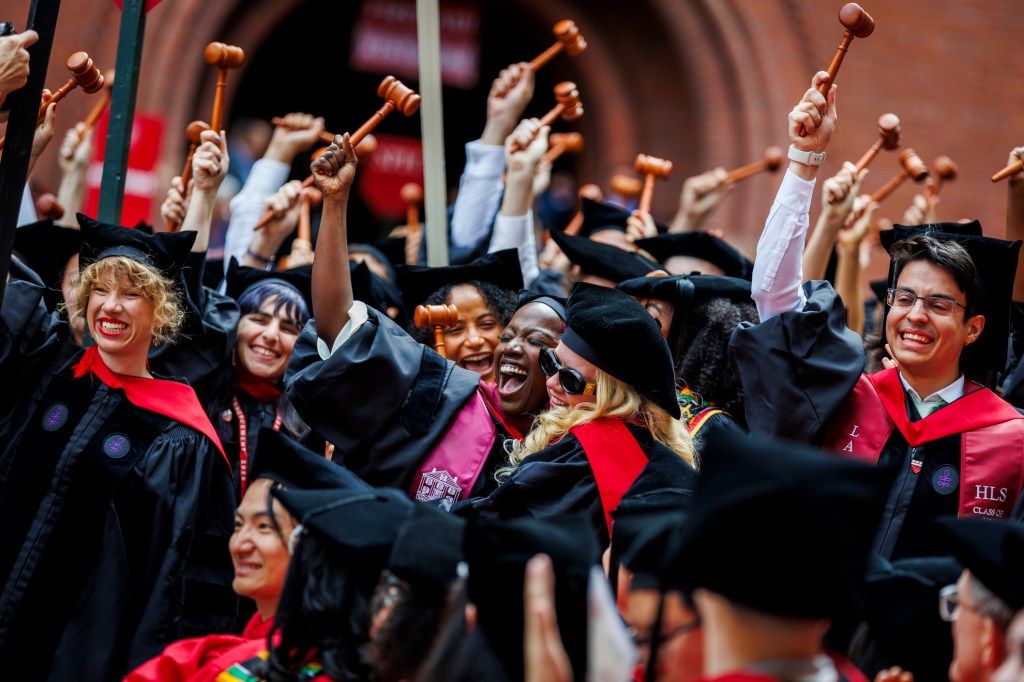
Commencement was a kind of reunion for Extension School A.L.M. grads Curtis Steinhauer and Stephanie Borcea, both of whom concentrated in global development practice. Steinhauer lives in Washington State, Borcea in Washington, D.C. They took classes remotely and hadn’t met in the flesh since the program’s in-person summer intensive.
Borcea entered the School at a difficult time in her personal life. She had a background in land use, human rights, and indigenous rights, but had taken time off work to grieve the death of her mother. Grad school, she thought, would be a great way to get back into the swing of things.
“It’s kind of cheesy, but I can’t express enough how much this pulled me out of a dark place,” she said. “Coming into this program, feeling enthused by learning again, being in a cohort of people who are just nice, kind, earnest people, it brought me back to life.”
About a year into the program, Borcea got a job at the World Resources Institute, helping support community-led forest protection efforts in the Amazon, the Congo River Basin and Indonesia.
Steinhauer was also able to leverage his classwork into a new job before he finished his degree. When he took his first class in 2017, he worked for a county in Washington State as a homelessness and housing coordinator. He is now the policy coordinator on land use and housing for the Washington State Association of Counties.
“In a pretty competitive job market in 2022, the degree helped me stand out to the organization I work for now,” he said.
Steinhauer particularly appreciated coursework that taught him skills he might not have had the chance to prioritize on the job, like negotiation and conflict resolution.
“I was reflecting a little bit today during Commencement, when they talked about the Veritas books facing out towards the world,” he said, referencing Rabbi Getzel Davis’ invocation of the Harvard shield and its three open books. “The Extension School has been a really incredible opportunity to learn more and immediately apply the skills in the community that I live and work in.”
Deeper learning
Meghna Middha filed into Tercentenary Theatre Thursday morning, proudly holding the signature golden oil lamp that all Extension School graduates carry during the ceremony.
“To me it represents us burning the midnight oil, because all of us are Extension students balancing work, life, classes, and adulting,” she said.
Middha, who received an A.L.M. in psychology, began her career as a teacher — she also holds a Ph.D. in English literature — but realized that her students, mostly teenagers, needed more support. She trained as an arts-based mindfulness practitioner and worked as a counselor.
“I wanted to deepen my knowledge of psychology, perhaps get another Ph.D. in psychology,” she said. With a laugh, she continued, “I might have gone a bit crazy, but I found my calling in adolescent well-being.”
Middha, who is 40, fit in her Extension School classes over the course of five years. As part of her capstone project, she developed what she calls the ABCD model of adolescent well-being:
“A for awareness, B for balance, C for choice, and D for direction. It’s everything repackaged for our teenagers, developing the skills teenagers need.”
She plans to combine her literature background with her newfound expertise in psychology into a series of workbooks and stories for adolescent readers — and she hopes to conduct research that bolsters the ABCD model.
“If anybody’s listening, I really want to do this, get in touch,” she said, laughing again.
Saying goodbye to a second home
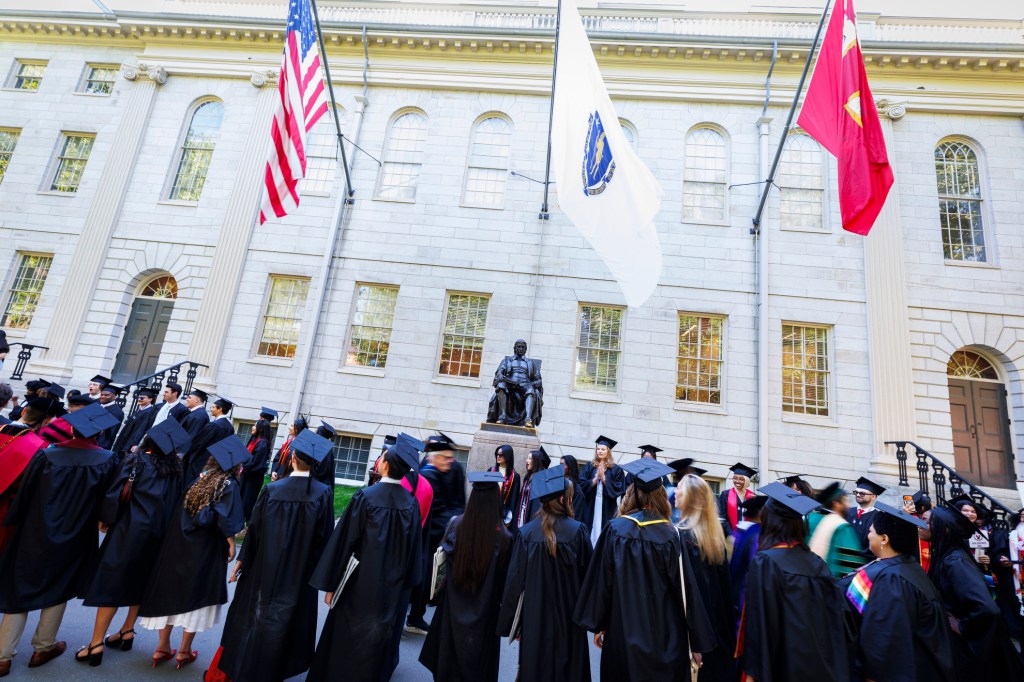
As the procession slowly moved through the yard, Lulu August chatted and laughed with her fellow graduates. Her family, who traveled from Maryland for the special occasion, stood nearby, taking pictures and jumping over to the line of graduates to give August hugs and well wishes. August took it all in stride but noted that she felt overwhelmed with the various emotions associated with her College days coming to an end.
“I feel a bit in denial. I feel theoretically sad, like it’s going to hit me in a few hours,” she said with a laugh. She concentrated in environmental science and public policy with a secondary in women’s studies, a decision largely shaped by a childhood spent in Tanzania. “This is a place where I’ve grown a lot into the person that I am and feels like a second home.” While at Harvard, August also operated as a peer advising fellow, volunteered at the Harvard Square Homeless Shelter, and was a member of Omo Naija x Wahala Boys, Harvard’s undergraduate West African dance group.
Her parents, Agnes Mwakingwe-Omari and Kakuri Omari, said they are so proud of everything that their daughter has accomplished. Agnes remembered the day they moved August into her dorm, pointing to Cabot House and saying the day felt like a moment where they had come “full circle.” Serendipitously, that moment was also captured on camera. “We are very, very proud of her because she’s worked really hard,” her mother said. “She’s liked being here and she’s learned a lot.”
After graduation, August will be moving closer to home to work as a paralegal for Planned Parenthood in the D.C. area. While she’s happy that she’ll be nearby, Agnes is mostly excited that August will be following her dreams. “We really raised Lulu to just go wherever she wants to go, wherever she has the opportunity to do what she really loves to do.”
Her father added that Harvard has been an important part of their daughter’s journey. “It’s been a good four years and we’re sorry that it’s come to an end,” he said. “We look forward to the great things I hope she will do based on the education that she got here.”
While leaving is bittersweet for August, she’s also happy for the time she spent on campus and the memories she made.
“It’ll be exciting to see what happens next in the next chapter of my life, but I’m grateful to have had these four years,” August said.
‘The most rewarding and surreal experience’
Walking through the Yard, Sandra Taves Bhutto felt like she was actually walking on clouds.
The new graduate and ultrasound technologist at SickKids, a hospital in Toronto, was accompanied by her husband of five years, Mustafa Bhutto, who was beaming.
“It has been an incredibly hard journey, but it’s been the most rewarding and surreal experience in my life,” said Bhutto, who received a Master of Medical Sciences in Medical Education from Harvard Medical School.
Bhutto, who applied to Harvard at her husband’s encouragement, took four years to complete the two-year program as she worked at the Canadian hospital. The program helped her gain training in pediatric ultrasound education, she said.
“I wanted an opportunity to improve healthcare globally,” said Bhutto. “Harvard Medical School’s master’s program was the best opportunity to get the education to do that.”
Bhutto said she’s going to miss the program’s intellectual stimulation and the camaraderie among the students. “Everyone is so engaged and just thrilled to be there and to contribute,” she said. “Everyone embraces the challenges and really pushes each other to do what’s best for the world. That’s what’s been so rewarding over the past four years.”
As for her plans after graduation, Bhutto is preparing to become a new mother and to return to the hospital to do the work she is passionate about.
‘Change is a constant’
Indra Gonzalez Ojeda was raised in Cabo Rojo, the home of the best beaches in Puerto Rico, in her humble opinion.
Back then Gonzalez Ojeda, who is graduating with a Ph.D. in biophysics, thought she would grow up to become a physician. Over the years she decided that path was not the one for her.
She did enjoy science, though, and while in high school she participated in a biomedical research program at the University of Puerto Rico at Mayaguez, where she would eventually do her undergraduate degree in chemistry
She never thought of attending Harvard until she went to a summer research program in her senior year and met Kevin Wood, a professor of biophysics and physics at the University of Michigan.
Wood, who would become a mentor, asked whether she’d considered applying.
“It just didn’t feel like something that was possible,” she said, in her graduation regalia. “There was this aura of intimidation.”
He wrote her a letter of recommendation, and Gonzalez Ojeda got in.
At the Kenneth C. Griffin Graduate School of Arts and Sciences (GSAS), Gonzalez Ojeda rotated through many different labs and ended up studying evolution.
“I like that it’s about change, and change is a constant,” she said. “In biology, there are few constants.”
Grateful to the mentors who helped get her to Harvard, Gonzalez Ojeda helped lead an outreach program during her studies that matched graduate students with undergraduates seeking some guidance.
Many of the students she’d worked with are working on PhDs right now — at Yale, the University of Iowa, the University of Chapel Hill — and she still keeps in touch.
As her academic journey continues next year as a post-doc at Stanford, she’s glad she can continue paying that mentorship work forward.
Raised near stunning beaches, she can perhaps enjoy some warmer weather now and may even see how coastal California compares to Cabo Rojo.
What’s with all the moral outrage?
Dylan Tweed studies moral outrage but is not particularly susceptible to feeling that way himself.
His sister, visiting for graduation, agrees, describing him as measured and calm.
It was partly Tweed’s slowness to anger that drew him to the subject in the first place.
“I just saw it everywhere, and myself not feeling coalitionally affiliated with an actual moral tribe, I was just curious,” he said. “I haven’t experienced this very strongly, so why is everybody else doing this?”
The curiosity turned into a six-year project under Steven Pinker, Johnstone Family Professor of Psychology and Tweed’s adviser at the Kenneth C. Griffin Graduate School of Arts and Sciences.
Tweed began working in evolutionary psychology as an undergraduate at University of California, Santa Barbara (UCSB). There, he studied under anthropologist John Tooby and psychologist Leda Cosmides, who helped found the field and deeply influenced the work of Pinker.
“Steve’s in the family,” Tweed said, smiling.
Community, humility top of mind
One line in particular from Conan O’Brien’s speech resonated with Marley Dias, a sociology concentrator with a secondary in African American studies.
“My wish for you is not that Harvard becomes the last thing people know about you,” O’Brien said to the graduates, “but instead that Harvard become the least important thing people know about you.”
Beyond her studies, Dias, a Winthrop House resident, started the #1000blackgirlbooks drive to increase diversity in school reading lists and authored an inspirational book herself, “Marley Dias Gets It Done: And So Can You!”
“I’ve always tried to let my activism and the impact that I make in my community be the biggest highlight of it all.”
Dias said the speech also left her feeling thankful for the people who helped her get across the finish line. In addition to O’Brien’s remarks stressing community and humility, College seniors were also prompted by Dean David Deming in the morning valediction to write thank you notes to two people in their lives.
“I think the idea of gratitude as a part of this moment is really important, because you feel like you do it alone, but you really don’t,” Dias said.
Dias was joined in Winthrop’s courtyard by family. She credits her mom, sociologist Janice Johnson Dias, as her biggest supporter on her journey to Harvard.
“Whether it’s been joining the Black Arts Collective of Harvard, or just making new friends, she’s always encouraged me to be myself, to say the things that I want to say, and to say please, and thank you,” Dias said, “And that advice has ushered me into what feels like a very exciting future, because I know who I’m grateful for, I know who’s helped me along the way, and I want to help other people.”
Dias plans to continue writing after graduation. She has a second title, “I am the Dream Come True,” a children’s book, set to publish in June — co-authored by her parents.
Her mother remarked that Commencement is a fitting celebration ahead of the release of the book about migration and family legacies.
“I’m an immigrant,” Johnson Dias said. “Her father’s family is an immigrant family, and we had all these rituals today, and so forth, that our families could have never participated in. And now she gets to be a part of this new formation.”
A secret dream fulfilled
For College graduates, Commencement doesn’t stop after the ceremony in Tercentenary Theatre. The graduates gather later in the afternoon with family and friends at their respective Houses to celebrate and collect their diplomas.
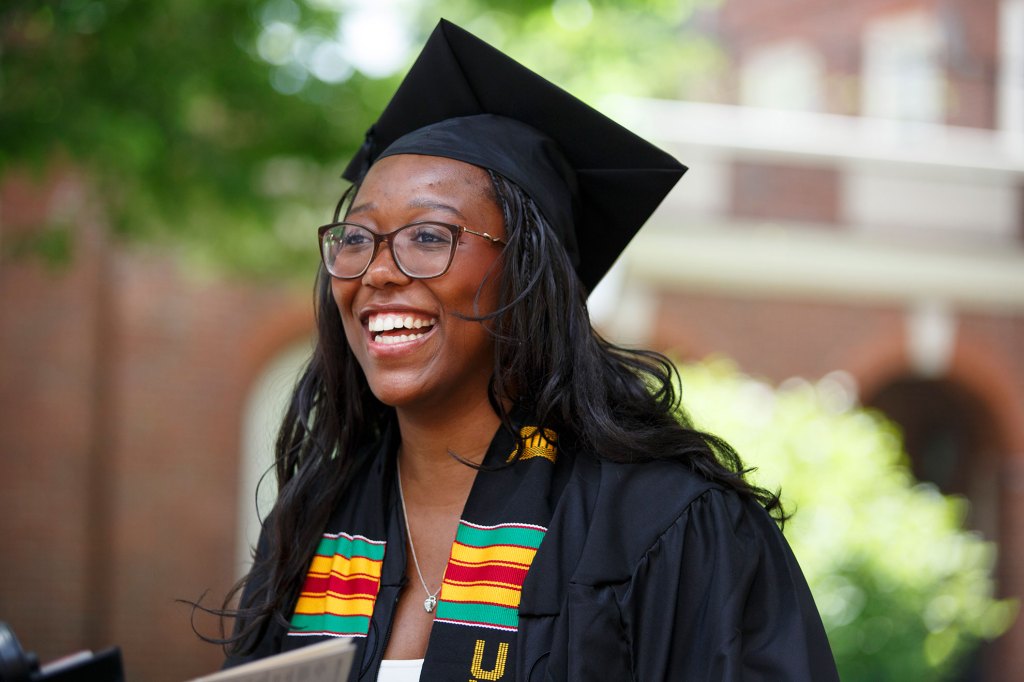
Taye Revels, a neuroscience concentrator at Lowell house, was one of many that brought an entourage. Revels’ mom, dad, two little sisters, older sister, two aunts and a family friend all gathered in the House courtyard to watch her receive her degree.
And while she shared the celebration openly with her loved ones, Revels said she initially kept her dreams of Harvard under wraps.
“I actually didn’t tell anyone I was applying but my mom,” Revels said. “So I kept it a secret until the results came out in December, and that’s when I revealed to everyone that I’d gotten in. They were so shocked, but they were really happy.”
Revels, who came into College pre-med, said she’s setting her sights on law school after Harvard with ambitions to pursue the arts as well.
Not that Revels regrets pursuing a neuroscience degree. For the last two summers, her expertise has come in handy at the law firm where she’s worked helping with pro bono cases representing clients with neurodegenerative diseases. She’s also used her skills as a senior editor for the Harvard Undergraduate Health Policy Review.
In the immediate future, Revels said, she’s heading back to her hometown of Jacksonville, Florida, then off to Chicago in late June to start a gap year before law school. In the meantime, she’ll miss Lowell house.
“I’m going to miss seeing my friends every day, and even the people that I’m not super close to that I have daily conversations with who are moving to different parts of the country,” she said.
Staff writers Sy Boles, Anna Lamb, Max Larkin, Liz Mineo, Samantha Laine Perfas, Alvin Powell, and Jacob Sweet contributed to this report.