Featured series


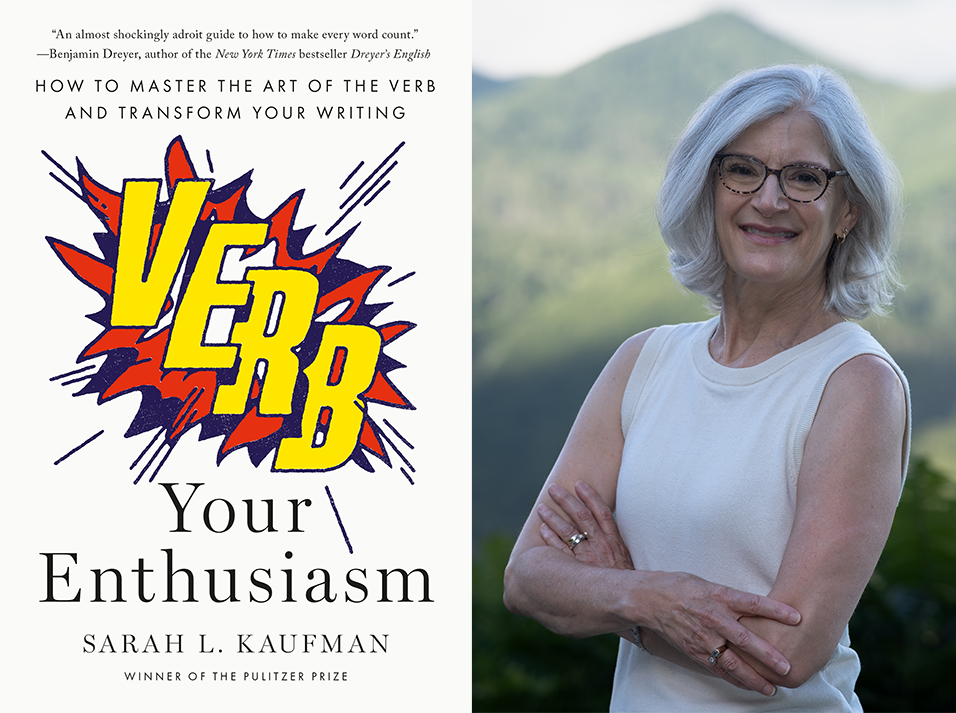
Sarah L. Kaufman
Photo by Asa Rogers
Arts & Culture
Want to avoid being replaced by AI? Think fresh verbs.
Pulitzer winner explains how to level up writing in new book
Excerpted “Verb Your Enthusiasm: How to Master the Art of the Verb and Transform Your Writing” by Sarah L. Kaufman, Nieman Fellow ’21, published by Penguin Press, an imprint of Penguin Publishing Group, a division of Penguin Random House LLC.
AI may be pounding on the writer’s door. But the writer has some defenses. AI cannot do what you can do to make your work unforgettable: Surprise the reader. Write with truthfulness and humanity. Write with fresh verbs.
I’m not Pollyannaish enough to believe that journalism, literature, marketing content, and other forms of writing can easily resist the onslaught of bots. Countless news organizations and other employers of writers are relying on the word production and hallucinations of AI even though they also require human writers to fix them — the so-called AI babysitters. Here’s a grim testimonial about where that leads: “I contributed to a lot of the garbage that’s filling the internet and destroying it,” a writer told the BBC after he lost his job rewriting AI-generated articles for a company. “Nobody was even reading this stuff by the time I left because it’s just trash.”
He’s right. It’s distressing and everywhere: bad summaries, flat, uninformative explanations. Here’s a typical example. I searched “how to use perambulate in sentence” and landed on a site that offered many paragraphs of fluff before this instruction: Begin your sentence with a subject, like “He” or “She.” Follow the subject with the verb “perambulate” to indicate the action of walking or traveling.
AI content tends to run to what I’m arguing against: numbing obviousness, lack of nuance, forgettable phrasing, clichés, and lifeless metaphors, telling not showing, no personality.
“AI content tends to run to what I’m arguing against: numbing obviousness, lack of nuance, forgettable phrasing, clichés, and lifeless metaphors, telling not showing, no personality.”
I asked ChatGPT to write a love scene between talking trout in a mountain brook using all active verbs. The result began like this:
In the crystal-clear waters of the mountain brook, two trout, Trevor and Tessa, swam gracefully, their scales shimmering like precious jewels in the dappled sunlight. Their hearts danced to the rhythm of the babbling stream as they circled each other, their fins brushing in a tender caress.
Trevor darted forward with a flick of his tail, his eyes locking onto Tessa’s with an intensity that stirred her very core. With a graceful twist, Tessa mirrored his movements, their bodies intertwining in a graceful ballet of desire.
Because this is a family verb book, I am sparing you the story’s end, which got too hot for this babbling stream and threatened to cook the other fish who were undoubtedly begging Trevor and Tessa to slip behind a rock somewhere.
However, these two paragraphs are enough. Three mentions of gracefulness; hearts dancing (?), and a parallelism problem in the last sentence. (Better: With a graceful twist, Tessa mirrored his movements, her body intertwining with his . . .) Not to get too picky, but how do fish intertwine? That takes more gymnastics than simple entwining. I’m imagining slippery looped figure eights. Also, I note that neither trout talks. Did Big C not read the prompt?
(I realize I wrote that in my teaching voice, the one murmuring in my head as I grade papers. Chat, my friend, please find me during office hours.)
I decided to give another try, and asked for a five-paragraph short story using strong active verbs about two alligators planning brunch, interrupted by a surprise guest. As animal stories go, this one is more tolerable than the fish romantasy. ChatGPT, eager to impress, produced seven paragraphs. The first two:
In the heart of the Louisiana bayou, two alligators, Al and Gus, were planning their Sunday brunch extravaganza. Al snapped up some succulent crawfish while Gus wrestled with a hefty catfish, their mouths watering in anticipation. They squabbled over recipes, their tails swishing in excitement as they concocted their culinary masterpiece.
As they debated the perfect seasoning for their gumbo, a rustle in the reeds interrupted their fervent planning. With a flick of their tails, they turned to find an unexpected guest — a majestic heron named Henrietta, her sleek feathers shimmering in the sunlight. Al and Gus exchanged puzzled glances, unsure of how to react to this uninvited visitor.
You get the idea. Predictable adjectives, yes. Active verbs, check. More tail-flicking, just like Trevor, the horny trout! What a limited vocabulary AI has. This passage is also a bit stereotypical, though maybe I’m reading too much into the names. I do like “squabbled over recipes.” But in the same breath Al and Gus are also happily collaborating on a masterpiece. So they’re not squabbling? Rethink that verb. This author, obviously, has never been around alligators, has it?
Here’s what I know about alligators. A few years ago, one charged at me and next thing I knew I was inside my car with no memory of how I got there. My lizard brain did all the work. All I remember is that long blade of a body shooting across the creek, popping up on my side, and blinding me with its stare.
Even a brunching gator needs some bossassery.
AI can generate better text than it did in those brief exercises above. But what AI cannot do is think explicitly about its living self. It cannot watch the light in summer and feel it as a type of motion, as Zadie Smith does with such grace in “Swing Time,” when she describes an afternoon among tomato plants:
The garden was long and thin and it faced south, the outhouse abutted the right-hand fence, so you could watch the sun fall behind it, rippling the air as it went.
No bot — so far — can craft poetic physical language that makes us feel something. That is your territory. You can surprise and move your reader with your own irreplaceable sensitivity, your necessary nervous system, and your deliberate, intentional, refreshing verbs to connect it all.
Copyright © 2026 by Sarah L. Kaufman