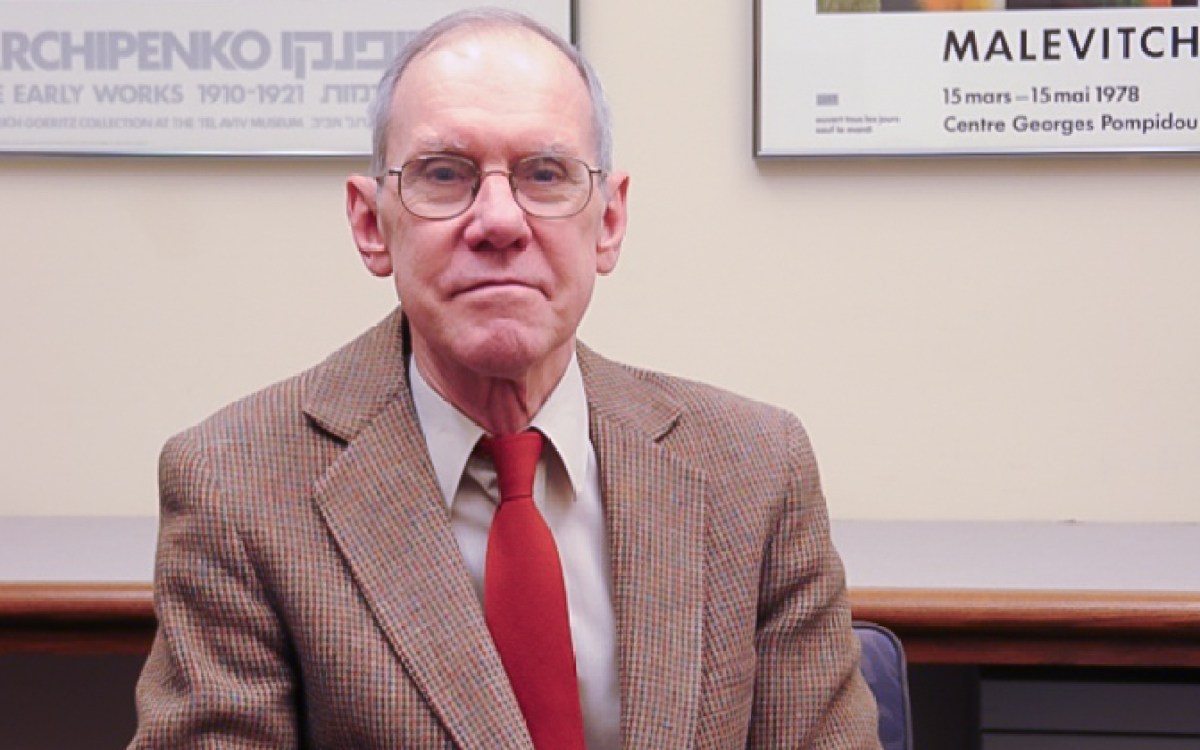
At a meeting of the Faculty of Arts and Sciences on Oct. 6, 2026, the following tribute to the life and service of the late John E. Malmstad was spread…
Harvard University Monday (Dec. 12) announced the creation of a University-wide program on Islamic studies, made possible by a $20 million gift from Prince Alwaleed Bin Talal Bin Abdulaziz Alsaud. The new program will build on Harvards strong commitment to the study of the religious traditions of the world. It will also augment Harvards existing strength by increasing the number of faculty focused on Islamic studies, providing additional support to graduate students, and making rare Islamic textual sources available in digital format.
With thousands of foreign scholars coming to Cambridge and Boston to study and to pursue careers in research or teaching, Harvard has long been a global university. Increasingly, in addition to being a global destination, Harvard has been extending itself to locations around the world, either in partnerships with governments and institutions or through physical sites.
Harvard College has created the Program for Research in Science and Engineering (PRISE) to establish a stimulating, collegial, and diverse residential community for Harvard undergraduates engaged in summer research in life science, physical science, applied science, mathematics, and engineering.
Robin Abrahams is living her dream. I always wanted to be an advice columnist, she said. As a young girl, I was always very attracted to the character of Lucy from Peanuts with her booth of psychiatric advice for five cents. I wasnt quite sure what psychiatric advice was, but I was quite sure I could dispense it.
Family Firm Institute honors HBS professor Renato Tagiuri, professor of social sciences in business administration emeritus at Harvard Business School (HBS), has received the Richard Beckhard Practice Award from the…
Rev. Griswold to preach at Memorial Church service The Most Rev. Frank T. Griswold III ’59 will preach at the Memorial Church on Sunday (Dec. 18) at the 11 a.m.…
The intimate confines of the fencing room in Harvards Malkin Athletic Center are perhaps better-suited for practice than competition, but on the evening of Dec. 7, it was bursting at the seams as a raucous and impassioned crowd of Crimson supporters watched the Harvard fencing teams continue their strong start with convincing victories over Brandeis.
Tay nabs rookie honors The Ivy League nominated Harvard basketball’s Emily Tay ’09 its Rookie of the Week for the period beginning Dec. 12. The freshman guard is Harvard’s top…
The Tennis Camps at Harvard (TCH), one of the areas most appealing summer activities for children and adults, will start its 16th season on June 12 at the Beren Tennis Center at Soldiers Field Athletic Complex.
David Westfall, who held the John L. Gray and Carl F. Schipper Jr. professorships at Harvard Law School (HLS), died Dec. 7 surrounded by his family. He was 78.
William R. Kenan Jr. Professor of English and American Literature and Language Marjorie Garber has won the 2005 Christian Gauss Award for Shakespeare After All (Pantheon Books, 2004). The $2,500 award is offered annually by the Phi Beta Kappa Society for books in the field of literary scholarship or criticism.
The music industry should embrace the passion of fans for their tunes and find ways to encourage consumer tools like online playlists rather than fighting such innovations as yet another form of file-sharing, a new report says.
Edward O. Wilson, Pellegrino University Professor Emeritus of biology at Harvard, is celebrated worldwide for his contributions to evolutionary biology, spurred by a lifelong passion for ants. He is also the distinguished recipient of two Pulitzer Prizes for nonfiction writing. But on Nov. 29, Wilson assumed the role of amateur historian to commemorate another famed scientist and writer. The Geological Lecture Hall was filled to capacity when Wilson delivered a lecture on Darwin in the Twenty-First Century. This lecture was hosted by the Harvard Museum of Natural History to celebrate the release of From So Simple a Beginning, a four-volume anthology of selected works by Charles Darwin published by WW Norton and edited by Wilson.
Monique Rinere, dean of Butler College at Princeton University, has been named associate dean of advising programs for Harvard College, effective Feb. 27. In this newly created position, the associate dean will coordinate, manage, and monitor the academic advising systems for all undergraduates.
The official portrait of beloved former Dean of Students Archie Epps III was unveiled recently in its permanent home in University Hall. The framed, oil-on-canvas portrait was painted by Stephen Coit 72. Valerie Epps, professor of law at Suffolk University, spoke at the unveiling of her late husbands picture. Archie Epps, who received a degree from Harvard Divinity School in 1961, became assistant dean of students at Harvard College in 1964. Six years later, he became the dean of students and remained in the position for more than 30 years. He retired in 2001.
Forty-three hundred members of the Harvard community signed the Campus Sustainability Pledge in a two-week campaign that ended on Nov. 23. In so doing, pledgers promised to support Harvards official Campus-wide Sustainability Principles and to implement those principles in their own lives by taking simple actions to conserve resources.
After a semester studying everything from the press in China to the culture wars in the United States, five research fellows from the Shorenstein Center on the Press, Politics and Public Policy shared their findings during a discussion Monday afternoon (Dec. 12) at the Kennedy School of Government.
A group of 25 Harvard students is reaching far beyond the boundaries of Harvards Cambridge campus – into developing nations to lend a hand to microfinance organizations seeking to help low-income residents pull themselves out of poverty.
Thick-skinned bottle gourds widely used as containers by prehistoric peoples were likely brought to the Americas some 10,000 years ago by individuals who arrived from Asia, according to a new genetic comparison of modern bottle gourds with gourds found at archaeological sites in the Western Hemisphere. The finding solves a longstanding archaeological enigma by explaining how a domesticated variant of a species native to Africa ended up millennia ago in places as far removed as modern-day Florida, Kentucky, Mexico, and Peru.
The Edmond J. Safra Foundation Center for Ethics recently announced that Harvard College students are eligible to apply for a Lester Kissel Grant in Practical Ethics to support research and writing that makes contributions to the understanding of practical ethics. A number of grants will be awarded on a competitive basis for projects to be conducted during the summer of 2006. The projects may involve research for senior theses, case studies for use in courses, essays or articles for publication, or similar scholarly endeavors that explore issues in practical ethics.
Harvard School of Dental Medicine (HSDM) researcher Martin Nweeia has just answered a marine science question that had eluded the scientific community for hundreds of years: why does the narwhal, or unicorn, whale have an 8-foot-long tooth emerging from its head, and what is its function? Nweeia, a clinical instructor in restorative dentistry and biomaterials sciences at HSDM, will be presenting his conclusions at the 16th Biennial Conference on the Biology of Marine Mammals in San Diego.
The 2005 Annual Report of the Corporation Committee on Shareholder Responsibility (CCSR), a subcommittee of the President and Fellows, is now available upon request from the Office for the Committees on Shareholder Responsibility. Please call (617) 495-0985 to request copies.
Math homework is not one of 10-year-old Aubrey Cappuccis favorite things, but at The East End House after-school program in her East Cambridge neighborhood, shes found a way to learn about math and love it – through games.
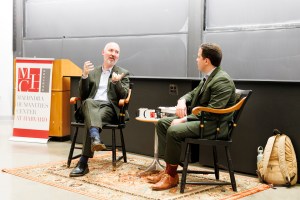
The day before she visited Harvard, Louise Arbour, the United Nations High Commissioner on Human Rights, was criticized by the U.S. Ambassador to the UN, John Bolton. Arbour had just issued a statement on terrorists and torturers, in which she said that the absolute ban on torture, a cornerstone of the international human rights edifice, is under attack. The principle once believed to be unassailable … is becoming a casualty of the so-called war on terror. To which Bolton responded that it was inappropriate and illegitimate for an international civil servant to second-guess the conduct that were engaged in in the war on terror. The next day, Dec. 8, Arbour visited the Kennedy School of Government (KSG) to have an informal, public conversation with Michael Ignatieff, Carr Professor of Human Rights Practice.
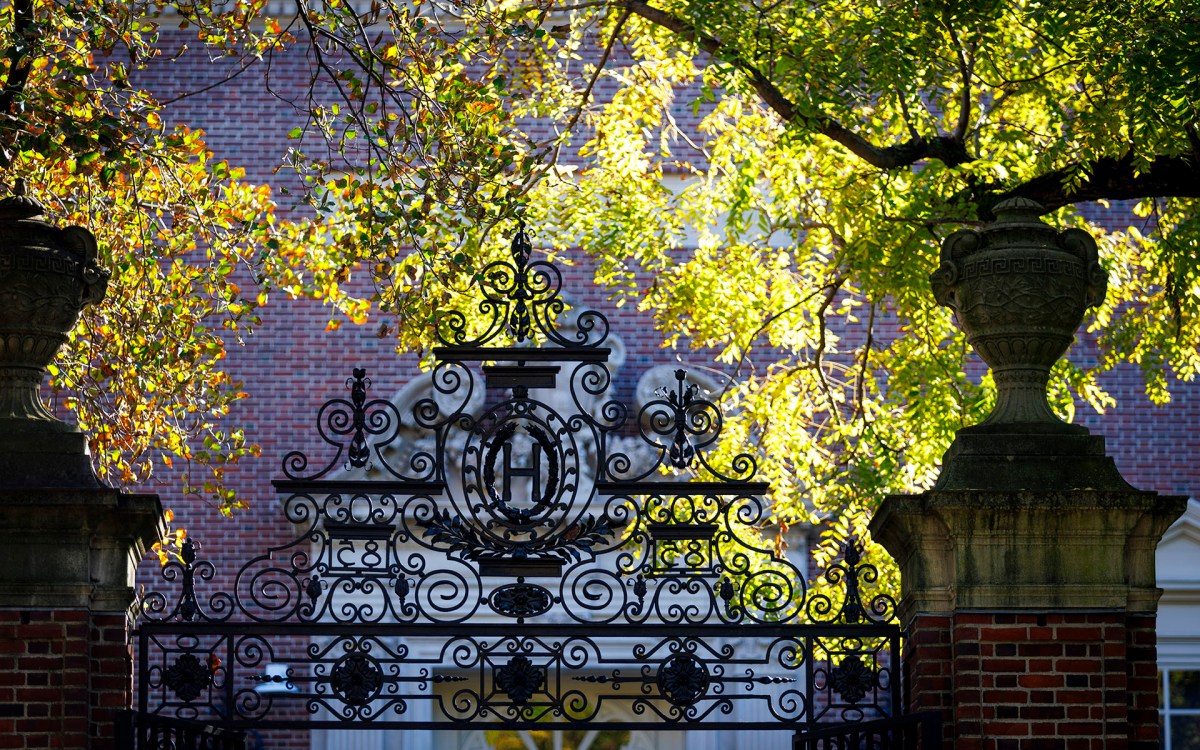
From the perspective of Harvards 369-year history, the gates in and around the campus are a relatively new phenomenon. For more than two-thirds of its existence, Harvard had nothing more to guard its perimeter than a low post-and-beam fence. When the Johnston Gate – the initial component of the present-day enclosure – went up in 1889, many decried its towering piers and elaborate ironwork as a pretentious imposition on the schools austere Puritan heritage. But as time went on and succeeding Harvard classes raised generous sums to extend the fence and punctuate it with stately apertures, the structure grew to be as familiar and beloved as any of the schools more venerable monuments.

 Featured series


 Gallery