Featured series


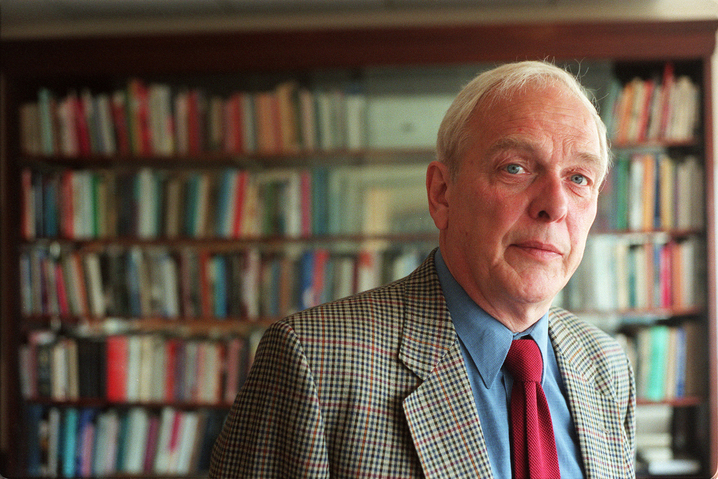
Aage Bøttger Sørensen
Kris Snibbe/Harvard University News Office
At a meeting of the Faculty of Arts and Sciences on Nov. 3, 2026, the following tribute to the life and service of the late Aage Bøttger Sørensen was spread upon the permanent records of the Faculty.
Born: May 13, 1941
Died: April 18, 2001
Our colleague Aage B. Sørensen died on April 18, 2001, in Boston, Massachusetts, one month before his 60th birthday. The passage of time has not diminished the sense of loss felt by those who knew him personally, nor has it lessened the impact of his scholarship on sociology. This belated and overdue memorial recognizes both Sørensen’s intellectual contributions and the lasting mark he left on the scholarly communities he helped to shape.
Born in May 1941 in Silkeborg, Denmark, Sørensen exhibited a distinctly Danish temperament throughout his life, combining intellectual austerity with a dry humor that often revealed deep sociological insight. After earning the University of Copenhagen’s first master’s degree in Sociology, he pursued doctoral studies in Social Relations at Johns Hopkins University under James S. Coleman’s guidance, receiving the Ph.D. in 1971. Sørensen then held a faculty appointment in the Department of Sociology at the University of Wisconsin–Madison from 1971 until 1984, when he moved to Harvard, teaching in the Faculty of Arts and Sciences for the balance of his career.
Sørensen’s research and writing were concentrated in sociology’s central field of inequality; he gave special attention to socioeconomic standing and education. Throughout his career, he was concerned with how inequalities were shaped by structural and organizational constraints on opportunity in tandem with individual efforts and resources. His early scholarship on labor markets, in dialogue with both the then-prevailing status attainment tradition in sociology and human capital theory in economics, formulated stylized mathematical models of attainment within fixed regimes of possible employment opportunities. In the years preceding his premature death, Sørensen brought a different perspective to bear on understanding structural constraint. He argued that the economic concept of rent — an asset that yields benefits unrelated to its possessor’s characteristics — generates intergroup conflicts and provides a basis for the formation and persistence of classes.
In his educational research, Sørensen applied a similar framework to understanding academic achievement. He conceived achievement as the result of the opportunities for learning presented by a school or classroom, together with individual resources that allow someone to take advantage of those opportunities. This theorizing led to new insights into school effects and the differential opportunities to learn provided by ability grouping.
Sørensen was among those scholars whose work forces a field to reexamine its assumptions. His writings about inequality, educational opportunity, and organizational structure reflected an insistence on conceptual clarity, theoretical rigor, and identifying the mechanisms linking social structure to individual action. In the tradition of Max Weber and of Sørensen’s mentor, James Coleman, Sørensen brought an uncompromising seriousness to questions about how societies create, distribute, and constrain opportunity. Empirically grounded, theoretically generative, and morally attuned to the consequences of institutional arrangements for individual lives, his work reminds us that inequality is never merely a distributional problem. Inequality is instead a structural and organizational phenomenon that shapes, and that is shaped by, our collective assumptions and aspirations.
Sørensen’s influence extended beyond the United States. He maintained active collaborations with research institutes in Norway, Sweden, and Germany and served on the board of the Danish National Science Foundation. These engagements made clear his belief that sociology advances through transnational dialogue and the comparative study of institutional variation.
Education as a social institution was central to Sørensen’s scholarship, and he understood it both analytically and ethically. His popular undergraduate course “Schooling and Society” underscored the role of educational systems in allocating opportunity and reproducing — or disrupting — inequality. The weekly “Ed Group” he convened for graduate students became a crucible for intellectual debate and a community whose influence extends into its members’ careers.
Sørensen’s record of service reflects his enduring commitment to building and sustaining strong academic institutions. After chairing the Madison department between 1979 and 1982, he became Chair of the Department of Sociology upon his arrival at Harvard, remaining until 1992. In this capacity, he led a renewal of the faculty and initiated thoroughgoing revisions of both the undergraduate and graduate curricula together with other undertakings, including heightened career support for untenured faculty. He later chaired the Subcommittee on the Degree of Doctor of Philosophy in Organizational Behavior, strengthening its intellectual foundations and disciplinary coherence.
But for many, Sørensen’s mentorship is his most enduring legacy. He advised an unusually large number of graduate students with a level of commitment that was at once demanding and deeply caring. He believed fervently that intellectual development requires honesty, discipline, and a willingness to confront one’s own limitations. Praise from him was rare and therefore meaningful when received. He never offered false encouragement; instead, he offered forthright, sometimes-intense critiques reflecting his unyielding belief that rigorous thinking was itself a moral practice and that his students were capable of meeting his demands. It was fitting that he received the Graduate School of Arts and Sciences Excellence in Mentoring Award in April 2001, just prior to his death. This recognition formalized what those who worked with him had long known: rather than simply training scholars, Sørensen cultivated independent thinkers who would carry his questions, exceptionally high standards, and intellectual integrity into their own work.
Following a devastating accident, Sørensen continued to display the determination that defined his intellectual approach during the final year of his life. Students and colleagues who visited him during his rehabilitation saw the same disciplined mind at work — probing, questioning, and engaging. His unwavering curiosity during this period is testimony to the depth of his commitment to ideas and the scholarly life. Today, Sørensen remains an unmistakable intellectual presence. His conceptualization of opportunity structures, his integration of sociological and economic frameworks, and his imprint on the work of generations of scholars continue to shape our field. Years after his passing, Sørensen’s influence still circulates through our institutions and informs our understanding of important problems that define sociology as a discipline.
Aage Sørensen was survived by his wife of 37 years, Annemette, who passed away in 2024; his son, Jesper; and three grandchildren.
Respectfully submitted,
Stanley Lieberson†
Orlando Patterson
Christopher Winship
Rakesh Khurana, Co-Chair
Peter V. Marsden, Co-Chair