
 Featured series


Tag: Geology
-
Campus & Community
John H. Shaw steps down
John H. Shaw, the Harry C. Dudley Professor of Structural and Economic Geology, steps down at the end of June, having served as chair of the Department of Earth and Planetary Sciences since 2006.

-
Science & Tech
Tracking rivers to read ancient glaciers
In a new study, Harvard researchers say they may be able to estimate how glaciers moved by examining how the weight of the ice sheet altered topography and led to changes in the course of rivers. The study is described in a paper published in Geology.

-
Campus & Community
William Cromie, Gazette science writer, dies at 84
William J. Cromie, a longtime Harvard Gazette science writer who retired in 2007 after 18 years of writing about the latest scientific findings out of Harvard laboratories and field research, has died at his home in Somerville, Mass., at age 84.

-
Health
Rock sleuths
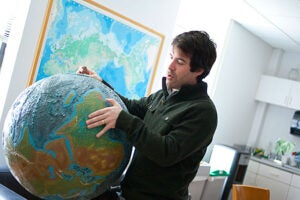
In one of the largest studies of its kind, Harvard researchers have found that carbon records from the mid-Neoproterozoic era can be “read” as a faithful snapshot of the surface carbon cycle between 717 million and 635 million years ago, a finding that directly challenges a decades-long belief of most scientists.
-
Science & Tech
Magnetism on the moon
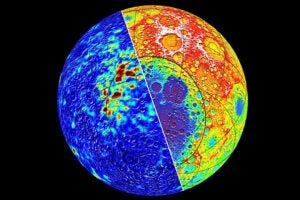
A team of researchers from Harvard, MIT, and the Institut de Physique du Globe de Paris have proposed a surprisingly simple explanation for magnetic anomalies that have baffled scientists since the mid-1960s, suggesting they are remnants of a massive asteroid. As described in a paper published in Science, the researchers believe an asteroid slammed into…
-
Science & Tech
With the Earth as teacher
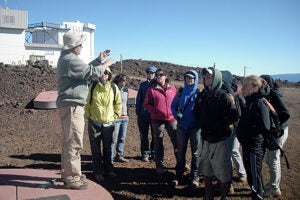
Students in Earth and Planetary Sciences kicked off their academic year early, spending a late-August week in paradise, observing Hawaii’s volcanoes, green and black sand beaches, and overarching geologic splendor.
-
Arts & Culture
Boulders that bowl over
A new exhibit at Gund Hall shows how rocks are used to shape landscape design and to create art.

-
Science & Tech
Scientists find signs of ‘snowball Earth’
Geologists have found evidence that sea ice extended to the equator 716.5 million years ago, bringing new precision to a “snowball Earth” event long suspected of occurring around that time.
-
Science & Tech
Geology is destiny
As a teenager in Toronto in the 1950s, Paul Hoffman would spend hours in the Royal Ontario Museum studying its collection of rocks and minerals. He became a passionate collector, trading rocks with friends and exploring abandoned mines in search of crystals.
-
Science & Tech
Sulfur dioxide may have helped maintain a warm early Mars
Sulfur dioxide (SO2) may have played a key role in the climate and geochemistry of early Mars, geoscientists at Harvard University and the Massachusetts Institute of Technology (MIT) suggest in…
-
Campus & Community
Finding a fossilized needle in an Arctic haystack
The first season searching Arctic Canada for a fossil that would illuminate how our ancestors first crawled onto land proved Harvard Professor Farish Jenkins’ explorer’s maxim: Never go any place…
-
Campus & Community
Missing link crawls out of muck
Paleontologists have discovered fossils of a species that provides the missing evolutionary link between fish and the first animals that walked out of water onto land about 375 million years…
-
Campus & Community
Winds and waves sculpted a ‘snowball Earth’
It’s a world hard to imagine. Some 650 million years ago, Earth’s land and oceans were almost completely covered by ice and snow. The planet’s population – primitive plants and…
-
Science & Tech
Australian shale tells tale of layered seas
Harvard researchers have found important clues about the Earth’s environment 1.5 billion years ago. Their results present quite a different picture from present times, in which oceans have oxygen-rich waters…
-
Science & Tech
New earthquake mapping system could save lives
“The earthquake-hazard maps currently in use are based on the premise that the closer a building is to a large fault, the better designed it should be,” says Harvard earthquake…
-
Science & Tech
El Nino found to be 124,000 years old
Records preserved in corals from Indonesia reveal that El Niño was causing severe weather even before the last ice age began, when the climate apparently was like it was for…