Featured series


Work & Economy
Why AI hasn’t triggered mass layoffs — yet
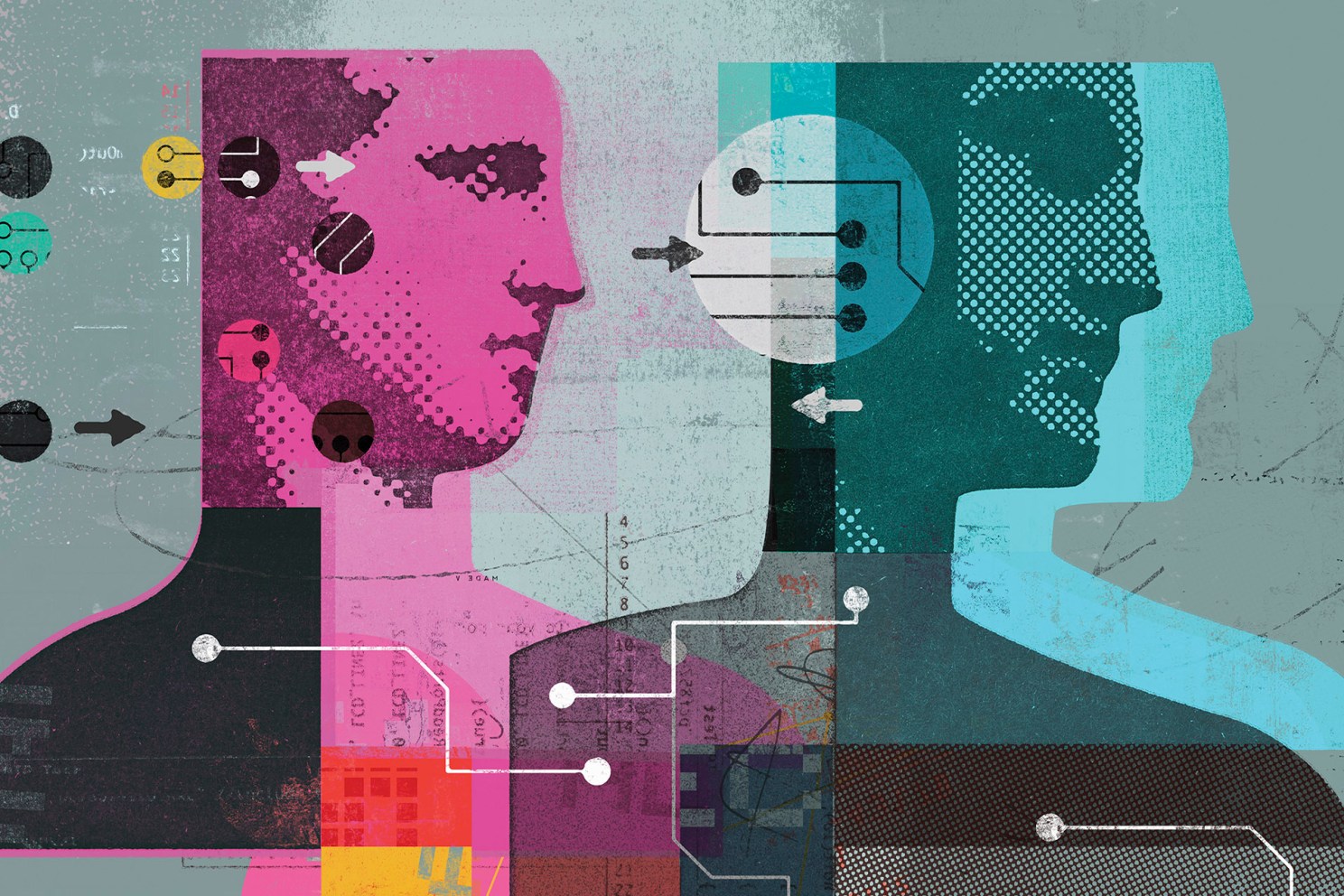
Illustration by Stuart Kinlough/Ikon Images
Artificial intelligence can do some jobs already, but experts say CEOs have good reasons to keep humans on the payroll
If you’re looking for omens of an AI jobs apocalypse, you can certainly find them. News outlets report more layoffs attributed to AI this year than last. Anthropic CEO Dario Amodei famously said in 2025 that AI could wipe out half of entry-level white-collar jobs within five years. Entry-level job postings have fallen by up to 73 percent in four years, by some counts.
Other data points are more reassuring. Largely buoyed by growth in the healthcare industry, the unemployment rate is hovering around 4.1 percent. For every article announcing AI-related layoffs, another one dismisses it as “AI-washing.” And management consulting firm Accenture says 52 percent of top executives expect AI to increase entry-level hiring, not decrease it.
So how to square the dire forecasts with a job market that still looks mostly normal?
Doug Elmendorf, a Harvard Kennedy School economist and former director of the Congressional Budget Office, says the answer may take patience.
“What we’ve seen so far in the labor market from artificial intelligence has very little predictive power for what we’re going to see in the labor market because of AI in five years, or 10 years, or 15 years,” said Elmendorf, the Lucius N. Littauer Professor of Public Policy and a Harvard University Distinguished Service Professor at HKS.
Along with Karen Dynan, also of the Kennedy School, and Louise Sheiner of the Brookings Institution, this spring Elmendorf wrote a National Bureau of Economic Research working paper that examines four possible scenarios for AI’s impact on the economy. The scenarios range from a moderate boost to GDP with little reduction in the number of workers to much faster GDP growth with persistently high unemployment.
The co-authors cautiously declined to speculate on the relative likelihood of their scenarios. But in an interview, Elmendorf tended toward measured worry about job loss.
“I think it’s very likely that there will be significant job losses from artificial intelligence in the coming couple of decades, but that most — not all, but most — of those people will be able to find new work,” he said.
As a comparison, the co-authors point to the China shock in the early 2000s, when a surge of cheap Chinese exports devastated manufacturing communities across the American Midwest and South. They cite other researchers who estimate that the disruption cost about 1.5 to 2 million total jobs between 2000 and 2007. The authors’ scenario for AI has much larger effects, with 3 million people, or roughly 2 percent of the labor force, out of work at any given time — therefore many millions over the next few decades.
“What we’ve seen so far in the labor market from artificial intelligence has very little predictive power for what we’re going to see in the labor market because of AI in five years, or 10 years, or 15 years.”
Doug Elmendorf
According to Joseph Fuller, MBA Class of 1960 Professor of Management Practice at Harvard Business School, much of what’s standing in the way of that large-scale disruption is companies’ clumsy implementation.
In collaboration with industry partner Accenture Research, Fuller developed an AI model that analyzed work tasks for all job categories. They found that as of today, 41 percent of all work tasks can be automated or augmented by AI. But firms aren’t rushing to automate.
Only about one-third of firms’ AI experiments are successful, he said, possibly due to faulty data inputs or employees who don’t know what they’re working with.
“Companies are not training people formally, so employees are basically using it like glorified Google, and they’re not getting much productivity out of it,” said Fuller. “Maybe the boss says, ‘Well, this isn’t as good as I was hoping, I guess we shouldn’t worry too much about this.’”
That’s temporary, Fuller warned. He expects adoption to rise as cheaper, more specialized AI agents arrive.
Eventually, all that stands in the way of AI layoffs may be the C-suite resisting the temptation of the “shiny new object,” according to Raffaella Sadun, Charles E. Wilson Professor of Business Administration at HBS and a principal investigator at the HBS Digital Reskilling Lab.
“For the first time we have a technology that learns, sometimes autonomously, that allows us to have access to expertise that has previously been dispersed,” said Sadun. Executives wonder whether AI can automate away the need to invest in human capital, she added. “I think that’s a tremendous trap, a terrible trap.”
Automating people out of their jobs, Sadun said, trades short-term savings for long-term problems. Human employees’ tacit knowledge — firm-specific context about their market, their role, and their resources — makes them far more valuable than their job descriptions suggest.
At the Digital Reskilling Lab, Sadun and Jorge Tamayo, her co-principal investigator and assistant professor of business administration, work with firms to retrain workers for AI-augmented roles, then test whether the training works.
“At the lab, we see investments in human capital and training as strategic investments, meaning these are things you should do not because you want to be nice or corporate-social-responsibility-compliant, but because knowledge plays an important role in your company, and investment in human capital is part of how you create knowledge,” Sadun said.
Similarly, Fuller works with executives who say a 22-year-old with a freshly minted computer science degree might not offer the same value anymore — but the execs understand they can’t have a senior software engineer without first having a junior one. Fuller helps them reimagine their entry-level job descriptions.
At one large tech company, which he declined to name, Fuller helped executives study senior engineers’ performance reviews to see what was holding them back. Many lacked sales and product management experience.
“So rather than stopping hiring junior software engineers, we changed the job description so those hires are still doing some software engineering, but they’re also getting regular structured introductions to sales and product management,” he said. “We can pre-position what we want 10 years from now by getting them the experience their current bosses didn’t get.”
The entry-level job, Fuller said, may now look like a second or third job would have looked five years ago.
But Elmendorf of HKS doubts that entreaties to protect workers that are not backed by such evidence can beat the profit motive.
“Individual companies are going to be focused on what’s good for their company, and yelling at them to do something different can matter a little bit but it won’t fundamentally change their desire to produce goods and services at the lowest possible cost,” he said. “And for a number of companies, that will mean the use of AI instead of workers for some things.”
That is what the government is for, he said: solving collective-action problems that the market isn’t set up to handle.
In his NBER paper with Dynan and Sheiner, Elmendorf described possible solutions including sprawling changes to the nation’s tax scheme, safety-net programs, and unemployment-insurance system. The authors suggest subsidizing private employment, encouraging shorter work weeks, and expanding worker retraining programs. They also consider the value of a wage insurance program that pays laid-off workers part of the difference between what they made at their previous jobs and their new wages.
“Policymakers should be prepared for much bigger economic changes than we’ve seen so far from AI,” Elmendorf said. “Not because we’re sure those changes will happen, but for the same reason you buy insurance against possible problems in your personal life: It might happen, and you’d rather not be surprised when it does.”