Featured series


Nation & World
Why we need to break the grip of ‘oldigarchy’

Legal historian’s new book argues older Americans control power, wealth — and lack sense of urgency to fix nation’s most pressing problems
Part of the Excerpts series
Works by Harvard-affiliated authors
Excerpted from “Gerontocracy in America: How the Old Are Hoarding Power and Wealth ― and What to Do About It” by Samuel Moyn, J.D. ’01, and published by Farrar, Straus and Giroux
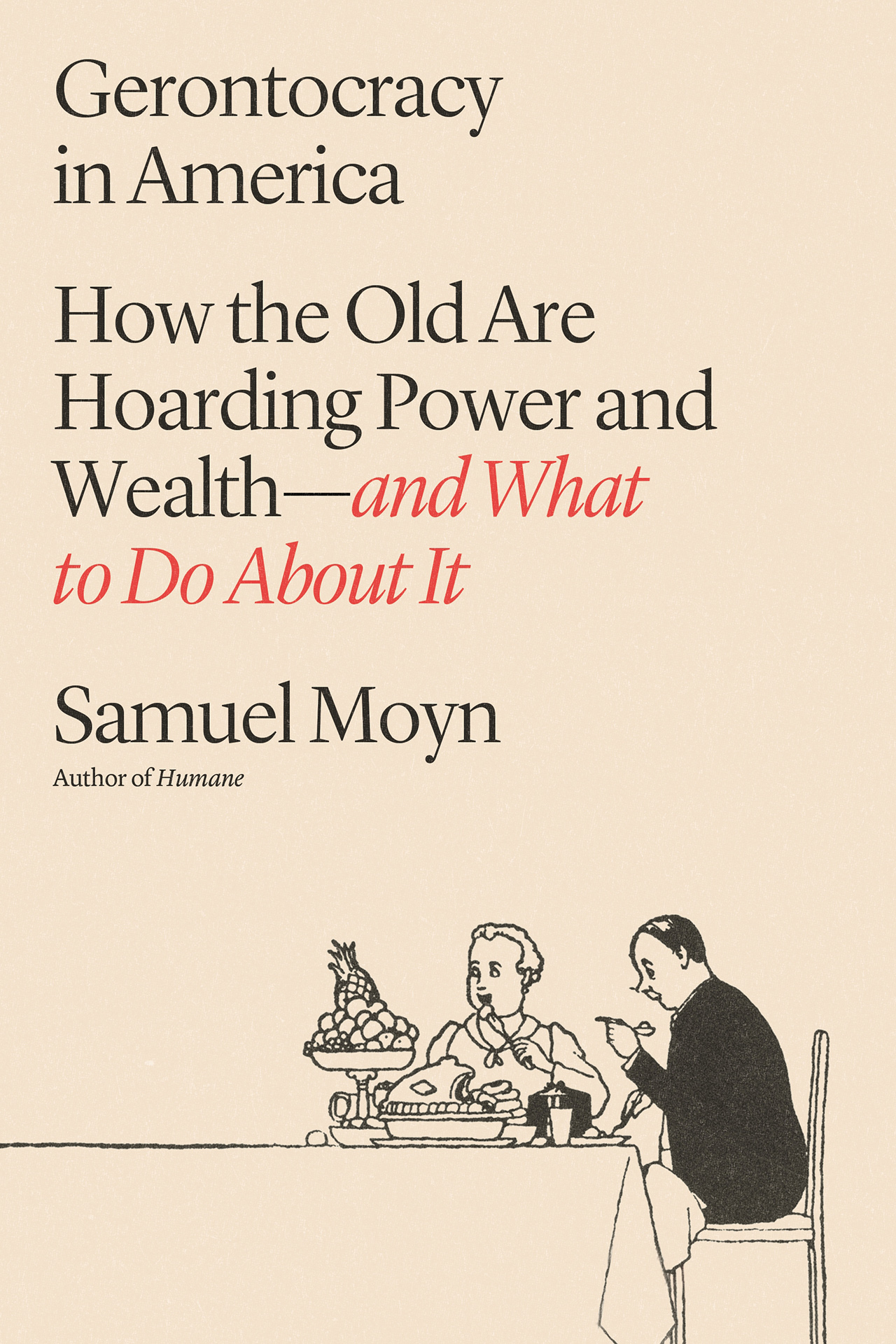
For two centuries, “Democracy in America,” published by the Frenchman Alexis de Tocqueville starting in 1835, has been the most famous book about the United States. It deserves to stay that way. But it might need an update.
There have always been older people. A psalm of the Bible says that, unless they die early for some reason, human beings get 70 years — 80 if they’re lucky. Genesis mentions generations of superagers at the start of humanity — like Adam, Noah, and Methuselah, the latter of whom celebrated his 969th birthday. And elders have long been accorded preferences and priorities. Whenever seniority is used to allocate positions or resources, an impulse toward gerontocracy — the empowerment of the old — is at work. Another biblical passage, this one from Proverbs, holds that “gray hair is a crown of glory.” The “preference for age and seniority,” one historian has remarked, has been “shared by all those corporate institutions which set a value on hierarchy, stability, and continuity.”
But there is something new that has supercharged elder power. Starting in Tocqueville’s 19th century, a “great aging” took place as average life expectancies increased, thanks to the reduction of childhood mortality and eventually adult disease. Today, a new crop of Methuselahs is living beyond 110 or even 120, in the case of Frenchwoman Jeanne Calment, who died in 1997 at 122, the oldest age on record. But the real change is not that more people live to 100 but that so many reach 80 or 90, even as fewer are born. The political effects of a citizenry with a higher median age have been mounting.
At the dawn of modernity, Tocqueville commented that a new political science was needed for a new age; in the 21st century, an even newer political science is needed for the new aging.
The virtue of life extension, obviously, is that life is generally preferable to death — especially if the debilitating effects of age are also driven into the future. I remember my father, as he progressed toward the unavoidable, often counseling me never to get old; one of my mother’s nuggets of wisdom, as she has lived past 80, is that the alternative to aging is even worse. “Death, no matter how inevitable, is an abrupt cancellation of indefinitely extensive possible goods,” the philosopher Thomas Nagel writes, adding that death is no less tragic for those lucky enough to live long rather than short lives.
But there are vices to a culture of extended life — and one of the biggest is political, in the broadest sense. An aging society is more set on preservation than on renovation. And then there’s the unfairness involved in blocking the young and hoarding their inheritance while mandating them to care for the old and requiring them to serve a government helmed by their elders.
Americans definitely worry today that our democracy is at risk — that new forms of oligarchy are a frightening possibility. But what if we have long been drifting into an unsuspected form of rule, one less apparent because it is only sometimes visible in government: a new kind of society that privileges many older Americans — to the detriment of all, including many senior citizens themselves?
Welcome to gerontocracy in America.
←→
President Donald Trump is old. His predecessor, Joe Biden, is old, too — and was even older-seeming when it counted. The evidence of Biden’s decline during the 2024 election campaign altered the course of American history, leaving a storied republic on the brink.
For years, loud voices had cautioned against even broaching the topic of Biden’s debilitation. One observer went so far as to boast that gerontocracy serves America well. Even he flip-flopped in the face of Biden’s undeniable limits. The experience of 2024 brought the political consequences of aging leadership home to millions of American citizens. Of course, Democrats continued to show a default respect for the aged — except for when they were combating Trump by highlighting his own age-related dysfunction.
Of course, not all aging politicians are decrepit. Nor is the cognitive and physical decline of politicians — a genuine problem beyond the presidency, with the median age of congresspeople spiking to over 60 and of federal judges to 68 — the main effect of aging on politics.
An aging society is more set on preservation than on renovation.
Our political system is democratic, meaning that the authorities — no matter their age — depend on electoral and other popular support to rule. And our society is capitalist, so most actual power is exercised by people outside government, especially the wealthy. To inveigh merely about the age of politicians is, in many ways, to miss the point of how power works today. If the voters and the wealthy are old, it may not even matter whether the politicians are young.
To a gobsmacking extent, seniors, with their high rates of participation, dominate elections, especially the apparently boring local and off-cycle ones. The median age of actual voters these days — meaning that equal numbers of voters are older and younger — is about 52, and on the way up. Outside presidential contests, it is 55 or 56; in primaries, it is 65. Even older funders disproportionately finance the races. The most common age of donors in recent elections can run as high as 70. Finally, older Americans are backed by the best-funded advocacy group in world history — the AARP — and enjoy the most governmental benefits by a vast degree. The government is bought and paid for by those who are up in years and is organized for their sake. Trump’s “big beautiful bill” is only the most recent exacerbation, cutting down the welfare state — except elder entitlements — to make up for lost taxes.
It doesn’t stop there. Aging Americans control the biggest bank accounts and stock portfolios, partly as a function of living long enough to accumulate more and more wealth without giving much away. In our time, the old rich have pulled away from everyone else. In the two decades or so straddling 2000, households headed by adults older than 65 improved their median net worth by 42 percent, while the wealth of families of adults 18 to 34 fell by 68 percent. American oligarchy is, by and large, an “oldigarchy.”
Older people are also hoarding jobs. Following the abolition of mandatory retirement in most professions, older people are choosing to stay in some of the best positions, accumulating more money and blocking pipelines. The average age of CEOs and professors alike has gone through the roof. The United States, which has the highest wage inequality by age in the world, has seen the numbers gallop: Between 1979 and 2018, the pay gap between those over 55 and under 35 has increased by 61 percent. In those same years, the proportion of older people in the workforce has also exploded: The share of workers over 55 rose a shocking 88 percent.
The elderly possess the choicest real estate in great cities. The housing crisis, now well-known, is partly a story of old people refusing to downsize as they age. The age group most likely to own a home in America, at a rate of over 80 percent, is 70 to 74, with those 75 and older second highest. Shockingly, the age of the median homebuyer leaped from barely 30 in 1981 to 53 in 2022. The failure of abundant supply is also partly the fault of the elderly, since their political mobilization arrests development and blocks new builds. In defense of their incomes, wealth, homes, or land, they have driven tax revolts so that they don’t have to contribute to the common good.
In short, it’s not just that presidents and other politicians are old. It’s not just the cognitive or bodily decline they suffer. Rather, what’s most important is that such leaders represent an aging constituency that controls the political system. They are also the visible face of the elder domination of private forms of power, especially wealth. What’s more, with millions privileged by gerontocracy, there is no way to separate the age of our elites from their ascendancy. In America today, age is the modality in which class is lived (with apologies to the great, late cultural theorist Stuart Hall, who said the same thing about race).
Today’s gerontocracy is not anybody’s malevolent plan, exactly. It is more an accidental by-product of a legitimate and understandable desire to survive, with political effects that nobody has reckoned with. Another day, month, or year among loved ones — what downside could that have? Such a question would have been rhetorical until recently, but it has now snuck up on unsuspecting societies. Boomers aren’t distinctively evil (well, some are). Rather, the fact that they are so numerous, and the fact that they are aging in an era when the extension of life is normalized, makes an endemic syndrome more obvious.
That syndrome is a gerontocratic crisis of succession on the scale of American society itself. It often involves a deathwatch for old people. The melodrama of succession — waiting for the old to make way for the new and give up effective power — is a feature not only of our politics but also of our economy and of our culture writ large.
Should Trump fail, for whatever reason, to survive beyond the midpoint of his second term, J.D. Vance would succeed him as the youngest president in all American history, beating Theodore Roosevelt, who occupied the office just shy of his 43rd birthday. Even then, American gerontocracy would remain. It would retain its grip on the rest of government, and on our society as a whole.
←→
If Americans deserve a society that is oriented to innovation and problem-solving and equips and launches the young into the prime of life, the country is heading in the wrong direction. “They live in memory rather than hope,” the Greek philosopher Aristotle observed in his ancient diatribe against the aging and in defense of people in their prime.
The presumption that people grow more conservative as they age is one of the hoariest political clichés — but it is nonetheless true. Of course, these days the far right often draws from the very young. Even so, it’s abundantly clear that age and outlook tend to correlate. Who believes the children are our future? Not American seniors. The politics of educational funding for public primary and secondary schools shows a definite connection between aging and stinginess — with voters beyond their child-raising years preferring lower taxes to decent schools. Far beyond education, elder priorities, according to experts, have come “at the expense of investments” that “promote long-term growth” such as housing and infrastructure. Enterprise in the broadest sense is not a priority of gerontocratic societies. And it has been demonstrated that older voters register more sensitivity to inflationary pressure on the continuity of their way of life than to low growth, which they do not feel affects them.
Shockingly, the age of the median homebuyer leaped from barely 30 in 1981 to 53 in 2022.
The oldest are also the most implacable opponents of immigration — even though newcomers are the likeliest to provide the care an aging American population needs. One reason for the disconnect is that older Americans incarnate the demography of the past. Ethnic and racial diversity in the United States is at its maximum in current infants and lowers all the way up the age continuum to the 85 to 99 set. The most common age for whites is 58 — more than double the most frequent age for minorities. This wide disparity, partly due to existing immigration, sets up a choice between preserving older people’s conception of the America they knew and allowing immigrants to fulfill the basic needs of older people themselves.
Most important, gerontocracies are prone to let long-term problems fester and worsen. As the individual life dwindles, playing for time in the face of impending catastrophe is a psychologically appealing stratagem of avoidance and denial. The aged preference for addressing the short term leads to the imposition of heavier and heavier consequences for the future — as those understandably concerned about an indebted nation or a warming planet stress.
A fundamental imperative is therefore at stake. Americans must transcend gerontocracy if we are to realize our collective aspiration to innovation, as well as achieve other important goals such as intergenerational equity, fair political representation, and even an existential acceptance of limits as we age. Everyone likes to think of themselves as ageless, but we are finite, with just one passing life to live. Ultimately, gerontocracy is built on a denial of this transience. The aging often respond to mortality by holding on to power as long as they can — but if life is inevitably lived in stages, then succession doesn’t need to be as melodramatic or unfair as it is now.
←→
If modern gerontocracy functions through a new political environment, it follows that a new range of solutions is required. Age limits for political office are a must. Other fixes range from amplifying the political voice of younger voters and disrupting the stranglehold of the old people’s lobby on our politics to policies that facilitate intergenerational wealth transfer. The schemes I offer seek to advance “intergenerational equity.” But unlike the most vocal partisans of the cause, I don’t oppose the American entitlement state for seniors. Such voices insist that an end or reduction of perquisites like Social Security must occur in the name of fairness. The truth is the opposite: only an expansion of our generosity, including the promise of long-term care, can overcome the iron grip of old people on power.
While gerontocracy is hardly the only source of our difficulties, no one interested in how injustice and social strains are shaped and reproduced in America today should ignore how deep it goes. Gerontocracy has to be assessed properly, for the sake of a new intergenerational political compact. In the end, taking it seriously is essential for treating everyone appropriately and fairly.
There is still a chance for a reset. The extension of the lifespan has had political consequences, many for the worse. It has already brought an ancient phenomenon — the authority of elders over everyone else — back in a dangerous new guise. Biden and Trump have exposed one part of our gerontocracy. Ripping away the curtain that hides the rest can prepare us to dismantle the system and create something new.
Copyright © 2026 by Samuel Moyn. All rights reserved.